[미국] 퍼시픽 연구소, 기후재난이 미국 수도요금 상승에 미치는 영향 분석
재난 피해, 요금 인상으로 이어지며 '악순환' 고리 형성
잭슨·LA 카운티 등 미국 각지서 재난 비용 이미 가계로 전가
기후재난 대응, 수도요금 설계 단계부터 ‘부담 능력’ 고려해야
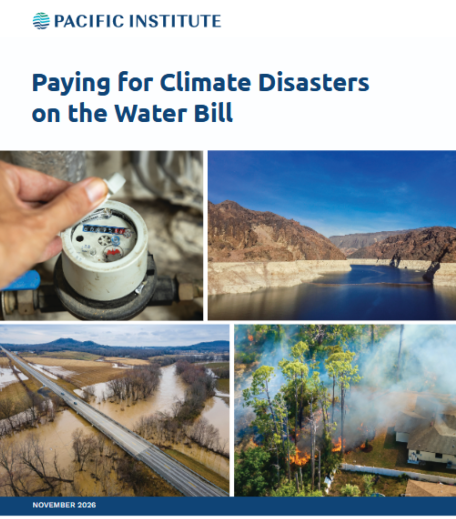
퍼시픽 연구소(Pacific Institute)는 최근 ‘수도요금으로 기후재난 비용 부담(Paying for Climate Disasters on the Water Bill)’ 보고서를 발표했다. 사진은 보고서 표지. [사진제공(Photo Source) = 퍼시픽 연구소(Pacific Institute)]
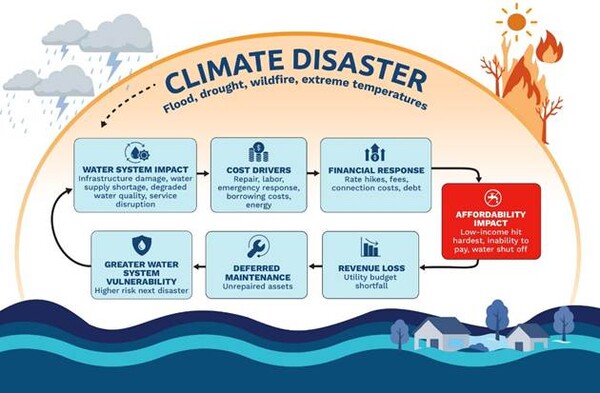
퍼시픽 연구소(Pacific Institute)는 최근 ‘수도요금으로 기후재난 비용 부담(Paying for Climate Disasters on the Water Bill)’ 보고서를 발표했다. 보고서는 기후재난이 수도 서비스 비용 부담을 확대하는 과정을 설명하기 위해 ‘수도요금 부담-기후재난 피드백 루프(Water Affordability-Climate Disaster Feedback Loop)’라는 새로운 개념을 제시했다.
이 프레임워크에 따르면, 기후재난으로 수도 시스템이 손상되면 수도사업자는 복구 비용을 충당하기 위해 요금을 인상하게 된다. 그러나 요금 부담이 커진 가정은 납부를 연체하거나 수도 서비스를 이용하기 어려워지고, 이에 따라 수도사업자의 수익이 감소한다. 결국 시설 유지보수와 인력 확보가 어려워지면서 수도 시스템은 다음 재난에 더욱 취약해지는 악순환에 빠지게 된다.
미국에서는 이미 약 1천200만~1천900만 가구가 상하수도 요금을 감당하기 어려운 상황에 놓여 있다. 수도요금 납부에 어려움을 겪는 가정은 물과 식료품, 주거비, 의료비 등 필수 지출 항목 사이에서 선택을 강요받는다. 여기에 홍수, 가뭄, 산불, 극 기온과 같은 기후재난이 수도 시스템의 재정 부담을 가중시키면서 물과 위생 서비스 비용은 더욱 상승하고 있다.
모건 시마부쿠(Morgan Shimabuku) 퍼시픽 연구소 프로그램 매니저는 "기후재난으로 수도 시스템이 손상되더도 복구 비용이 사라지는 것은 아니다"며 "이 비용은 가정의 수도요금 고지서에 반영되고, 이미 생활비 상승으로 어려움을 겪는 지역사회가 가장 큰 부담을 떠안게 된다”고 말했다.
실제로 재난 비용은 이미 가계에 전가되고 있다. 미시시피주 잭슨에서는 수십 년간 미뤄진 시설 유지보수 문제에 홍수 피해까지 겹치면서 수도 요금이 약 12% 인상됐다. 또한 로스앤젤레스 카운티에서는 이튼(Eaton) 산불로 저수지가 파괴된 한 수도회사가 가구당 3천 달러(약 401만 원)의 추가 부담금을 부과했다.
보고서는 이 밖에도 텍사스주 코퍼스크리스티의 가뭄, 뉴멕시코주 라스베이거스의 산불 및 홍수, 샌안토니오의 겨울 폭풍 유리(Winter Storm Uri), 뉴올리언스의 허리케인 카트리나 등 미국 각지의 사례를 분석했다.
그림 1. 수도요금 부담-기후재난 피드백 루프(Water Affordability-Climate Disaster Feedback Loop)
[그림제공(Picture Source) = 퍼시픽 연구소(Pacific Institute)]
보고서는 이러한 악순환의 영향이 특히 이미 여러 부담을 안고 있으면서도 자원이 부족한 최전선 지역사회(frontline communities)와 요금 인상에 대응해 물사용량을 줄일 여력이 없는 저소득 가구에 집중된다고 지적했다.
다만 이러한 피드백 루프가 불가피한 것은 아니다. 보고서는 재난 대비 투자, 형평성을 고려한 요금 체계 설계, 단수 유예 조치 등을 통해 악순환을 끊을 수 있다고 강조했다. 특히 기후변화 적응 정책을 수립하는 초기 단계부터 요금 부담 능력을 반영하는 것이 중요하다고 제안했다.
보고서에 따르면 기존 고객 지원 프로그램은 평균적으로 수도요금을 약 40% 낮추는 효과를 보이는 경우가 많다. 그러나 실제 참여율은 매우 낮아 자격 요건을 충족하는 가구 가운데 통상 10~25%만 혜택을 받고 있는 것으로 나타났다.
보고서가 소개한 대표 사례 중 하나는 필라델피아의 단계별 지원 프로그램(Tiered Assistance Program)이다. 이 프로그램은 자격 요건을 충족한 가구를 자동 등록하고, 수도요금을 가구 소득의 일정 비율에 따라 책정한다. 또한 2023년 제정된 워싱턴주 법률은 폭염 시 수도 및 에너지 공급을 중단하지 못하도록 규정하고 있다.
이번 보고서의 공동 저자인 섀넌 맥닐리(Shannon McNeeley) 퍼시픽 연구소 부소장이자 물·기후 형평성 프로그램 책임자는 “비용 부담 능력은 기후변화 적응 정책에서 사후적으로 고려할 문제가 아니다"며 "재난이 발생하기 전, 그리고 요금이 책정되기 전에 반영돼야 하며, 가계가 이미 요금을 체납한 이후에 고려해서는 안 된다"고 강조했다.
한편 현재 재난 비용이 가정의 수도요금에 어떤 방식으로 반영되는지를 추적한 연구는 대부분 가뭄에 초점을 맞추고 있다. 이 때문에 홍수, 산불, 극한 기온이 수도요금에 미치는 영향은 상대적으로 충분히 파악되지 않은 상황이다.
보고서는 이러한 근거가 축적되기 전까지 지역사회가 점차 심화되는 비용 부담 문제에 제한된 수단으로 대응할 수밖에 없다고 지적했다. 또한 이번에 제시한 프레임워크가 연구자와 수도사업자, 정책 입안자, 시민사회단체가 소득이나 거주 지역에 관계없이 모든 사람이 안전하고 신뢰할 수 있으며 부담 가능한 물과 위생 서비스를 이용할 수 있도록 정책을 설계하는 데 출발점이 될 수 있다고 평가했다.
[원문보기]
New Pacific Institute Report Shows How Climate Disasters Can Drive Up Water Bills in the US
The report explains how climate disasters can trigger a harmful water affordability feedback loop between utilities and the households they serve, and outlines strategies for water systems, government agencies, technical assistance providers, and communities to break the cycle.
The Pacific Institute today releases Paying for Climate Disasters on the Water Bill, a report that introduces a new framework, the Water Affordability-Climate Disaster Feedback Loop, to explain how climate disasters can trigger a self-reinforcing cycle. Disasters can damage water systems, utilities raise rates to cover repairs, households fall behind or lose service, and the lost revenue leaves utilities less able to maintain and staff their systems, making them more vulnerable to the next disaster.
Water and wastewater services are already unaffordable for an estimated 12 to 19 million US households. For families struggling to pay their water bills, that can mean difficult choices between water and other necessities like food, housing, and healthcare. Climate disasters such as floods, droughts, wildfires, and extreme temperatures place added financial pressure on water systems, driving the cost of these fundamental services even higher.
“When climate disasters damage water systems, the costs of recovery do not disappear. They show up on household water bills, and the communities already burdened by the rising costs of living feel them most,” said Morgan Shimabuku, Program Manager at the Pacific Institute and lead author of the report.
Disaster costs are already reaching households, from a roughly 12% rate increase in Jackson, Mississippi, where flooding compounded decades of deferred maintenance, to a $3,000 per-household charge from a water company whose reservoirs were destroyed in the Eaton Fire in Los Angeles County. The report draws on examples from across the country, including drought in Corpus Christi, Texas; wildfire and flooding in Las Vegas, New Mexico; Winter Storm Uri in San Antonio; and Hurricane Katrina in New Orleans.
The most severe impacts fall on frontline communities that are already overburdened and underresourced, and on low-income households that have less ability to reduce their water use when rates rise.
The feedback loop is not inevitable, and strategies from disaster preparedness to equitable rate design and shutoff protections can disrupt it, especially when affordability is built into climate adaptation from the start. The report notes that while existing customer assistance programs often offer substantial median bill reductions of around 40%, they remain severely undersubscribed, with typical participation rates of only 10% to 25% of eligible households.
Among the approaches the report highlights are Philadelphia’s Tiered Assistance Program, which enrolls prequalified households automatically and structures utility bills as a percentage of household income, and a 2023 Washington State law that requires water and energy utilities to delay shutoffs during extreme heat events.
“Affordability can’t be an afterthought in climate adaptation. It needs to be considered before disaster strikes and before rates are set, not after households have already fallen behind on their bills,” said co-author Shannon McNeeley, Pacific Institute Associate Director and Water and Climate Equity Program lead.
Currently, research tracing disaster costs to household water bills has largely focused on drought, leaving the effects of floods, wildfires, and extreme temperatures less understood. Until that evidence base is built, communities will be left to navigate a growing affordability challenge with inadequate tools. The report’s framework offers a starting point for researchers, utilities, policymakers, and advocates working to ensure that everyone, regardless of income or zip code, has access to safe, reliable, and affordable water and sanitation.
[출처 = 퍼시픽 연구소(Pacific Institute)(https://pacinst.org/announcement/new-pacific-institute-report-shows-how-climate-disasters-can-drive-up-water-bills-in-the-us/) / 2026년 11월 12일]
|  즐겨찾기 추가
 시작페이지로 설정
























