[일본] 도쿄과학대, 물 속 나노플라스틱 몇 분 만에 검출하는 바이오센서 개발
펩타이드 기반 바이오센서로 폴리스티렌 나노입자 직접 검출 가능
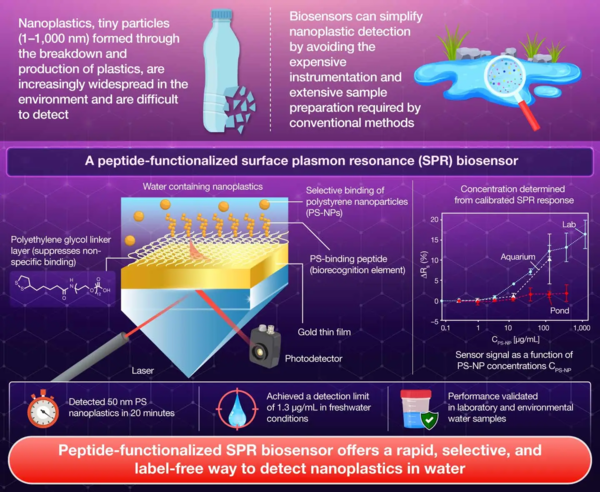
일본 도쿄과학대학교(Science Tokyo) 연구진은 물 속 폴리스티렌 나노입자(PS-NPs)를 신속하게 검출할 수 있는 바이오센서를 개발했다. 연구진은 인공 수질 샘플과 폴리스티렌 나노입자를 인위적으로 첨가한 실제 수질 시료를 통해 성능을 시험한 결과, 이 센서가 별도의 라벨링이나 복잡한 전처리 과정 없이도 20분 내에 50nm 크기의 입자를 검출해 낸다는 것을 확인했다. [그림제공(Picture Source) = Science Tokyo]
환경에서 나노플라스틱의 존재가 증가하면서 보다 간편한 검출 방법의 필요성이 커지고 있다. 이에 일본 도쿄과학대학교(Science Tokyo) 연구진은 물 속 폴리스티렌 나노입자(PS-NPs)를 신속하게 검출할 수 있는 바이오센서를 개발했다. 연구진은 인공 수질 샘플과 폴리스티렌 나노입자를 인위적으로 첨가한 실제 수질 시료를 통해 성능을 시험한 결과, 이 센서가 별도의 라벨링이나 복잡한 전처리 과정 없이도 20분 내에 50nm 크기의 입자를 검출해 낸다는 것을 확인했다. 이 기술은 환경 속 나노플라스틱의 축적 실태를 파악하고 이에 대응하는 데 크게 기여할 것으로 기대된다.
플라스틱은 시간이 지남에 따라 점점 더 작은 입자로 분해되며, 결국 1~1천nm 크기의 나노플라스틱을 형성한다. 이러한 초미세 플라스틱 입자는 이미 환경 전반에 퍼져 있으며, 인체를 포함한 생물체에서도 검출되고 있어 환경과 건강에 미칠 잠재적 영향에 대한 우려가 커지고 있다. 현재 나노플라스틱 검출에는 현미경 및 분광학적 방법이 사용되지만, 고가의 장비와 복잡한 시료 준비가 필요해 일상적인 모니터링에는 한계가 있다.
폴리스티렌은 가정과 산업에서 가장 흔히 사용되는 플라스틱 소재 중 하나로, PS-NPs는 나노플라스틱 검출의 주요 대상이다. 최소한의 시료 준비만으로 수중 환경에서 선택적이고 라벨링이 필요 없는 검출을 가능하게 하는 이 센서는 수질 평가를 크게 개선할 수 있으며, 실질적인 나노플라스틱 검출을 향한 중요한 진전을 의미한다.
이번 연구는 마나 토마(Mana Toma) 공과대학 전기전자공학과 부교수와 청수오(Shuo Cheng) 환경사회학부 조교수가 공동으로 이끌었다. 논문은 2026년 5월 9일 온라인으로 공개됐으며, 9월 15일 학술지 『Biosensors and Bioelectronics』 308권에 게재될 예정이다.
토마 교수는 “나노플라스틱은 극도로 작은 크기 때문에 기존 방법으로 검출하기 어렵다. 우리는 센서 표면에서 PS-NP 입자를 선택적으로 포획하고 이를 광학적으로 검출하는 바이오센싱 플랫폼을 개발해 이러한 문제를 해결했다”고 설명했다.
바이오센서는 특정 표적과 결합할 수 있는 생물인식(Biorecognition) 요소를 포함하며, 이를 통해 측정 가능한 신호를 생성한다. 이번 연구에서는 PS 결합 펩타이드가 인식 요소로 사용됐고, 이는 폴리에틸렌 글리콜(PEG) 연결자를 통해 얇은 금 박막에 고정돼 비특이적 결합을 최소화하고 PS-NP의 선택적 포획을 강화했다.
이 바이오센서는 표면 플라즈몬 공명(SPR) 기술을 기반으로 작동한다. SPR은 표면에서 발생하는 미세할 굴절률 변화를 실시간으로 감지하는 광학 센싱 기법이다. 레이저 빛을 고굴절률 유리 프리즘을 통해 얇은 금 박막에 조사하면 금속 표면의 자유전자 집합 진동인 표면 플라즈몬이 여기된다. PS-NP가 센서에 결합하면 국소 굴절률이 변해 공명각이 이동하며, 시스템은 이를 특정 입사각에서 반사광 강도 변화로 측정한다. 반사광 강도 변화를 SPR 반응 곡선과 비교해 PS-NP 농도를 정량화한다.
연구진은 담수의 이온 조성을 모사한 실험실 물에 PS-NP를 첨가해 시험했으며, 50nm PS-NP를 20분 이내 검출하고, 1.3μg/mL의 낮은 검출 한계를 달성했다. 또한 수족관 물과 연못 물에 PS-NP를 첨가한 샘플에서도 검출 성능을 검증했다.
토마 교수는 "검출 과정을 간소화함으로써 이 바이오센서는 특수 장비와 복잡한 시료 준비가 필요한 기존 방법보다 나노플라스틱 모니터링을 훨씬 더 쉽게 접근할 수 있게 할 것"이라고 말했다.
플라스틱의 지속적인 사용과 분해는 환경 내 나노플라스틱 축적을 불가피하게 증가시킬 것이다. 검출 과정을 간소화하고 모니터링을 더욱 실용적으로 만든다면, 제안된 바이오센서는 연구자들이 나노플라스틱의 확산과 거동을 더 잘 이해하도록 도와줄 수 있으며, 이는 점점 심각해지는 환경 문제 해결에 기여할 수 있다.
[원문보기]
Biosensor detects nanoplastics in water within minutes
Peptide-based biosensor enables direct detection of polystyrene nanoparticles
The growing presence of nanoplastics in the environment has highlighted the need for simpler detection methods, leading researchers at Science Tokyo to develop a rapid biosensor for detecting polystyrene nanoparticles in water. Tested in both model water samples and real water samples spiked with polystyrene nanoparticles, the device detected 50 nm particles within 20 minutes without labeling or extensive sample preparation. The technology could support efforts to understand and address nanoplastic accumulation in the environment.
Plastics fragment into increasingly smaller particles over time, eventually forming nanoplastics, particles ranging from 1 to 1,000 nm in size. These nano-sized plastic particles have permeated the environment and have been detected in living organisms, including the human body, raising growing concerns about their potential impacts on the environment and human health. The current analytical techniques used to detect nanoplastics include microscopy and spectroscopy methods. However, these conventional approaches require expensive equipment and extensive sample preparation, limiting their practicality for routine monitoring.
A research team at Institute of Science Tokyo (Science Tokyo), Japan, has now developed a biosensor that can rapidly detect polystyrene nanoparticles (PS-NPs) in fresh water. PS is one of the most commonly used plastic materials in both household and industrial applications, making PS-NPs an important target for nanoplastic detection. By enabling selective, label-free detection in aqueous environments with minimal sample preparation, the device could significantly improve water quality assessment, marking an important step toward practical nanoplastic detection.
The study was led by Associate Professor Mana Toma of the Department of Electrical and Electronic Engineering, School of Engineering, in collaboration with Assistant Professor Shuo Cheng from the School of Environment and Society, Japan
The paper was made available online on May 9, 2026, and will be published in Volume 308 of the journal Biosensors and Bioelectronics on September 15, 2026.
“The extremely small size of nanoplastics makes them difficult to detect using conventional methods. We addressed the challenge by designing a biosensing platform that selectively captures PS-NP particles at the sensor surface and detects them optically,” says Toma.
A biosensor consists of biorecognition elements that can bind with specific targets, producing a measurable signal. Here, a PS-binding peptide serves as the recognition element. The peptide was immobilized onto a thin gold film through a polyethylene glycol (PEG) linker, which minimizes non-specific binding and enhances the selective capture of PS-NPs.
The biosensor works using surface plasmon resonance (SPR), an optical sensing technique that detects tiny refractive index changes at a surface in real time. In this setup, laser light is directed through a high refractive index glass prism onto a thin gold film, exciting surface plasmons, which are collective oscillations of free electrons at the metal surface. When PS-NPs bind to the sensor, they change the local refractive index near the gold film, shifting the resonance angle. In the present system, this binding-induced SPR shift is monitored as a change in reflected light intensity at a selected incident angle. By comparing this intensity changes with a calibrated SPR response versus concentration curve, the system quantifies PS-NP concentrations in water.
The researchers tested the biosensor in laboratory water designed to mimic the ionic composition of freshwater, to which they added PS-NPs at known and controllable concentrations. In these samples, the proposed biosensor was able to detect 50 nm PS-NPs within 20 minutes and achieved a detection limit as low as 1.3 μg/mL. They also validated the detection in environmentally relevant samples using aquarium water and pond water spiked with PS-NPs.
“By simplifying the detection process, this biosensor could make nanoplastic monitoring more accessible than conventional methods that require specialized instruments and extensive sample preparation,” says Toma.
The continued use and degradation of plastics will inevitably increase nanoplastic accumulation in the environment. By simplifying detection and making monitoring more practical, the proposed biosensor could help researchers better understand how nanoplastics spread and behave, supporting efforts to address this growing environmental challenge.
[출처 = 도쿄과학대학교(Science Tokyo)(https://www.isct.ac.jp/en/news/0wb20bf07czk) / 2026년 7월 17일]
|  즐겨찾기 추가
 시작페이지로 설정
























