[영국] 동물플랑크톤 장내 이동이 보여준 미세플라스틱의 해양 생태계 순환
요각류를 통해 미세플라스틱이 수주와 먹이그물 전반으로 이동하는 경로 규명
장 통과 시간·섭취 간격 정량화로 해양 미세플라스틱 이동 모델 정확도 향상
국제학술지 『Journal of Hazardous Materials』에 게재
새로운 연구는 주요 동물플랑크톤 종의 장을 통과하는 미세플라스틱이 얼마나 빠르게 이동하는지를 처음으로 실시간 기록·측정하는 데 성공했다. 또한 측정 결과를 활용해 해당 동물플랑크톤이 하루 동안 얼마나 많은 플라스틱을 해양을 따라 운반하고 또 가라앉히는지를 추정했다.
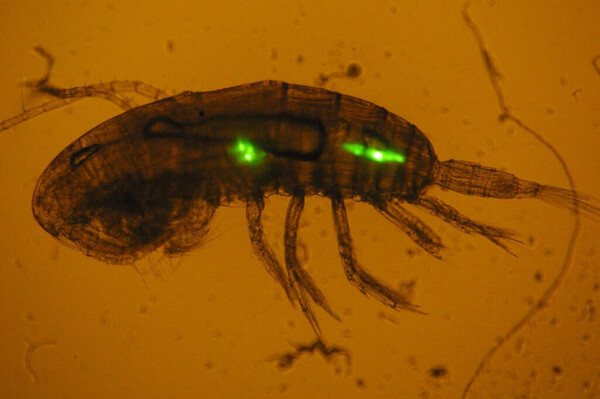
플리머스 해양연구소(Plymouth Marine Laboratory)와 발레아레스 제도 해양연구센터(Oceanographic Centre of the Balearic Islands, COB-IEO-CSIC) 연구진은 동물플랑크톤인 요각류( copepod)가 미세플라스틱을 섭취·배출하는 과정을 실시간으로 정량 분석해, 미세플라스틱이 해양 생태계 전반으로 이동·순환하는 핵심 경로를 규명했다. [사진제공(Photo Source) = 플리머스 해양연구소(Plymouth Marine Laboratory)]
동물플랑크톤은 이미 미세플라스틱이 해양 생태계 전반으로 이동하는 주요 생물학적 경로로 주목받고 있다. 바다에 축적된 미세플라스틱 입자가 125조 개가 넘는 것으로 추정되는 만큼, 이들 오염 물질이 해양 생태계와 먹이그물 속에서 어떤 방식으로 이동하는지를 이해하는 것은 해양 건강의 장기적 영향을 예측하는 데 중요하다.
요각류(copepod)는 해양에서 가장 개체 수가 많은 동물플랑크톤으로 널리 알려져 있으며, 표층 해역부터 심해까지 거의 모든 해역에서 동물플랑크톤 군집을 지배하고 있다. 이러한 막대한 개체 수로 인해, 미세플라스틱 섭취와 같은 개별 개체의 미미한 행동도 집합적으로는 생태계 차원의 상당한 변화를 초래할 수 있다.
발렌티나 파지아노(Valentina Fagiano) 발레아레스 제도 해양연구센터(Oceanographic Centre of the Balearic Islands, COB-IEO-CSIC) 박사와 플리머스 해양연구소(Plymouth Marine Laboratory, PML) 소속 매슈 콜(Dr Matthew Cole) 박사, 레이첼 코폭(Dr Rachel Coppock) 박사, 페넬로페 린데퀘(Professor Penelope Lindeque) 교수가 참여한 연구에 따르면, 요각류는 매일 수주를 따라 해수 1세제곱미터(㎥)당 수백 개의 미세플라스틱 입자를 해수 하층으로 운반하고 있을 가능성이 있는 것으로 나타났다.
이번 연구는 ‘실시간 관측으로 드러난 요각류에 의한 미세플라스틱 이동 흐름 (Real-time visualization reveals copepod mediated microplastic flux)’이라는 제목의 논문으로 국제 학술지 『저널 오브 해저더스 머티리얼스(Journal of Hazardous Materials)』에 게재됐다. 이 연구는 동물플랑크톤에 의해 미세플라스틱이 해양에서 어떻게 순환하는지를 보여주는 가장 명확한 정량적 자료 중 하나를 제시한다.
동물플랑크톤 가운데서도 요각류는 해양 먹이그물에서 중심적인 역할을 한다. 요각류는 미세조류를 먹고, 물고기와 바닷새, 해양 포유류의 먹이가 된다. 이와 함께 탄소를 배설물 형태로 포장해 더 깊은 바다로 가라앉히는, 이른바 ‘생물학적 펌프’ 역할도 수행한다.
최근 몇 년간 요각류는 해수에 떠 있는 미세플라스틱 입자를 섭취해 포식자에게 전달하거나, 배설물과 사체를 통해 심해로 이동시키는 매개체로 인식돼 왔다. 그러나 지금까지는 개별 요각류가 얼마나 많은 플라스틱을 처리하는지, 또 그 속도가 어느 정도인지를 정밀하게 파악할 방법이 없었다.
이번 연구에서 연구진은 플리머스(Plymouth) 남쪽 약 6해리에 위치한 웨스턴 채널 관측소의 L4 지점(L4 Station of Western Channel Observatory)에서 북대서양의 대표적 요각류인 ‘칼라누스 헬골란디쿠스(Calanus helgolandicus)’를 채집했다. 이를 위해 PML 소속 연구선 ‘퀘스트(Quest)’를 타고 미세망 플랑크톤 네트를 이용했다.
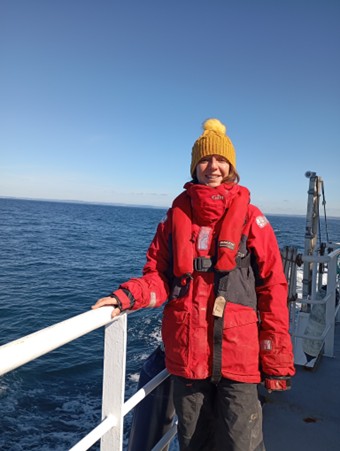
플리머스 해양연구소(Plymouth Marine Laboratory) 연구선 ‘퀘스트(Quest)’에서 시료 채집 중인 제1저자 발렌티나 파지아노(Valentina Fagiano) 박사. [사진제공(Photo Source) = 플리머스 해양연구소(Plymouth Marine Laboratory)]
연구진은 실험실에서 요각류를 세 가지 일반적인 미세플라스틱 유형에 노출시켰다.
형광 폴리스타이렌 비드(Fluorescent polystyrene Beads)
폴리아미드(나일론) 섬유(Polyamide (Nylon) Fibres)
폴리아미드(나일론) 파편(Polyamide (Nylon) Fragments)
이후 연구진은 서로 다른 먹이 조건에서 이러한 미세플라스틱을 제공해, 플라스틱 형태나 먹이 공급 여부가 입자가 장을 통과하는 속도에 어떤 영향을 미치는지 실험했다.
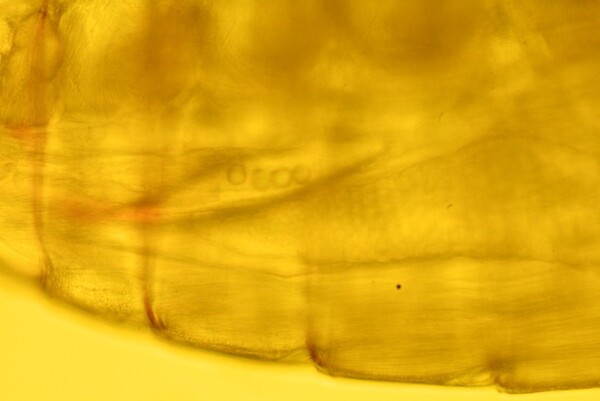
요각류(copepod)의 중앙 관(장관)에서 관찰된 미세플라스틱 비드. 형광 표지(Fluorescently Labelled)된 비드를 사용해 시각화와 식별이 가능하다. [사진제공(Photo Source) = 플리머스 해양연구소(Plymouth Marine Laboratory)]
실시간 시각화 기법을 활용해 개별 미세플라스틱 입자가 섭취된 뒤 배출되기까지의 과정을 추적한 결과, 다음 두 가지 핵심 지표를 높은 정밀도로 측정할 수 있었다.
장 통과 시간(Gut passage time): 미세플라스틱 입자가 요각류 체내에 머무는 시간
섭취 간격(Ingestion interval): 새로운 플라스틱 입자가 섭취되는 빈도
모든 실험에서 ‘장 통과 시간’은 중앙값 약 40분 수준으로 나타났고, 플라스틱 형태나 먹이 농도에 따른 유의미한 차이는 관찰되지 않았다. 다시 말해, 비드·섬유·파편 모두 비슷한 속도로 장을 통과했으며, 먹이 조건 역시 미세플라스틱의 장내 이동을 크게 변화시키지 않았다.
연구팀은 이러한 측정값을 잉글리시 해협(English Channel) 서부의 요각류 개체 수에 대한 추정치와 종합해, 해당 지역에서 요각류가 하루 기준 해수 1㎥당 약 271개의 미세플라스틱 입자 이동을 유도하고 있을 가능성을 산출했다. 잉글리시 해협 서부는 전 세계에서 연구가 가장 활발히 이뤄진 해역 중 하나로 꼽힌다.
PML 소속 선임 해양생태학자이자 생태독성학자인 매슈 콜 박사는 “요각류의 분변 펠릿(faecal pellet)은 음의 부력을 지녀 수주를 따라 가라앉는다”며 “미세플라스틱이 요각류에 의해 섭취된 뒤 분변 펠릿으로 다시 포장되면, 미세플라스틱 역시 함께 수주를 따라 해양 하층으로 이동하게 된다”고 설명했다.
PML 해양생태학자인 레이첼 코폭 박사는 “미세플라스틱 오염이 표층 해역의 문제로만 인식돼 온 데 비해 실제로는 동물플랑크톤을 통해 수주 전체와 먹이그물로 확산되고 있음을 이번 연구가 보여준다”고 말했다. 그는 “요각류는 미세플라스틱을 단순히 마주치는 데 그치지 않고, 매일 이를 처리하고 운반한다”고 덧붙였다.
페넬로페 린데퀘 교수는 “이번 연구 과정을 미세플라스틱 배관 시스템이자 미세플라스틱 식품 전달 서비스에 비유하고 싶다”며 “동물플랑크톤은 미세플라스틱을 수주를 따라 아래로 가라앉히는 동시에 해양 먹이사슬의 상위 단계로 전달하고 있다”고 밝혔다.
지금까지 미세플라스틱 이동을 다룬 많은 대규모 컴퓨터 모델은 동물플랑크톤의 섭취와 배출에 대한 종별·과정 기반 매개변수가 부족했다. 이번 연구에서 개발된 정량적 프레임워크는 장 통과 시간, 섭취 간격, 현실적인 개체 수 추정치를 기반으로 하며, 다음과 같은 활용 가능성을 제시한다.
동물플랑크톤의 행동을 해양 플라스틱 이동 모델에 통합
시간 경과에 따른 미세플라스틱 축적 위치에 대한 불확실성 감소
생태적·경제적으로 중요한 지역에 대한 위험 평가 개선
궁극적으로 이는 과학자와 정책 결정자들이 미세플라스틱 노출이 집중되는 지역과 개입이 필요한 지점을 식별하는 데 도움을 준다.
이번 연구는 스페인 COB-IEO-CSIC 소속의 방문 연구원 발렌티나 파지아노 박사와 PML의 매슈 콜 박사, 레이첼 코폭 박사, 페넬로페 린데퀘 교수가 공동으로 수행했다. 이들은 미세플라스틱과 플랑크톤 생태 분야에서 국제적 명성을 지닌 전문가들이다.
이번 협력은 동물플랑크톤 생태와 미세플라스틱 연구 기법에 대한 PML의 전문성과 실시간 시각화 및 이동량 정량화 분야에서 발렌티나 박사의 신흥 전문성을 결합했다. 이는 지속적인 국제 멘토링과 훈련의 가치를 보여주는 사례로 평가된다.
연구의 제1 저자인 발렌티나 파지아노 박사는 “이동량을 정량화함으로써, 개별 생물 내부에서 일어나는 과정과, 전체 생태계 차원에서 플라스틱이 어떻게 재분배되는지를 연결해 살펴볼 수 있게 됐다”고 말했다. 이어 그는 “연구는 동물플랑크톤이 하루 24시간 미세플라스틱을 쉽게 섭취한다는 사실을 보여준다”며 “요각류는 미세플라스틱을 단순히 마주치는 데 그치지 않고 미니 생물학적 펌프처럼 이를 처리해 분변으로 다시 포장하며, 이 분변은 수주를 따라 가라앉아 하부 퇴적물에 축적된다”고 설명했다.
또한 그는 “섭취량과 장 통과 시간에 대한 현실적인 수치는 컴퓨터 모델에 필수적이며, 이를 통해 미세플라스틱이 어디로 이동하는지, 어떤 종이 가장 많이 노출되는지, 그리고 이러한 오염이 해양 생태계에 작용하는 다른 압력들과 어떻게 상호작용하는지를 보다 정확히 예측할 수 있다”고 덧붙였다.
[원문보기]
Real-time imaging of microplastic gut passage in zooplankton
A new study has, for the first time, recorded and measured just how fast microplastics move through the gut passage of a key zooplankton species in real time – and used those measurements to estimate how much plastic these tiny animals might be transporting – and sinking down – through the ocean each day.
Zooplankton are already emerging as a major biological pathway for microplastics to transport through marine ecosystems. With over 125 trillion microplastic particles estimated to have accumulated in the ocean, understanding how these pollutants are moving through marine ecosystems and food webs is vital for predicting long-term consequences for ocean health.
Copepods are widely considered to be the most numerous zooplankton in our ocean, dominating zooplankton communities in nearly every ocean region, from surface waters to the deep sea. Their staggering numbers mean that even small actions by individual animals – like ingesting microplastics – can collectively drive substantial ecosystem-level changes.
New research, authored by Dr Valentina Fagiano (Oceanographic Centre of the Balearic Islands, COB-IEO-CSIC) and PML’s Dr Matthew Cole, Dr Rachel Coppock and Professor Penelope Lindeque, reveals that copepods may be transporting hundreds of microplastic particles per cubic metre of seawater down through the water column each and every day.
The paper, ‘Real-time visualization reveals copepod mediated microplastic flux’, published in Journal of Hazardous Materials, provides one of the clearest quantitative pictures to date of how microplastics are cycled by zooplankton in the ocean.
Zooplankton, and copepods in particular, are central to the marine food web. They eat microalgae and are, in turn, eaten by fish, seabirds and marine mammals. They also drive the ‘biological pump’, packaging carbon into faecal pellets that sink into deeper waters.
In recent years, copepods have also been recognised as vectors for microplastics – ingesting tiny plastic particles suspended in seawater and potentially passing them on to predators, or exporting them to depth via their pellets and carcasses. But until now, there has been no precise way to gauge how much plastic an individual copepod processes and how fast.
Through the study, researchers collected the copepods Calanus helgolandicus (a common North Atlantic copepod) through a fine-mesh plankton net, at the L4 Station of Western Channel Observatory – about six nautical miles south of Plymouth – aboard PML’s Research Vessel Quest.
In the lab, the copepods were exposed to three common types of microplastics:
fluorescent polystyrene beads
polyamide (Nylon) fibres
polyamide (Nylon) fragments
These were offered under different food conditions, allowing the scientists to test whether plastic shape or food availability changed how quickly particles moved through the gut.
Using real-time visualisation, the researchers tracked individual microplastic particles as they were ingested and later expelled. This allowed them to measure two key metrics with high precision:
Gut passage time – how long a microplastic particle stays inside the copepod
Ingestion interval – how often a new plastic particle is consumed
Across all experiments, gut passage times clustered around a median of roughly 40 minutes, and were consistent across plastic shapes and food concentrations. In other words: beads, fibres and fragments all moved through the gut at similar speeds, and feeding conditions did not significantly slow or accelerate plastic throughput.
By combining these measurements with realistic estimates of copepod abundance in the western English Channel – one of the most highly studied bodies of water in the world – the team calculated that copepods could be driving microplastic fluxes on the order of about 271 particles per cubic metre of seawater per day, in that region.
Senior marine ecologist and ecotoxicologist at PML, Dr Matthew Cole, explains how copepods sink microplastics after ingestion:
“Copepod faecal pellets are negatively buoyant – meaning they sink down the water column – and so, when microplastics have been ingested by copepods, and then repackaged into the faecal pellets, the microplastics should drop down the water column with them.”
Dr Rachel Coppock, Marine Ecologist at PML, added:
“Microplastic pollution is often framed as a surface ocean problem, but our study shows that zooplankton are constantly moving plastics through the water column, and into the food web. Copepods don’t just encounter microplastics – they process and transport them, day in, day out.”
Professor Penelope Lindeque outlines the wider implications:
“I would liken this process to both a microplastic plumbing system, and a microplastic food delivery service. Zooplankton are both sinking microplastics down the water column, and passing them higher up in the marine food chain.”
Up to now, many large-scale computer models of microplastic transport have lacked species-specific, process-based parameters for zooplankton ingestion and egestion. The quantitative framework developed here – based on gut passage times, ingestion intervals and realistic abundances – offers a way to:
Integrate zooplankton behaviour into ocean plastic transport models
Reduce uncertainty around where microplastics accumulate over time
Improve risk assessments for ecologically or economically important regions
Ultimately, that helps scientists and policymakers identify hotspots of microplastic exposure and potential intervention points.
The study was a collaboration between visiting scientist Dr Valentina Fagiano, based at COB-IEO-CSIC in Spain, and PML’s Dr Matthew Cole, Rachel Coppock and Prof Penelope Lindeque – internationally-recognised leaders in microplastics and plankton ecology.
The partnership combines PML’s expertise in zooplankton ecology and microplastic methods with Valentina’s emerging specialism in real-time visualisation and flux quantification, illustrating the value of sustained international mentoring and training.
Lead author Dr Fagiano, said:
“By quantifying this flux, we can start to link what happens inside a single animal to how plastics are redistributed across entire ecosystems.”
“Our research has shown that zooplankton readily ingest microplastics 24/7. Copepods don’t just encounter microplastics – they are like mini biological pumps, – processing and repackaging the microplastics into their faeces, which sink through the water column and accumulate in underlying sediment.”
“Having realistic numbers for ingestion and gut passage is a vital for computer models. It means we can better predict where microplastics end up, which species are most exposed, and how this pollution interacts with other pressures on marine ecosystems.”
[출처 = 플리머스 해양연구소(Plymouth Marine Laboratory)(https://pml.ac.uk/news/watch-now-real-time-imaging-of-microplastic-gut-passage-in-zooplankton/) / 2025년 1월 5일]
|  즐겨찾기 추가
 시작페이지로 설정
























