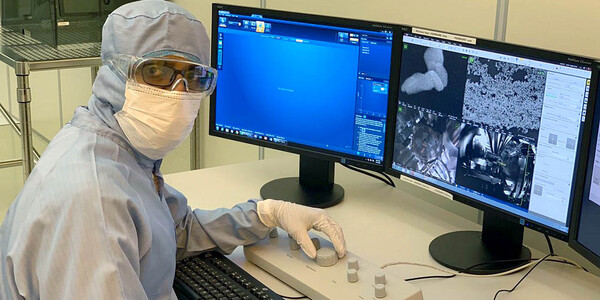
지빈 앤토니(Jibin Antony)가 노르웨이과학기술대학교(NTNU) 나노랩에서 주사전자현미경(SEM)을 활용해 비스무타이트 나노입자를 연구하고 있다. [사진제공(Photo Source) = NTNU Saravanan Janakiram]
노르웨이과학기술대학교(Norwegian University of Science and Technology, NTNU) 화학공학과 연구진이 햇빛과 비스무타이트(Bismutite)를 활용한 광촉매 기술을 통해 물속 오염물질을 정화할 수 있는 가능성을 제시했다. 연구진은 비스무타이트의 구조와 표면을 개질해 자외선에 국한됐던 기존 한계를 극복하고, 자연 태양광에서도 광촉매(Photocatalysis) 효율을 높일 수 있음을 확인했다.
담수는 산업 폐기물, 염료, 화학물질 등 다양한 오염원으로 인해 위협받고 있다. 이러한 오염물질을 지속 가능한 방식으로 제거하는 것이 중요한 과제로 떠오른 가운데, NTNU 화학공학과 박사과정 연구원인 지빈 앤토니(Jibin Antony)는 풍부하고 무료로 이용 가능한 자원인 햇빛에 주목했다.
앤토니 연구원은 “우리는 친환경적이고, 저렴하며, 효율적인 기술이 필요하다. 태양은 막대한 에너지를 완전히 무료로 제공한다. 과제는 햇빛을 이용해 물속 오염물질을 분해할 수 있는 소재를 찾는 것”이라고 말했다.
연구는 빛에 노출되면 화학 반응을 일으켜 물속 유해 물질을 분해하는 광촉매 공정에 초점을 맞췄다. 연구진이 주목한 소재는 비스무타이트로, 이는 탄산산화비스무트 형태로 자연에 존재하는 광물이며 노르웨이 일부 지역에서 발견된다. 비스무타이트는 광촉매로 활용 가능하지만, 자외선에서만 효과적으로 작동해 태양광 활용에는 한계가 있었다.
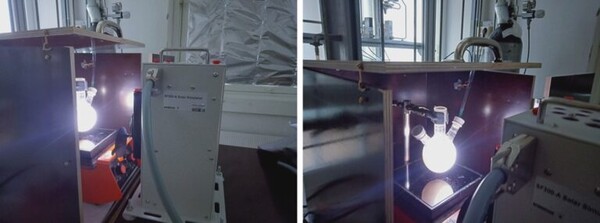
본 연구에서 사용된 실험 장치 구성. [사진제공(Photo Source) = NTNU]
이를 개선하기 위해 앤토니는 세 가지 방법을 시험했다. 첫 번째는 비스무타이트에 실리카(SiO₂)를 도입해 표면을 개질하는 방식이다. 이에 대해 그는 “실리카는 오염물질이 소재에 더 잘 부착되도록 돕고, 공정을 가속하는 미세한 구조적 결함을 만들어준다”고 설명했다.
두 번째 방법은 다양한 형태의 플라즈모닉(Plasmonic) 금 나노입자로 비스무타이트 표면을 코팅하는 것이었다. 플라즈모닉 금속 입자는 특정 파장의 빛을 흡수하고 산란시킬 수 있으며, 특히 길쭉한 형태의 금 나노입자가 광촉매 성능을 크게 향상시켰다. 그는 “이들은 거의 햇빛 안테나처럼 작동한다. 광촉매 반응에 미치는 효과가 매우 분명했다”고 말했다.
세 번째로는 알칼리 용액을 이용해 비스무타이트를 에칭하는 화학적 처리를 적용했다. 이 방법만으로는 뚜렷한 성과를 내지 못했으나, 다른 방법과 결합할 경우 효과를 증대시키는 것으로 나타났다.
본 연구에서 비스무타이트 나노입자를 연구한 지빈 앤토니. [사진제공(Photo Source) = NTNU]
연구 결과를 종합하면, 비스무타이트와 같은 소재를 자연 태양광 조건에서도 훨씬 더 효과적인 광촉매로 활용할 수 있음이 확인됐다. 그는 “이는 유해 화학물질을 사용하지 않고 물을 정화할 수 있는, 저렴한 태양광 기반 시스템으로 나아가는 한 걸음”이라고 밝혔다.
연구진은 햇빛이라는 자연에서 가장 풍부한 자원을 활용해 강과 호수, 식수의 수질을 개선하는 기술개발을 목표로 하고 있다. 앤토니는 “단 하나의 방법으로 모든 환경 문제를 해결할 수는 없지만, 햇빛과 정교한 화학 기술을 이용해 물을 정화할 수 있다면 우리는 올바른 방향으로 중요한 발걸음을 내디딘 것”이라고 말했다.
해당 연구는 유해 화학물질에 의존하지 않고 태양광만으로 수질을 개선할 수 있는 광촉매 기술의 가능성을 보여준 사례로, 향후 친환경 수처리 기술개발에 새로운 선택지를 제시하고 있다.
[원문보기]
Gold particles and sunlight can help purify water
Fresh water is under threat on many fronts. Researchers are working hard to solve this problem. One solution uses sunlight and bismutite.
Industrial waste, dyes and chemicals all potentially pollute our waters. This is a problem we have to address, but how can water be cleansed of these pollutants in a sustainable manner?
Jibin Antony, a PhD research fellow at NTNU’s Department of Chemical Engineering believes the solution may lie in using something of which we have in great abundance: sunlight.
“We need technologies that are green, affordable and efficient. The sun provides us with an enormous amount of energy, completely free of charge. The challenge is finding materials that can use sunlight to break down pollutants in water,” Antony said.
He is studying a process called photocatalysis. Photocatalysts are special materials that start a chemical reaction when exposed to light. The reaction can break down harmful substances in water.
Using bismutite
The material Antony has ended up focusing on is called bismutite. This is a mineral that naturally occurs as bismuth carbonate oxide, and can be found in certain places in Norway.
Bismutite can be used as a photocatalyst, but it only works effectively when exposed to ultraviolet light – a very small portion of sunlight. In order to make bismutite more effective in normal sunlight, Antony has tested three different methods:
The first was to combine bismutite with silica to form silicon dioxide (SiO₂).
“Silica helps the pollutants adhere better to the material while also creating small structural defects that serve to accelerate the process,” he said.
The second method was to cover bismutite with ‘plasmonic’ gold nanoparticles in various shapes. Plasmonic metal particles can absorb and scatter light at specific wavelengths. The elongated nanoparticles in particular produced a significant improvement.
“They work almost like antennas for sunlight. The effect on the photocatalysis was very clear,” added Antony.
Finally, Antony tried a chemical treatment in which bismutite was etched using an alkaline solution.
This method alone did not produce significant results, but it can enhance the effects of the other methods.
Making bismutite more effective
Collectively, the experiments showed that it is possible to make materials like bismutite much more effective in normal sunlight.
“This is a step towards affordable, solar-powered systems that can purify water without the use of harmful chemicals,” said Antony.
The goal is that, sometime in the future, a technology can be developed that helps create cleaner rivers, lakes and drinking water, using one of nature’s most abundant resources.
“We can’t solve every environmental problem with just one method, but if we can use sunlight and smart chemistry to purify water, we will have taken an important step in the right direction.” concluded Antony.
References:
Antony, J., Gonzalez, S.V., Bandyopadhyay, S., Yang, J. and Rønning, M., 2023. Silica-modified bismutite nanoparticles for enhanced adsorption and faster solar photocatalytic degradation of methylene blue. Catalysis Today, 413, p.113986. https://doi.org/10.1016/j.cattod.2022.12.017
Antony, J., Bandyopadhyay, S., Yang, J. and Rønning, M., 2023. Optimizing the shape anisotropy of gold nanoparticles for enhanced light harvesting and photocatalytic applications. Photochemical & Photobiological Sciences, 22(4), pp.773-781. https://doi.org/10.1007/s43630-022-00351-8
 즐겨찾기 추가
 시작페이지로 설정