[노르웨이] 노르웨이생명과학대, “미세플라스틱에 부착된 병원균 수처리 공정서 제거 안돼”
노르웨이 생명과학대 연구진 주도…『플로스 원(PLOS One)』 저널에 게재
플라스틱스피어 생물막 형성으로 수처리 공정서 병원균 살아남아…인간 및 환경에 영향
물재이용 계획에 걸림돌로 작용…미세플라스틱 제거 및 병원성 미생물 분해 기술 개발 필요

노르웨이 생명과학 대학교(Norwegian University of Life Sciences)의 연구진은 식품 매개 및 기회성 병원균이 물 속 미세 플라스틱에 부착돼 빠른 속도로 미생물 생물막을 형성할 경우 수처리 공정에서 제거되지 않고 살아남을 수 있으며, 처리된 하폐수가 식수 및 관개용수와 같은 용도로 재사용될 때 인간 및 환경 건강에 잠재적인 위협이 될 수 있다고 경고했다. [사진출처(Photo Source) = 픽사베이(Pixabay)]
노르웨이 생명과학 대학교(Norwegian University of Life Sciences) 연구진은 식품 매개 및 기회 감염성 병원체 (Opportunistic Pathogens)가 물 속 미세 플라스틱에 부착돼 빠른 속도로 미생물 생물막을 형성해 하·폐수처리 공정에서 제거되지 않고 살아남을 수 있으며, 처리된 하·폐수가 식수 및 관개용수와 같은 용도로 재이용될 때 인간 및 환경 건강에 잠재적인 위협이 될 수 있다고 경고했다.
연구진은 2021년 8월과 9월에 노르웨이의 한 처리장에서 원수와 처리수에서 세 가지 일반적인 유형의 플라스틱(폴리프로필렌, 폴리염화비닐, 고밀도 폴리에틸렌 프로필렌)에서 플라스티스피어(점성 미생물 생물막에 있는 병원균 군집)를 형성한 식품 매개 병원체를 확인했다.
플라스티스피어(Plastispheres)는 원수와 처리수에서 각각 14일과 30일 동안 번식하도록 두었다. 연구진은 호기성 또는 혐기성 조건에서 병원체를 배양하고 병원체를 유전적으로 분석했으며, 그 결과를 과학 저널인 『플로스 원(PLOS One)』에 게재했다.
미세 플라스틱 즉, 크기가 5mm(0.20인치) 미만의 조각과 입자는 플라스틱 제조가 증가함에 따라 환경에서 확산돼 심각한 식품 오염 물질로 인식되고 있다.
연구진은 "시립 하수처리장(Wastewater treatment plants, WWTP)에는 합성 의류 세탁, 화장품을 가정용 배수구로 직접 헹구는 것과 같은 가정 활동에서 발생하는 다양한 크기의 플라스틱 입자가 유입된다. 또한 타이어 마모 입자는 환경으로 유입되는 미세 플라스틱의 주요 공급원이며, 종종 빗물 등을 통해 하수처리장으로 유입된다"고 설명했다.
역전사 정성적 중합효소 연쇄 반응(Reverse-transcription qualitative polymerase chain reaction, RT-qPCR)을 실시한 결과, 미세 플라스틱에서 리스테리아 모노사이토게네스, 대장균, 노로바이러스 및 아데노바이러스와 같은 유해한 박테리아와 바이러스를 발견됐다. 이 병원체의 양은 1% 미만이었지만, 원수나 처리수에서 14일과 30일 동안 검출됐다.
배양된 세균은 원수와 처리수에서 클렙시엘라 폐렴균( Klebsiella pneumoniae)과 아시네토박터(Acinetobacter) 종을 성장시켰으며, 이는 플라스틱스피어 생물막이 하·폐수 처리를 견디는 데 도움이 될 가능성이 있음을 나타낸다.
[그림 1] 하·폐수 플라스티스피어 커뮤니티의 지배적인 분류군
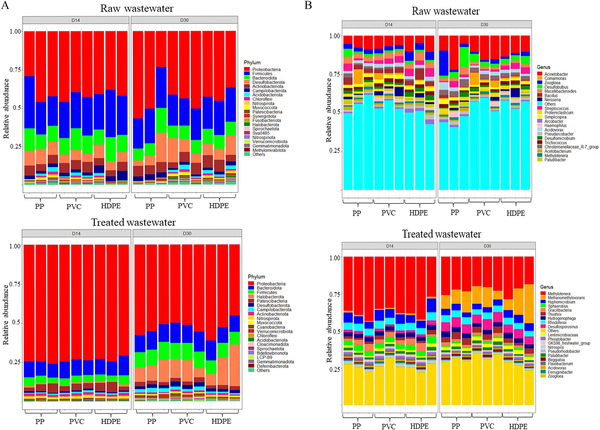
원수 및 처리된 하·폐수 플라스티스피어에서 가장 풍부한 20개의 문(A)과 속(A)의 상대적 존재비. 각 색은 하나의 문 또는 속을 나타내며, 패치의 길이는 문/속의 상대적 존재비를 나타낸다. 각 막대는 세 개의 복제물 그룹을 나타낸다. 서로 다른 플라스틱 재료는 x축에 나열되어 있고 y축은 문 및 속의 존재비를 나타낸다. 막대 그림은 원수 하·폐수 플라스티스피어와 처리된 하·폐수 플라스티스피어 간의 박테리아 군집의 명확한 차이를 보여준다. [그림출처(picture source) =『플로스 원(PLOS One)』 저널 ]
플라스틱스피어의 분류학적 다양성과 구성은 플라스틱이 하·폐수에 머무는 시간과 환경에 의해 크게 영향을 받았다. 플라스틱 재료의 종류는 박테리아 구성에는 영향을 미치지 않았지만 박테리아 다양성에는 영향을 미쳤다.
연구진은 "이러한 발견은 플라스틱스피어가 병원성 종을 보유하고 전파할 가능성을 강조하며, 이는 물재이용 계획에 걸림돌로 작용할 수 있다"고 말했다. 이어 "효율적인 하·폐수 처리와 적절한 플라스틱 폐기물 관리가 없다면 하·폐수는 플라스틱 관련 병원균을 식품 사슬로 옮기는 원천이 될 수 있으며, 인간의 건강에 위협이 될 수 있다"고 강조했다.
또한 "미세 플라스틱을 보다 효과적으로 제거하고 잠재적인 병원성 미생물을 분해하기 위해 지속 가능한 대체 기술을 개발하거나 기존 수처리 공정을 보완하기 위해서는 지속적인 연구와 혁신이 필요하다"고 덧붙였다.
[원문보기]
Report: Pathogens clinging to microplastics can weather water treatment, pose health risk
Foodborne and opportunistic pathogens can survive wastewater treatment when they hitch a ride on microplastics in the water and quickly form a supportive and protective microbial biofilm, posing a potential threat to human and environmental health when the treated water is reused for things like drinking and crop irrigation, suggest researchers from the Norwegian University of Life Sciences.
Tiny plastic fragments have proliferated
The investigators identified foodborne pathogens that had formed plastispheres (colonies of pathogens in a sticky microbial biofilm) in three common types of plastic (polypropylene, polyvinyl chloride, and high-density polyethylene propylene) in raw and treated wastewater at a single plant in Norway in August and September 2021.
The plastispheres were allowed to grow for 14 and 30 days in raw and treated wastewater, respectively. The team cultured the pathogens under aerobic or anaerobic conditions and genetically analyzed the pathogens, the results of which were published last week in PLOS One.
Microplastics, or plastic fragments and particles less than 5 millimeters (0.20 inch) in size, have proliferated in the environment as plastic manufacturing has increased and are recognized as significant food contaminants.
"Municipal WWTPs [wastewater treatment plants] are recipients of plastic particles of different sizes originating from household activities such as washing synthetic clothes, personal care, and rinsing cosmetic products directly down household drains," the study authors wrote. "In addition, tire wear particles represent a major source of microplastics entering the environment and are often transported into WWTPs through storms and meltwater."
Viable Klebsiella pneumoniae, Acinetobacter
On reverse-transcription qualitative polymerase chain reaction (RT-qPCR), microplastics yielded evidence of harmful bacteria and viruses such as Listeria monocytogenes, Escherichia coli, norovirus, and adenovirus. The pathogens' abundance was less than 1%, but they were detectable for 14 and 30 days in raw or treated wastewater.
"These findings underscore the potential of plastispheres to harbor and disseminate pathogenic species, posing challenges to water reuse initiatives."
Cultures grew Klebsiella pneumoniae and Acinetobacter species from raw and treated wastewater, indicating that the plastisphere biofilms likely help them withstand wastewater treatment.
The taxonomic diversity and composition of the plastispheres were significantly influenced by the environment and the length of time the plastic was in the wastewater. The type of plastic material didn't affect the bacterial composition but did influence the bacterial diversity.
"These findings underscore the potential of plastispheres to harbor and disseminate pathogenic species, posing challenges to water reuse initiatives," the researchers wrote. "Without efficient wastewater treatment and proper plastic waste management, wastewater could act as a source of transferring plastic-associated pathogens into the food chain and possibly pose a threat to human health."
"Continued research and innovation are necessary to develop alternative sustainable technologies or supplement conventional treatment processes to ensure more effective removal of microplastics and to degrade potential pathogenic microorganisms," they concluded.
[출처 = 미네소타대학교 감염병 연구 및 정책 센터(CIDRAP)(https://www.cidrap.umn.edu/foodborne-disease/report-pathogens-clinging-microplastics-can-weather-water-treatment-pose-health) / 2024년 11월 13일]
[논문 출처 = 『플로스 원(PLOS One)』 저널(https://journals.plos.org/plosone/article?id=10.1371/journal.pone.0312157) / 2024년 11월 6일]
|  즐겨찾기 추가
 시작페이지로 설정
























