[미국] “반도체 산업 오염 근절하는 새로운 PFAS 제거 프로세스 개발”
미국 일리노이대 샤오수 교수 연구팀, 물에서 PFAS 포집·농축·파괴하는 전기화학적 전략을 최초로 연구
완전한 PFAS 크기 스펙트럼을 포착 관련된 문제 해결하기 위해 산화환원 전기투석 담수화 여과기술을 단일 장치에 결합
국제학술지 『네이처 커뮤니케이션즈(Nature Communications)』에 게재
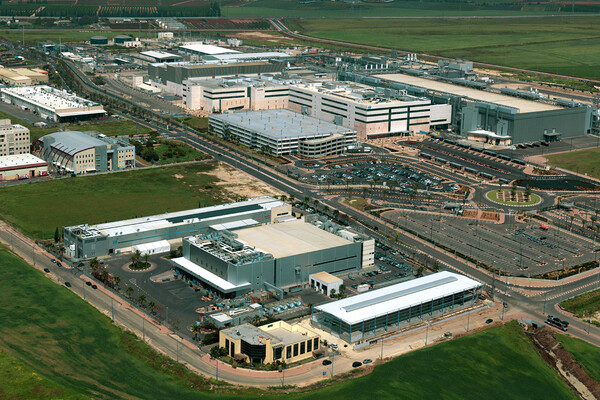
반도체 공장 건설이 증가할 것으로 예상되는 가운데 미국 일리노이 대학교 어바나-샴페인 캠퍼스(University of Illinois Urbana-Champaign)의 샤오수(Xiao Su) 교수 연구팀은 점점 더 널리 퍼져 있는 ‘초단사슬 PFAS(ultra-short-chain PFAS)’를 포함하여 PFAS로 알려진 다양한 화학물질의 혼합물을 단일 공정으로 물에서 포집, 농축 및 파괴하는 전기화학적 전략을 최초로 개발했다. 사진은 커터스티 레하바 센터(courtesty Lehava Center). [사진출처(Photo source) = 일리노이대학교 어바나-샴페인 캠퍼스(University of Illinois Urbana-Champaign)]
미국 일리노이대학교 어바나-샴페인 캠퍼스(University of Illinois Urbana-Champaign)의 샤오수(Xiao Su) 교수 연구팀은 점점 더 널리 퍼져 있는 ‘초단사슬 PFAS(ultra-short-chain PFAS)’를 포함하여 과불화화합물(per- and polyfluoroalkyl substances, PFAS)로 알려진 다양한 화학물질의 혼합물을 단일 공정으로 물에서 포집, 농축 및 파괴하는 전기화학적 전략을 최초로 개발했다.
이 새로운 연구개발은 특히 반도체 제조에서 퍼플루오로알킬(perfluoroalkyl) 및 폴리플루오로알킬(polyfluoroalkyl) 물질로 인한 오염이라는 산업적 문제를 해결할 준비가 되어 있다.
이전 일리노이대학교(U. of I.) 연구에 따르면 전기흡착이라고 하는 전기화학적 구동 흡착을 사용하여 물에서 단사슬(short-chain) 및 장사슬(long-chain) PFAS를 제거할 수 있지만, 이 방법은 크기가 작고 화학적 특성이 다르기 때문에 초단사슬 분자에는 효과적이지 않다.
일리노이대학교 화학·생체분자공학과 샤오수(Xiao Su) 교수가 이끄는 이 새로운 연구는 ‘산화환원 전기투석(redox electrodialysis)’이라는 담수화 여과기술과 단일 장치의 전기흡착을 결합하여 전체 PFAS 크기 스펙트럼을 포착하는 것과 관련된 문제를 해결한다.
이 연구 결과는 국제학술지 『네이처 커뮤니케이션즈(Nature Communications)』 9월 24일자에‘초단사슬에서 장사슬 PFAS 제거를 위한 산화환원 전기투석 및 전기 흡착 통합(Integrating redox-electrodialysis and electrosorption for the removal of ultra-short- to long-chain PFAS)’제목으로 게재됐다.
샤오수(Xiao Su) 교수는 “매우 단사슬 PFAS가 물 속의 염 이온과 매우 유사하게 작용하기 때문에 산화 환원 전기투석을 결정했다”고 말했다.
그는 특히 “문제는 초단사슬 PFAS를 포집하고, 장쇄 PFAS의 전기흡착 공정과 함께 작동하도록 하고, 전기화학적 산화로 파괴하고, 단일 장치 내에서 이를 실현하기 위한 효율적이고 효과적인 전기투석 시스템을 만드는 것”이라고 강조했다.
샤오수의 연구팀은 이전에 다양한 비 PFAS 오염물질을 제거하는 고효율 전기투석 장치를 시연한 바 있다. 그러나 이 과정에는 비싸고 PFAS 분자로 인해 빠르게 오염되는 이온 교환막(ion-exchange membranes)이 필요하다.
샤오수 교수팀은 막 장애물을 제거하기 위해 전기장 구동 PFAS를 파울링 없이 제거할 수 있는 저렴한 나노 여과막(nanofiltration membranes)을 도입했다.
이 기술은 에너지 효율적인 담수화를 가능하게 하기 위해 산화환원 중합체와 이러한 나노여과막을 결합한 그룹에서 이전에 이룬 발전에 기반한다.
PFAS 제거의 경우 작업에 적합한 재료를 갖는 것도 중요하지만, 가장 효과적인 구성을 찾는 것 자체가 중요한 과제이다.
샤오수 교수는 “다양한 장치 구성을 실험한 끝에 마침내 PFAS에 오염된 물을 담수화하여 초단사슬 분자를 제거하고, 동시에 탄소 전극이 나머지 단사슬 및 장사슬 분자를 제거하는 시스템에 정착했다”라면서 “이 과정은 또한 모든 PFAS를 집중시켜 한 번 포획되면 더 쉽게 파괴할 수 있다”고 강조했다.
[그림 1] PFAS 제거를 위한 산화환원 중합체 전기투석 시스템
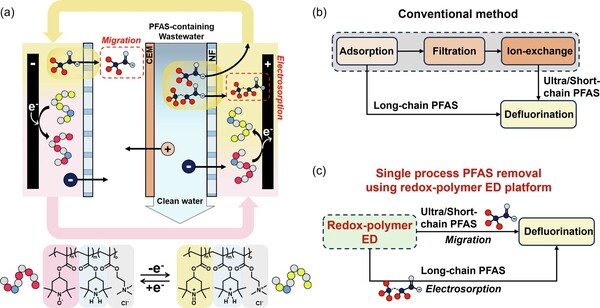
a : 담수화와 함께 PFAS 제거(전기흡착 및 이동을 통해)를 위한 산화환원 중합체 ED 시스템의 개략도.b : 흡착, 여과 및 이온 교환 방법을 포함한 일련의 분리 공정을 통해 초단쇄에서 장쇄 PFAS를 제거하는 기존 전략.c : 산화환원 중합체 ED 플랫폼을 사용한 단일 공정 PFAS 제거. ※여기서 초단사슬/단사슬에서 장사슬 PFAS는 각각 이동 및 전기흡착을 통해 동시에 제거할 수 있다. CEM 및 NF는 각각 양이온 교환막과 나노여과막을 나타낸다. [그림출처(picture source) = 『네이처 커뮤니케이션즈(Nature Communications)』]
마지막으로, 산화환원 전기투석에 내재된 전기화학적 산화공정은 포집된 PFAS를 불소 이온으로 전환하여 파괴하는데, 이는 환경에서 이러한 지속적인 오염물질을 제거하기 위한 핵심 단계이다.
샤오수 교수는 “우리 연구팀이 공정을 확장하여 실험실에서 현장으로 옮겨 하·폐수 처리 분야를 다룰 뿐만 아니라 현장에서 시스템을 산업폐수 흐름에 통합할 수 있게 되어 기쁘다”고 말했다.
샤오수 교수는 특히 “이 연구는 미국 정부, 하·폐수처리 시설 및 반도체 산업의 관심으로 인해 매우 시의적절하다”라면서 “반도체 생산은 앞으로 몇 년 동안 증가할 것으로 예상되며 지속 가능한 생산을 위한 PFAS 감소는 앞으로 중요한 문제가 될 것”이라고 강조했다.
이 연구에는 일리노이주 대학교 김나영(Nayeong Kim), 요하네스 엘버트(Johannes Elbert) 및 에카테리나 슈키나(Ekaterina Shchukina) 연구원 등이 참여했다. 또한 국립과학재단(National Science Foundation) ERASE-PFAS 프로그램이 이 연구를 지원했다. 샤오수 교수는 또한 일리노이 대학교의 토목 및 환경공학, 화학 및 베크만 첨단과학기술연구소(Beckman Institute for Advanced Science and Technology)에 소속되어 있다.
[원문보기]
New PFAS removal process aims to stamp out pollution ahead of semiconductor industry growth
CHAMPAIGN, Ill. - A University of Illinois Urbana-Champaign study is the first to describe an electrochemical strategy to capture, concentrate and destroy mixtures of diverse chemicals known as PFAS - including the increasingly prevalent ultra-short-chain PFAS - from water in a single process.
This new development is poised to address the growing industrial problem of contamination with per- and polyfluoroalkyl substances, particularly in semiconductor manufacturing.
A previous U. of I. study showed that short- and long-chain PFAS can be removed from water using electrochemically driven adsorption, referred to as electrosorption, but this method is ineffective for ultra-short-chain molecules because of their small size and different chemical properties.
The new study, led by Illinois chemical and biomolecular engineering professor Xiao Su, combines a desalination filtration technology, called redox electrodialysis, with electrosorption in a single device to address the problems associated with capturing the complete PFAS size spectrum.
The study findings are published in the journal Nature Communications.
“We decided upon redox electrodialysis because the very short-chain PFAS behave a lot like salt ions in water,” Su said. “The challenge was to produce an efficient, effective electrodialysis system to capture the ultra-short-chain PFAS, have it work in tandem with the electrosorption process for the longer-chain PFAS, destroy them with electrochemical oxidation, and make it happen within a single device.”
Su’s team has previously demonstrated highly efficient electrodialysis devices that remove various non-PFAS contaminants. However, the process requires ion-exchange membranes, which are expensive and quickly fouled by PFAS molecules.
To clear the membrane hurdle, Su’s team introduced an inexpensive nanofiltration membrane that enables the electric-field-driven removal of PFAS without becoming fouled.
This technology is based on prior advances made by their group in combining redox polymers with these nanofiltration membranes to enable energy-efficient desalination.
For PFAS removal, having the right material for the job is one thing, but finding the most effective configuration is a significant challenge on its own.
“After experimenting with a variety of device configurations, we finally settled on a system that desalinates the PFAS-contaminated water to remove the ultra-short-chain molecules, then at the same time, carbon electrodes remove the remaining short- and long-chain molecules,” Su said. “This process also concentrates all the PFAS, making them easier to destroy once captured.”
Finally, the electrochemical oxidation process inherent to redox electrodialysis destroys the captured PFAS by converting them to fluoride ions, a key step towards eliminating these persistent contaminants from the environment.
Su said that the team is excited about the prospect of scaling up the process so they can take it out of the lab and into the field not only to address wastewater applications but also to incorporate the system on-site into industrial wastewater streams.
“This work is very timely due to interest from the U.S. government, wastewater treatment facilities and the semiconductor industry,” Su said. “Semiconductor production is expected to rise over the coming years, and PFAS abatement for sustainable production will become a major issue moving forward.”
Illinois researchers Nayeong Kim, Johannes Elbert and Ekaterina Shchukina contributed to this study. The National Science Foundation ERASE-PFAS program supported this research. Su also is affiliated with civil and environmental engineering, chemistry and the Beckman Institute for Advanced Science and Technology at the U. of I.
[출처 = 일리노이대학교 어바나-샴페인 캠퍼스(University of Illinois Urbana-Champaign)(https://news.illinois.edu/view/6367/1396654060?utm_medium=web&utm_term=newsbureau&utm_campaign=yks&utm_source=uihomepage#image-1) / 2024년 11월 7일]
[연구논문 출처 = 『네이처 커뮤니케이션즈(Nature Communications)』(https://www.nature.com/articles/s41467-024-52630-w) / 2024년 9월 24일자]
|  즐겨찾기 추가
 시작페이지로 설정
























