[미국] 블루필드리서치, “2030년 미국 빗물관리 시장 545억 달러 전망”
이상기후로 미국 빗물관리, 지방자치단체·교통부서·부동산소유자에게 중요 관심 분야로 빠르게 성장
빗물관리를 위한 자본지출, 2023년 346억 달러(약 47조 7천64억 원)에서 2030년 545억 달러(약75조 1천337억 원)로 연 7.5% 상승 예상
기상이변과 심각성 증가로 미국 빗물사고에 필요한 하드웨어·혁신적 솔루션 및 자본 배치가 필요하게 됨
미국의 글로벌 시장조사기관인 블루필드 리서치(Bluefield Research)의 최근 용어에 따르면, GDP에 따라 이상기후로 미국의 빗물관리(Stormwater management) 시장이 지방자치단체단체, 교통부서 및 에도시소유자에게 중요한 관심 분야로 빠르게 성장해 2023년에는 346억 달러(약 47조7천64억 원)에서 2030년에는 545억 달러(약75조1천337억 원)로 증가할 것으로 예상합니다. [사진출처(사진출처) = 블루필드 리서치(Bluefield Research)]
GDP에 따른 이상기후로 인한 빗물관리(Stormwater management) 시장이 지방자치단체, 교통부 및 지방소유자에게 중요한 관심 분야로 빠르게 성장하고 있다.
2000년 이후 미국의 1천568억 달러(약 216조1천958억 원)가 붕괴되고, 이에 따라 미국의 빗물잠재력에 필요한 하드웨어, 즉 충당 솔루션 및 자본의 배치가 필요해지고 있다.
미국 보스턴에 있는 글로벌 시장조사기관인 블루필드 리서치(Bluefield Research)의 최근 보고서인 ‘미국의 빗물 인프라 시장 : 주요 동인, 경쟁 변화 및 투자 전망, 2024∼2030(U.S. Stormwater Infrastructure Market: Key Drivers, Competitive Shifts & Investment Outlook, 2024∼2030)’에 따르면, 미국의 빗물관리를 위한 자본지출(CAPEX)은 2023년 346억 달러(약 47조7천64억 원)에서 2030년에는 545억 달러(약75조1천337억 원)로 증가할 것으로 예상했다.
이는 연간 6.7%의 복합 성장률을 나타낸다. 단기적으로 이러한 성장은 인프라 투자 및 일자리 법을 포함한 연방 인프라 투자에 의해 부분적으로 주도될 것으로 예상된다.
블루필드 리서치(Bluefield Research)의 에릭 빈들러(Eric Bindler) 수석이사는 “역사적인 수준의 강수량을 감당하도록 설계된 폭우 기반 시설 자산은 오늘날의 폭우의 빈도와 심각성을 견디기에 점점 부족해지고 있다”고 강조했다.
게다가 이상기후현상(climate events)은 점점 증가하고 있다. 미국 국립해양대기청(NOAA)에 따르면, 미국은 1980년대 연간 평균 3건에 불과했던 것에 비해, 2020년 이후 매년 평균 22건의 ‘20억 달러 규모의 재난’ 즉, 최소 10억 달러(약 1조3천786억 원)의 피해를 입히는 기상이변을 경험했다.
식수 및 하수 부문에 대한 투자와 비교할 때, 빗물관리 및 인프라는 대부분 간과되고 자금이 부족했다. 블루필드 리서치의 분석에 따르면 현재 주요 공급원에서 전체 물 부문 자금의 약 7.5%만이 폭우(stormwater) 분야에 사용되고 있다.
이러한 격차는 유틸리티 및 공공사업 부서에서 주 교통기관, 지역 홍수통제 구역 및 사유 재산 소유자에 이르기까지 빗물에 대한 책임을 공유하는 기업들의 복잡하고 다양한 관할 구역 패치워크(patchwork)에서 비롯된다.
에릭 빈들러(Eric Bindler) 수석이사는 “명확한 옹호자ㄱ와 전담 자금 조달 채널이 없으면 크고 작은 지역사회 모두 홍수를 포함한 빗물관리 문제에 더 큰 위험에 처할 것”이라고경고했다.
빗물시장의 전망은 최근 공공 및 민간 건설의 급증에 의해 형성된다. 새로운 도로 건설, 상업 및 산업시설, 주거 구역이 폭우 인프라를 포함하여 점점 더 많이 설계되고 있어 공급업체와 솔루션 제공업체를 위한 그린필드(greenfield) 시장 활동이 급증하고 있다.
미국 지질조사국(United States Geological Survey, USGS) 데이터에 따르면, 미국 전체 토지 면적 350만 평방마일(910만㎢) 중 약 0.5%가 주차장으로 덮여 있다. 이는 메릴랜드 주보다 더 많은 토지 면적이다.
이러한 불투수 표면은 빗물이 더 이상 갈 곳이 없기 때문에 홍수와 수질오염 문제를 악화시킨다. 평가된 47만 개의 미국 전국 수역 중 약 3분의 1이 손상된 것으로 분류되며 도시지역, 도로 및 농업 운영으로 인한 빗물 유출이 주요 원인이다.
지금까지 빗물관리를 위한 기본 솔루션은 물리적 인프라(예 : 파이프, 펌프, 배수구)였다. 하드웨어 및 장비는 2030년까지 총 빗물 자본지출(CAPEX) 예측의 약 40%를 차지하며, 2023년 138억 달러(약 19조219억 원)에서 2030년에는 218억 달러(약 30조448억 원)로 규모가 확대될 전망이다. 블루필드 리서치의 분석에 따르면 빗물 CAPEX의 나머지 60%는 노동력과 서비스(예 : 엔지니어링, 설계, 건설)이다.
[표 1] 2023∼2030년 지출 유형별 미국 빗물관리 관련 자본지출(CAPEX) 예측
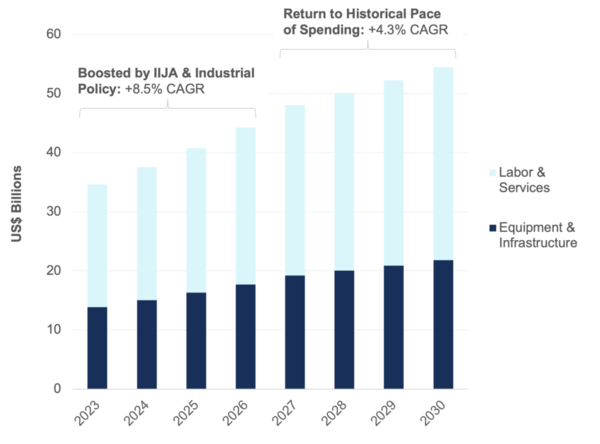
※참고 : 2023년 US 달러로 표시된 값[그림출처(picture source) = 블루필드 리서치(Bluefield Research)]
블루필드 리서치의 예측 방법론은 시장을 지자체, 교통, 상공업(commercial & industrial, C&I)의 세 가지 주요 최종 사용자 부문으로 구성한다. C&I 부문은 현재 전체 시장의 57%를 차지하고 있다.
에릭 빈들러(Eric Bindler) 수석이사 “주 및 지역 규정의 변화에 따라 민간 기업은 분산형 인프라를 구축하여 각자의 사무실 건물, 주차장, 제조시설의 현장 영향을 상쇄하고 있다”라면서 “특히 지방자치단체와 C&I 시설이 빗물관리 문제를 해결해야 함에 따라 제조된 빗물 저장 및 처리 시스템(예 : 현장 저장실, 유체역학적 분리기)에 대한 투자가 유치되고 있다”고 강조했다.
그는 이어 “해당 분야의 규모가 커지고 관련 과제가 늘어나면서 기존 업체와 신흥 솔루션 제공업체가 폭우관리 문제를 해결하기 위한 자리를 마련하고 있다”라면서 “솔루션은 배수구, 펌프, 챔버, 분산형 처리 시스템 등 전통적인 ‘회색 인프라(gray infrastructure)’부터 빗물 정원, 투과성 포장과 같은 대체 ‘녹색 인프라(green infrastructure)’ 솔루션과 최신 디지털 플랫폼까지 다양하다”라고 말했다.
시장의 선두에는 첨단 배수 시스템(Advanced Drainage Systems), 올드캐슬(Oldcastle), 노스웨스트 파이프(Northwest Pipe) 및 IPEX와 같은 인프라 및 장비 제공업체가 자리잡고 있다. 이들 기업은 수익 성장을 촉진하고 지리적 입지를 확장하기 위해 전략적 M&A를 추구하고 새로운 시장 기회(예 : 농업, 디지털)에 주목하고 있다.
전통적인 빗물관리에 대한 대체 접근 방식을 사용하는 다른 회사로는 녹색 인프라 시장에서 진전을 이루고 있는 트루그리드(TrueGrid), MKB 이노베이션(MKB Innovation) 및 인비시블 스트럭쳐스(Invisible Structures)와 같은 기업이 있다.
옵티RTC(OptiRTC), 2NDNATURE, 벤틀리 시스템(Bentley Systems) 및 오토데스크(Autodesk)는 디지털 렌즈를 통해 빗물관리 시장에 접근하고 있으며, 더욱 발전된 데이터와 사물 인터넷(IoT) 환경을 활용하여 보다 실시간으로 운영 결정을 내릴 방법을 모색하고 있다.
블루필드 리서치(Bluefield Research)의 에릭 빈들러(Eric Bindler) 수석이사는 “결론은 빗물관리가 지역사회, 인프라 및 생태계에 대한 잠재적 영향이 전국 모든 지역에서 명백하기 때문에 더 이상 지방자치단체 지도자와 부동산 소유자에게 사후 고려가 될 수 없다는 것”이라면서 “다행히도 이제 빗물은 정책 입안자, 지방 정부, 공급망으로부터 주목을 받고 있다”고 말했다.
[원문보기]
Climate Events, Construction Spend Drive U.S. Stormwater Market Forecast to US$54.5 Billion in 2030
21 June 2024, Boston, Massachusetts - Stormwater management in the U.S. is growing rapidly as an area of critical concern for municipalities, transportation departments, and property owners.
The increasing frequency and severity of climate events responsible for US$156.8 billion in damages since 2000, are driving the needed deployment of hardware, innovative solutions, and capital for U.S. stormwater infrastructure.
According to Bluefield Research’s report, “U.S. Stormwater Infrastructure Market: Key Drivers, Competitive Shifts & Investment Outlook, 2024-2030,” capital expenditures (CAPEX) for stormwater management in the U.S. are projected to grow from US$34.6 billion to US$54.5 billion between 2023 and 2030.
This represents a 6.7% compound annual growth rate. In the near-term this growth will be partly driven by federal infrastructure investment, including the Infrastructure Investment and Jobs Act.
“Stormwater infrastructure assets, which were designed to handle historical levels of precipitation, are increasingly insufficient to withstand the frequency and severity of today’s storms,” says Eric Bindler, Senior Director, Bluefield Research.
And climate events are on the rise. Since 2020, the U.S. has experienced an average of 22 ‘billion-dollar disasters’- or weather events causing at least US$1 billion in damages - each year, compared to an annual average of only three events per year in the 1980s, according to the National Oceanic and Atmospheric Administration.
When compared to investment in the drinking water and wastewater sectors, stormwater management and infrastructure has been largely overlooked and underfunded. Stormwater currently receives approximately 7.5% of total water sector funding across key sources, according to Bluefield’s analysis.
This disparity stems from stormwater’s complex, multijurisdictional patchwork of entities that share responsibility for stormwater-from utilities and public works departments to state transportation agencies - regional flood control districts, and private property owners.
“Without a clear champion and dedicated funding channels, both large and small communities are at greater risk of stormwater management issues, including flooding,” says Bindler.
The stormwater market outlook is shaped by the recent surge in public and private construction. New roadways, commercial and industrial facilities, and residential subdivisions are increasingly designed with stormwater infrastructure included, driving a surge of greenfield market activity for vendors and solutions providers.
However, the rapid construction boom in Sunbelt states including Arizona, Florida, Georgia, and Texas, is also contributing to the expansion of impervious surfaces (i.e., concrete, asphalt, and other surfaces that do not allow for water to seep into the ground), further exacerbating stormwater runoff and water pollution.
According to data from the United States Geological Survey, approximately 0.5% of the United States’ 3.5 million square miles of total land area are covered by parking lots alone?this is more land area than the state of Maryland.
These impervious surfaces exacerbate both flooding and water pollution issues as stormwater runoff has nowhere else to go. Nearly one-third of the nation’s 470,000 assessed water bodies are classified as impaired, with stormwater runoff - from urban areas, roadways, and agricultural operations - a leading contributor.
The underlying solution for stormwater management, to date, has been physical infrastructure (e.g., pipes, pumps, catch basins). Hardware and equipment account for roughly 40% of total stormwater CAPEX forecasts through 2030, scaling from US$13.8 billion in 2023 to US$21.8 billion in 2030. Labor and services (e.g., engineering, design, construction) make up the remaining 60% of stormwater CAPEX, according to Bluefield’s analysis.
Bluefield’s forecast methodology frames the market into three primary end-user segments: municipal, transportation, and commercial & industrial (C&I). The C&I segment currently represents 57% of the total addressable market.
“Private firms, driven by changing state and local regulations, are deploying decentralized infrastructure to offset onsite impacts from their respective office buildings, parking lots, and manufacturing facilities,” says Bindler. In particular, manufactured stormwater storage and treatment systems (e.g. on-site storage chambers, hydrodynamic separators) are attracting investment as municipal governments and C&I facilities are compelled to address stormwater management.
“Given the increasing scale of the sector and related challenges, a growing roster of incumbents and emerging solutions providers are carving out positions to address stormwater management.
The solutions range from traditional ‘gray’ infrastructure - drains, pumps, catch basins, chambers, and decentralized treatment systems - to newer digital platforms and alternative ‘green infrastructure’ solutions such as rain gardens and permeable pavement,” says Bindler.
At the leading edge of the market are established infrastructure and equipment providers, such as Advanced Drainage Systems, Oldcastle, Northwest Pipe, and IPEX. These players are pursuing strategic M&A and eyeing new market opportunities (e.g., agriculture, digital) to drive revenue growth and expand geographic footprints.
전통적인 폭우수 관리에 대한 대안적 접근 방식을 제시하는 다른 회사로는 TrueGrid, MKB Innovation, Invisible Structures 등이 있으며, 이들은 녹색 인프라 시장에서 큰 발전을 이루고 있습니다.
OptiRTC, 2NDNATURE, Bentley Systems, Autodesk는 디지털 관점에서 우수 관리 시장에 접근하여 더욱 진보된 데이터와 사물 인터넷(IoT) 환경을 활용하여 실시간으로 운영 결정을 내리고자 합니다.
"결론은 우수 관리가 더 이상 지방 지도자와 재산 소유자에게 뒷전이 될 수 없다는 것입니다. 왜냐하면 지역 사회, 인프라, 생태계에 미치는 잠재적 영향이 전국의 모든 지역에서 명백하기 때문입니다."라고 Bindler는 말합니다. "다행히도 우수는 이제 정책 입안자, 지방 정부, 공급망의 주목을 받고 있습니다."
[출처 = 블루필드 리서치(Bluefield Research) ( https://www.bluefieldresearch.com/ns/climate-events-construction-spend-drive-us-stormwater-market-forecast-to-us54-5-billion-by-2030/ ) / 2024년 6월 21일자 보고서]
|  즐겨찾기 추가
 시작페이지로 설정
























