[호주] 살충제 사용 급증 따른 식수를 안전하게 유지하기 위한 새로운 해결책 제안
지난 20년 동안 세계적으로 살충제 사용 62% 증가…상당수가 수로·하천·강에 유입되어 암 유발 우려 커져
남호주대·중국 시안건축기술대 물연구팀, 정을 개선하기 위한 일련의 실험 진행
PAC 입자를 기존 상업용 크기인 38㎛에서 6㎛로 줄이면 일반적인 살충제 6종 제거하는 데 분말이 최대 75% 적게 필요…상당한 수처리 절감 효과 얻을 수 있는 사실 발견
남호주 대학교와 중국 시안건축기술대학의 물 과학자들은 식수에서 유기 살충제를 제거하고 오염 위험과 잠재적인 건강 문제를 줄이는 보다 효과적인 방법을 제안했다. [사진출처(Photo source) = 남호주 대학교(University of South Australia)]
호주와 중국의 물 과학자들은 식수에서 유기 살충제(organic pesticide)를 제거하고 오염 위험과 잠재적인 건강 문제를 줄이는 보다 효과적인 방법을 제안했다.
지난 20년 동안 전 세계적으로 살충제(pesticide) 사용이 62% 증가하면서 이러한 화학물질 중 상당수가 수로나 하천·강 등에 유입되어 암을 유발할 수 있다는 우려가 커졌다.
분말 활성탄(Powdered activated carbon, PAC)은 현재 식수에서 유기 살충제를 제거하는 데 사용되지만 이 과정은 비용이 많이 들고 시간이 많이 걸리며 100% 효과적이지는 않다.
남호주대학교(University of South Australia)의 물연구원인 진밍 두안(Jinming Duan) 교수는 이전 박사 과정 학생인 시안건축기술대학(Xi’an University of Architecture & Technology)의 위리(Wei Li) 박사 및 중국 동료들과 협력하여 공정을 개선하기 위한 일련의 실험을 진행했다.
연구진은 PAC 입자를 기존 상업용 크기인 38㎛(100만분의 1m)에서 6㎛로 줄이면 일반적인 살충제 6종을 제거하는 데 분말이 최대 75% 적게 필요해 상당한 수처리 절감 효과를 얻을 수 있다는 사실을 발견했다.
6㎛의 PAC 입자는 흡착 공정 후에 걸러질 수 있을 만큼 충분히 크기 때문에 독성 살충제가 제거된 후에도 식수에 들어가지 않았다.
[그림 1] 6㎛의 BPAC는 입자의 침투를 억제하면서 살충제를 효과적으로 제거
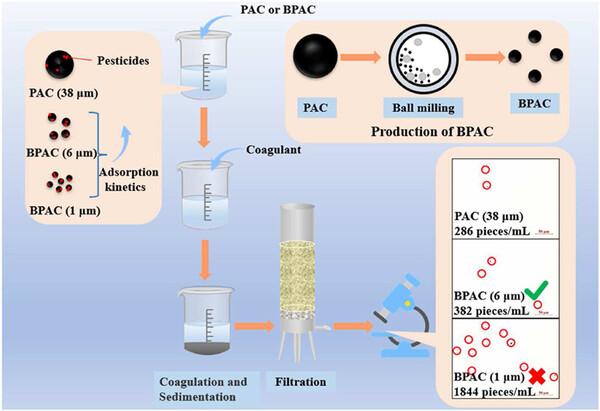
6㎛의 BPAC 입자는 흡착 공정 후에 걸러질 수 있을 만큼 충분히 크기 때문에 독성 살충제가 제거된 후에도 식수에 들어가지 않았다. [그림출처(picture source) = 『케스모피어(Chemosphere)』]
진밍 두안(Jinming Duan) 교수는 “세계 인구와 산업 발전이 성장함에 따라 향후 수십 년 동안 수로의 오염물질이 증가할 것으로 예상한다”라면서 “수로를 안전하게 유지하려면 비용 효율적인 처리 프로세스를 개발하는 것이 중요하다”고 말했다.
이들의 연구결과는 환경화학을 다루는 국제 학술지 『케스모피어(Chemosphere)』 최근호에 ‘기존 식수처리 공정에서 유기 살충제 제거를 위한 볼밀 분말 활성탄(BPAC)의 효과 및 타당성(The effectiveness and feasibility of ball-milled powdered activated carbon(BPAC) for removal of organic pesticides in conventional drinking water treatment process)’라는 제목으로 게재되었다.
두안 교수는“농약은 응집, 침전, 여과 등 기존의 수처리 공정으로는 제거할 수 없다. 분말 활성탄(PAC)은 그 역할을 수행하지만 기존 방법에는 한계가 있다. 우리의 연구를 통해 이 프로세스를 보다 효율적으로 만들 수 있는 방법이 밝혀졌다”고 역설했다.
스태티스타 리서치 부서(Statista Research Department)에 따르면 2021년 전 세계적으로 약 354만 톤의 농약이 농작물에 사용되었다.
걱정스럽게도 효율성을 높이려는 노력에도 불구하고 농약의 10%만이 목표 해충에 도달하는 것으로 추산되며, 대부분의 화학물질은 식물 표면에 남아 있거나 토양, 수로 및 대기를 포함한 환경에 유입된다.
독성학 연구에 따르면 주로 식사나 식수를 통해 낮은 수준의 살충제에 장기간 노출되면 암과 다른 질병의 위험이 증가할 수 있다고 경고했다.
두안 교수는 "이것이 가능한 한 낮은 수준으로 수준을 낮추는 것이 중요한 이유이다”라고 강조했다.
연구원들은 또한 건강에 해로운 영향을 미치는 많은 소비자 제품에서 발견되는 ‘영원한 화학물질’인 폴리플루오로알킬물질(polyfluoroalkyl substances, PFAS)과 과불화화합물(Perfluorinated compounds, PFCs)을 제거하기 위해 초미세 활성탄(super-fine activated carbon)을 사용할 수 있는 방법을 탐구하기를 희망하고 있다.
[원문보기]
New solutions to keep drinking water safe as pesticide use skyrockets worldwide
Water scientists from Australia and China have proposed a more effective method of removing organic pesticides from drinking water, reducing the risk of contamination and potential health problems.
A 62% rise in global pesticide use in the past 20 years has escalated fears that many of these chemicals could end up in our waterways, causing cancer.
Powdered activated carbon (PAC) is currently used to remove organic pesticides from drinking water, but the process is costly, time consuming and not 100% effective.
University of South Australia water researcher Professor Jinming Duan has collaborated with his former PhD student, Dr Wei Li of Xi’an University of Architecture & Technology and Chinese colleagues in a series of experiments to improve the process.
The researchers found that reducing the PAC particles from the existing commercial size of 38 μm (one millionth of a metre) to 6 μm, up to 75% less powder was needed to remove six common pesticides, achieving significant water treatment savings.
At 6 μm, the PAC particles are still large enough to be filtered out after the adsorption process, ensuring they do not end up in the drinking water after toxic pesticides are removed.
Prof Duan says pollutants in our waterways are projected to increase in coming decades as the world’s population and industrial development grows.
“It’s therefore critical that we develop cost-effective treatment processes to ensure our waterways remain safe,” he says.
Their findings have been published in the journal Chemosphere.
“Pesticides cannot be removed using conventional water treatment processes such as flocculation, sedimentation and filtration. Powdered activated carbon does the job, but the existing methods have limitations. Our study has identified how we can make this process more efficient.”
Approximately 3.54 million metric tons of pesticides were applied to agricultural crops worldwide in 2021, according to the Statista Research Department.
Worryingly, despite efforts to increase their efficiency, it is estimated that only 10% of pesticides reach their target pests, with most of the chemicals remaining on plant surfaces or entering the environment, including the soil, waterways and atmosphere.
Toxicological studies have suggested that long-term exposure to low levels of pesticides ? primarily through diet or drinking water - could increase the risks of cancer and other diseases.
“This is why it is important to reduce their levels to as low as feasibly possible,” Prof Duan says.
The researchers also hope to explore how super-fine activated carbon could be used to remove toxic polyfluoroalkyl substances (PFAS) and perfluorinated compounds (PFCs) found in many consumer products, which have been linked to adverse health impacts.
[출처 = 남호주대학교(University of South Australia)(https://www.unisa.edu.au/media-centre/Releases/2024/new-solutions-to-keep-drinking-water-safe-as-pesticide-use-skyrockets-worldwide)/2024년 7월 11일]
[연구논문 출처 = 『케스모피어(Chemosphere)』(https://www.sciencedirect.com/science/article/abs/pii/S0045653524011226?via%3Dihub) / 2024년 7월호]
|  즐겨찾기 추가
 시작페이지로 설정
























