미 오크릿지국립연구소(Oak Ridge National Laboratory, ORNL)가 에너지부(U.S. Department of Energy, DOE)를 위해 최근 작성한 `새로운 하천흐름 개발자원 평가 (New Stream-reach Development Resource Assessment)` 연구 보고서에 따르면 현재 댐(Dam)이 없거나 이를 발전할 수 있는 설비가 없는 지역의 수력발전 잠재력은 약 61 GW에 달하는 것으로 나타났다. 이번 평가에는 알래스카, 하와이 및 미 정부에서 보호하는 지역에 대해서는 제외하였다. ORNL이 예측하는 수력발전 자원은 EIA의 최근 Annual Energy Outlook 2014(AEO2014)에서 보여주었던 일반적 경우에 2040년까지 2 GW의 수력발전량 추가를 예상하고 있다. 두 보고서 간의 차이는 기술적 가능성과 경제성 및 운영 잠재력에 대한 차이가 있었기 때문이다.
ORNL의 연구진은 하천흐름에 대한 생태학적, 사회적, 문화적, 정책적, 법률적 제약사항을 공간적으로 연결하면서 지형학, 수문학(Hydrologic) 및 환경 데이터를 활용하여 각각의 하천흐름에 대한 에너지 밀도(Energy Density)를 평가하였다. 이번 보고서는 3 백만개 이상의 미국 내 물 흐름에 대해 기술적 자원 용량을 정량화하였으며, 투자의 적절성 판단 및 프로젝트 기반의 가능성 여부를 판단하기 위해 발전량, 비용, 가능성 등을 추정하기 위하여 정성화(Qualifying)하는 작업도 실시하였다.
수자원과 관련한 연구들은 일반적으로 자원의 분류에 따라 잠재적 수력발전용량을 예측하고 있다. 자원의 분류에는 1) 댐이 없는 미개발 지역(New Stream-reach), 2) 수력설비가 없어 발전으로 사용하지 않는 댐, 3) 발전용량을 추가할 수 있는 수력 설비 등이다. ORNL은 현재 개발되지 않은 지역에 대한 연구 이외에도 DOE 지원 하에 발전이 이루어지지 않는 댐에 대해서도 평가하였다. 이번 보고서에서 ORNL은 최대 12 GW의 추가 용량이 비-발전 댐(Nonpowered Dams)을 통해 기여할 수 있는 것으로 추정하였다. 또한 EIA의 AEO2014 보고서는 자원 분류 중 3번째에 해당하는 기존 수력설비에 1.4 GW의 용량 추가가 가능할 것으로 보았다.
수력자원 잠재력이 최대로 추가될 수 있는 용량을 정량화한 내용이지만 EIA AEO2014 보고서는 시장과 정책 관련 문제들이 신규 수력발전소 개발을 제한할 수 있다고 보았다. 여기에는 경제성, 성능 특성, 연방 규제, 전기 수요 및 다른 신규발전원과의 경쟁비용 등이 포함되어 있다. 그리고 수력발전은 이미 성숙단계에 접어든 기술이기 때문에 기술적으로나 경제성 면에서 우수한 지역은 이미 개발된 것으로 나타났다.
현재 EIA는 ORNL의 최근 데이터를 반영하지는 않고 있다. 그러나 AEO2014 보고서의 자원평가는 댐이 없는 미개발 지역과 비-발전 댐에 대한 가능성, 이들 데이터 간의 중복성을 고려하였다. EIA의 예측이 단기 및 중기적으로 개발되지 않은 수자원의 경제성이 그리 높지 않다고 보고있지만, 최근 ORNL 보고서는 수력발전의 기술적 가능성을 평가하고 해상에 위치하는 터빈(In-stream Turbines)과 같은 새로운 기술을 활용할 수 있는 자원에 대한 이해도를 제고할 수 있는 새로운 정보를 제공하고 있다.
[출처 = KISTI 미리안 『글로벌동향브리핑』/ 2014년 7월 16일]
[원문보기]
EIA Projections Show Hydro Growth Limited by Economics not Resources
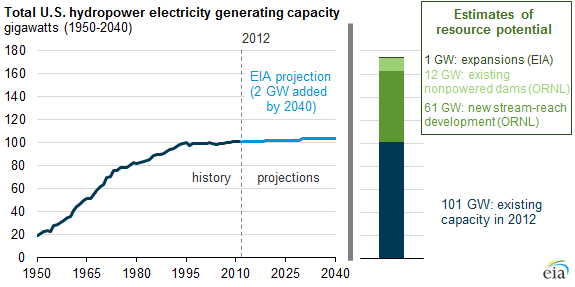
Source: U.S. Energy Information Administration, EIA-860, and the Oak Ridge National Laboratory (ORNL) Note: Capacity values prior to 1989 are estimates. Existing capacity includes conventional hydroelectric and pumped storage. New stream-reach developments are stream segments without an existing dam. Expansions add power to existing dams. Some expansions are included in the Annual Energy Outlook 2014 projections.
A recent study conducted by Oak Ridge National Laboratory (ORNL) for the U.S. Department of Energy, the New Stream-reach Development Resource Assessment, finds that 61 gigawatts (GW) of hydroelectric power potential exists at waterways without existing dams or diversion facilities. This value excludes Alaska, Hawaii, and federally protected lands.
ORNL's hydropower resource estimates contrast with the 2 GW of additional hydropower capacity projected to be added through 2040 in EIA's latest Annual Energy Outlook (AEO2014) Reference case. The difference in the two sets of numbers represents the significant gap between technical potential on the one hand and economic and operational potential on the other hand.
ORNL's assessment used topographical, hydropower, hydrologic, and environmental datasets to assess the energy density at stream reaches (segments), while spatially linking to each stream's respective ecological, social, cultural, policy, and legal constraints. The report quantified the technical resource capacity available at more than three million U.S. streams, qualifying its findings by saying "the methodology alone does not produce estimates of generation, cost, or potential impacts of sufficient accuracy to determine project-specific feasibility or to justify investments."
Hydro resource studies typically estimate potential hydropower capacity by resource class: undeveloped sites without dams (new stream reach); existing dams without hydroelectric facilities, or nonpowered dams (NPDs); and existing hydroelectric facilities with potential for additional generating capacity, all included in the chart above. In addition to its current study of undeveloped sites, in 2012 ORNL completed a DOE-sponsored assessment of NPDs. In that report, ORNL estimated that nonpowered dams could contribute as much as 12 GW of additional hydroelectric capacity. In addition to the first two resource classes, EIA's AEO2014 also considers 1.4 GW of potential from the third resource class—expansion of existing hydroelectric facilities.
Although resource potential quantifies maximum feasible capacity additions, EIA's AEO2014 Reference case also considers market and policy hurdles that can limit actual development of a new hydroelectric power plant. These include economic factors, performance characteristics, federal regulations, electricity demand, and the cost of competing sources for new generation. Because hydropower is a mature technology, most of the technically and economically superior sites have already been developed.
Current EIA projections do not reflect the recently released data from ORNL. However, the resource assessments for the AEO2014 Reference case do account for new stream-reach development and nonpowered dams potential and overlap between the two datasets is likely. Even though current EIA projections suggest that much of the undeveloped hydro resources may not be economic in the near- or mid-term, the latest ORNL report provides new information to assess the technical potential of hydropower and improve the understanding of resources that can take advantage of new technologies such as in-stream turbines.
 즐겨찾기 추가
 시작페이지로 설정























 미 오크릿지국립연구소(Oak Ridge National Laboratory, ORNL)가 에너지부(U.S. Department of Energy, DOE)를 위해 최근 작성한 `새로운 하천흐름 개발자원 평가 (New Stream-reach Development Resource Assessment)` 연구 보고서에 따르면 현재 댐(Dam)이 없거나 이를 발전할 수 있는 설비가 없는 지역의 수력발전 잠재력은 약 61 GW에 달하는 것으로 나타났다. 이번 평가에는 알래스카, 하와이 및 미 정부에서 보호하는 지역에 대해서는 제외하였다. ORNL이 예측하는 수력발전 자원은 EIA의 최근 Annual Energy Outlook 2014(AEO2014)에서 보여주었던 일반적 경우에 2040년까지 2 GW의 수력발전량 추가를 예상하고 있다. 두 보고서 간의 차이는 기술적 가능성과 경제성 및 운영 잠재력에 대한 차이가 있었기 때문이다.