먼지 폭풍, 화산 폭발 및 허리케인은 모래, 검댕이 및 염(salt) 입자를 대기로 보내는 역할을 한다. 이런 입자들은 지구를 가열하고 냉각하는 기후 사이클에 영향을 미친다. 발생원이 확실하지 않은 에어로졸(aerosol)도 이런 사이클에 영향을 미친다. 그러나 거의 추적하기 어려운 물질들은 대기 중에 새로운 입자들을 생성시킨다. 이렇게 새로 생성된 입자들과 구름 형성에 미치는 영향은, 기후모델을 개선하기 위한 핵심 인자이다. 최근 과학자들은 실험실이나 야외에서 이런 에어로졸을 정확히 추적할 수 있는 방법에 대해 논의하였다.
이런 새로운 입자들이 어떻게 형성되고 성장하고 구름의 형성을 촉진하는지에 대한 정확한 과정은 아직 수수께끼로 남아있다. 정교해진 기기들 덕분으로 과학자들은 이런 전환에 대한 새로운 정보를 확보해 가고 있다. 또한 이론적 모델과 실제 현장에서 큰 차이가 존재한다는 것도 지적되고 있다.
핵형성(nucleation)이 대기 입자의 중요한 근원이라는 사실이 발견된 것은 20년도 더 되었다. 그때 이후로 이런 생성 과정의 물리화학적 과정을 밝히려는 노력이 있었다. 이론 모델에 의해 예측되는 것과 대기 중에서 관찰되는 속도의 차이를 줄이는 것이 목표이며, 이로써 더 신뢰성 있는 기후 모델의 탄생이 가능해진다.
지난 15년 동안 대기 에어로졸 화학자인 Alexander Laskin 등은 채취한 입자 샘플을 분석하기 위해 EMSL의 독특한 화학분석설비를 이용하였다. 입자의 조성, 성질을 탐지하기 위한 다양한 미량분석, 현미경, 분광기 및 질량분석기(mass spectrometry)를 포함한 화학영상 기술들이 개발되었다. 그러나 기존의 어떤 한 가지 방법만으로는 필요한 모든 정보를 얻을 수 없다.
동일한 샘플에 대해 복합(multi-modal) 분석이 가능하다는 것은 EMSL의 강점이다. Laskin 등은 구름의 얼음 핵을 형성하는 에어로졸의 물리적 화학적 성질을 이해하기를 원했다. 비록 얼음 핵형성에 대한 연구가 20년 이상 진행되어 왔지만, 그 과정의 대부분은 아직 밝혀지지 않았다.
내재적인 과학적 문제는 반응이 어떻게 발생하고 입자의 표면이 어떤 역할을 하는냐는 것이다. 질량분석기를 통해 어떤 종류의 분자들이 에어로졸에 존재하는지 밝혀낼 수 있지만, 입자 표면에 어떻게 배열되어 있는지는 알지 못한다. 이 표면 구조를 확인하기 위해, 연구팀은 다른 기기보다 해상도가 10배 뛰어난 독특한 HR-SFG(high-resolution sum frequency generation)를 개발하여 표면 입자 반응을 확인할 수 있도록 하였다. 이 정도의 해상도는 에어로졸 광화학 연구에 중요한 영향을 미친다.
에어로졸 연구는 기존에 사용된 적이 없었던 기기를 출현시키고 있다. 과거에는 에어로졸 입자를 위한 필터 포집 방법과 작은 샘플 크기는 핵자기공명이나 분광학적 방법과 같은 분석법을 통해 좋은 결과를 얻을 수 없었다. 그러나 최근 매우 소량을 분석하는 핵작기공명 분석기를 개발하고 있다. 연구팀은 1년 이내에 이 장치를 사용할 수 있을 것으로 기대하고 있다.
또 다른 기술은 이미 유용함이 증명된 APT(atom probe tomography)이다. APT는 단일 에어로졸 입자에서 서브 나노미터의 공간 해상도로 3차원적으로 성분들의 분포를 시각화할 수 있을 것으로 기대되고 있다.
에어로졸은 매우 작은 입자이다. 때문에 작은 입자의 복잡한 연관성을 반영하여 모델에 반영하는 것이 쉽지가 않다. 때문에 반복된 실험을 통해 정확한 에어로졸 예측이 가능하도록 할 필요성이 있다. 예를 들어 연구팀의 모델은 구 형태의 입자를 기초로 하고 있다. 그러나 연구에 따르면 입자의 형상은 변화한다. 만약 이런 사실이 중요하다면 시간에 따라 어떻게 변화하는지 알 필요성이 있으며, 모델의 한 요소로 포함시켜야 할 것이다.
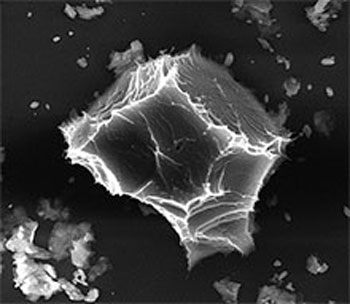
그림 1>미네랄 먼지 입자 샘플 위에서 영하 섭씨 37도에서 얼음 결정이 형성된 주사전자현미경 사진 그림 2>많은 형태와 혼합상을 가지는 에어로졸 입자들
[출처 = KISTI 미리안 『글로벌동향브리핑』/ 2014년 7월 4일]
[원문보기]
Designing new ways to probe aerosols for more accurate climate models
Dust storms, volcanic eruptions and hurricanes are tangible events that send particles of sand, soot and salt into the atmosphere. These particles can alter the climate cycles that heat and cool the Earth. Less obvious sources of aerosols affect these cycles, too; the sea salt sprayed off breaking waves or volatile organic compounds emitted from trees. But nearly untraceable chemical transformations also lead to the birth of new atmospheric particles. Accounting for these newborn particles and their role in cloud formation is key to improving climate models.
Scientists recently gathered at EMSL to discuss ways to more accurately chronicle the clandestine lives of these aerosols in the lab and the field.
The precise processes that govern how new particles are created out of vapor, then grow and nucleate clouds – enticing other organic molecules into chemical reactions – largely remains a mystery. Increasingly sophisticated instruments provide scientists with new details about these transformations; they also point out big gaps between theoretical models and field findings.
An environmental scanning electron microscopy image of an ice crystal nucleated at minus 37 C over a sample of mineral dust particles imaged in-situ using an experimental platform being developed by Bingbing Wang, an EMSL postdoc, to visualize ice nucleation.
“We discovered nucleation is an important source of atmospheric particles more than 20 years ago. And ever since we’ve been trying to figure out the chemical and physical processes that lead to their creation,” says Peter McMurry, a professor at the University of Minnesota. “The goal is to achieve closure between the rates observed in the atmosphere and those predicted by models. This will lead to more credible climate models. Right now we can’t do that.”
In the Beginning
Part of the problem is catching the particles in the act of doing whatever it is they do. Researchers spend weeks in the field stalking new particle formation events. With little lead time the particles are born. Within a few hours they grow to sizes large enough to serve as cloud condensation nuclei, sending a brief bloom of data across suites of specialized sampling instruments. “It’s a challenge,” says McMurry. “Some of the species that lead to particle formation are found in almost unimaginably low concentrations. Sometimes it’s like trying to pick out one person in a thousand or a million Earths.” Conceptual artwork illustrating an ice nucleation experimental platform under development by Bingbing Wang, an EMSL postdoctoral researcher.
From Field to Lab: An Inside Job
For the last 15 years Alexander Laskin, an atmospheric aerosol chemist at EMSL, and collaborators have been using the unique analytical chemistry capabilities of EMSL on particle samples collected from test facilities, laboratory studies and far-flung field sites. A variety of off-line chemical imaging techniques have been advanced at EMSL – including mass spectrometry, spectroscopy, microscopy and microanalysis methods – to probe the composition and properties of these particles. But there’s no single technique in existence that gives us all the information we need to know. says Laskin"
The ability to run multi-modal analyses on the same sample is a particular strength at EMSL.
But even interrogating particles with multiple techniques can’t answer some of the pressing questions. So EMSL researchers are devising new strategies in collaboration with scientists across the country.
Laskin and his colleagues want to understand the physical and chemical properties of aerosols that nucleate ice clouds. Although ice nucleation has been studied for more than two decades, much about the process remains unknown.
“In the traditional view of ice nucleation events, there are very few particles in the atmosphere with the right properties to become ice nuclei,” says Laskin. “But now there’s growing evidence that’s not always case,” he says.
“Particles with mediocre ice nucleation propensity – but present at high number concentrations – can play an equivalently important role. So the big question is how to delineate the two scenarios: Under which conditions would different nucleation particles prevail?”
It would be easier to figure out if they could visualize nucleation events, says Bingbing Wang, a postdoctoral researcher at EMSL.
To see which individual particles nucleate ice first, he started a project coupling ice nucleation experiments with scanning electron microscopy, complemented with particle spectro-microscopy. Then he can probe the composition of the instigating particles. “From that knowledge we can achieve better understanding of heterogeneous ice nucleation. Then with further data analysis we can provide better parameterizations for cloud and climate models,” says B. Wang.
The study involves a group of Pacific Northwest National Laboratory experts in collaboration with Daniel Knopf of Stony Brook University and Mary Gilles at Lawrence Berkeley National Laboratory.
An Outside Approach
Another way to analyze these perplexing particles is to look at them one by one. To accomplish this, transmission electron microscopy, or TEM, is the technique of choice for Peter Buseck, a professor at Arizona State University who attended the recent user meeting at EMSL. “We want to know the intimate details about these aerosol particles,” he says. “TEM has been used on a larger scale, but now the technique is needed on a nanometer scale because there’s a whole range of particle sizes in the atmosphere.”
Although Buseck already has the TEM capabilities he needs, EMSL could devise novel ways to combine electron microscopy with instruments such as the helium ion microscope in EMSL’s Quiet Wing. No one’s doing that now with aerosols, says Buseck.
Probing the Surface
It’s not just the particles that need to be accounted for.
“An intrinsic scientific problem is how reactions occur and the particle surface is key for those. From mass spectrometry you can find out what kind of molecules are in aerosols, but you don’t know how they are arranged on the particle surface,” says Hongfei Wang, a chief scientist at EMSL.
To get at the structure of the surface, in 2011 H. Wang and his colleagues developed a unique high-resolution sum frequency generation, or HR-SFG, spectrometer to discern surface particle reactions with a resolution 10 times better than any other instruments out there.
That kind of resolution was critical for Sergey Nizkorodov who studies aerosol photochemistry in his laboratory at the University of California at Irvine and then sends samples to H. Wang for high-resolution studies at the surface.
"We want to be able to detect minor species that might be important for controlling reactions,” says H. Wang. “We’ve improved resolution, but the sensitivity of the signal needs to be improved for field measurements. It’s possible – but will take at least several years. It will be a real milestone to do this.”
Another pioneer in applying SFG spectroscopy to aerosol particles is Franz Geiger of Northwestern University. After meeting H. Wang at an American Chemical Society conference two years ago, he started using the high-resolution instrument to study alpha-pinene, one of the main components of secondary organic aerosol particles. EMSL’s HR-SFG gave Geiger a significant improvement in his analytics, getting resolution from standard values of about 10 wave numbers down to 0.6 wave numbers.
To bridge the gap between particle analysis in the lab and the field, Geiger is working with Northwestern colleague Regan Thomson, Victor Batista of Yale University and Scot Martin at Harvard University on an EMSL user project and with matching funds from Northwestern (and he hopes, the National Science Foundation).
Geiger is focused on the organic emissions of trees, namely pinene, that react with ozone at the ground level. The resulting cascades of reactions create aerosols that can interact with water vapor and ultimately make clouds. The questions he wants to answer are: Will future, possibly warmer, climates lead to faster emission rates of pinene over the Northern hemisphere? And if more organic particles form, potentially leading to more clouds, would this cause a negative feedback mechanism to cool our planet?
The answers to how these particles form will be found on their surfaces, thinks Geiger.
But it’s hard to analyze what’s never been identified before. So the collaborators are creating synthetic compounds they surmise could be created when pinene reacts with ozone and are also surface reactive. By analyzing the chemical signatures of these lab-made components they’ll build a reference library to help identify the unknown surface components they discover on these particles.
"There’s no silver bullet," says Geiger. "But more current tools will give us a more complete understanding.”
Helping Solve Problems
Aerosol research may also get a boost with instruments that haven’t traditionally been used for studies in this field. In the past, the tiny sample sizes and filter collection methods for aerosol particles have hampered efforts to use analytic techniques such as nuclear magnetic resonance, or NMR, spectroscopy. But at the recent EMSL user meeting, NMR lead scientist Karl Mueller told researchers they’re building smaller and better tools to aid aerosol research.
“NMR is phenomenal for determining chemical structure,” says Nancy Washton, the capability lead for EMSL’s NMR group. “But it’s considered an insensitive technique because it requires such a large sample size – I want a vial full of stuff, about 20 milligrams.”
Now Mueller and Washton are working with a team of scientists to make very small volume NMR detectors. “We’re combining our abilities as ‘spin jocks’ with miniaturization and microfabrication capabilities to work with picoliter amounts more suitable for aerosol studies. Success here would be a real breakthrough,” says Mueller.
Washton anticipates they’ll be able to run aerosol samples within the year. The possibilities have already enticed collaborators to send samples and she thinks NMR will be very useful for scientists who are synthetically producing atmospheric molecules.
Another technique that might prove useful is atom probe tomography, or APT. EMSL Scientist Arun Devaraj thinks APT could provide a way to visualize the three-dimensional element distribution within a single aerosol particle at sub-nanometer spatial resolution.
“Even if a potential user doesn’t quite know what capabilities they need, the staff at EMSL can discuss their needs and provide guidance,” says Alex Guenther, the lead scientist for atmospheric aerosol science at EMSL. The staff will make extraordinary efforts to understand what scientists need for their research and how the laboratory’s capabilities can be applied to answer their scientific questions, he says.
Although new tools are nice, Nicole Riemer, a computer modeler at Illinois University, thinks researchers may squeeze more information out of the tools already on hand.
“As modelers, we are using different tools from the researchers in the lab who measure these things,” says Riemer. “But we’re trying to solve the same problems.”
The aerosols are really, really small. So it’s difficult to develop equations that reflect the complexity of those minuscule – but critical – interactions without bogging down the ability to scale up to global proportions. Riemer believes careful, repeated experiments under varied conditions, using the equipment already in EMSL laboratories, can provide key details needed to derive more accurate aerosol predictions.
 즐겨찾기 추가
 시작페이지로 설정























 먼지 폭풍, 화산 폭발 및 허리케인은 모래, 검댕이 및 염(salt) 입자를 대기로 보내는 역할을 한다. 이런 입자들은 지구를 가열하고 냉각하는 기후 사이클에 영향을 미친다. 발생원이 확실하지 않은 에어로졸(aerosol)도 이런 사이클에 영향을 미친다. 그러나 거의 추적하기 어려운 물질들은 대기 중에 새로운 입자들을 생성시킨다. 이렇게 새로 생성된 입자들과 구름 형성에 미치는 영향은, 기후모델을 개선하기 위한 핵심 인자이다. 최근 과학자들은 실험실이나 야외에서 이런 에어로졸을 정확히 추적할 수 있는 방법에 대해 논의하였다.