[미국] 글로벌 물산업 위한 생성형 AI(GenAI) 역할
생성형 AI가 물산업 분야 지원하는 ‘WRF(워터 리서치 파운데이션) 프로젝트 5321’ 개발
실질적인 활용 사례, 책임감 있는 도입, 상하수도 운영기관서 얻은 교훈에 초점 맞춘 글로벌 연구 프로젝트
미국수도협회(AWWA)·물환경연맹(WEF)·카무스 에드워즈 컨설팅 및 전 세계 22개 상하수도 운영기관 등이 지원
생성형 AI, 이미 조직이 정보 찾고, 데이터 분석하며, 구성원들을 지원하는 방식을 변화시키고 있어
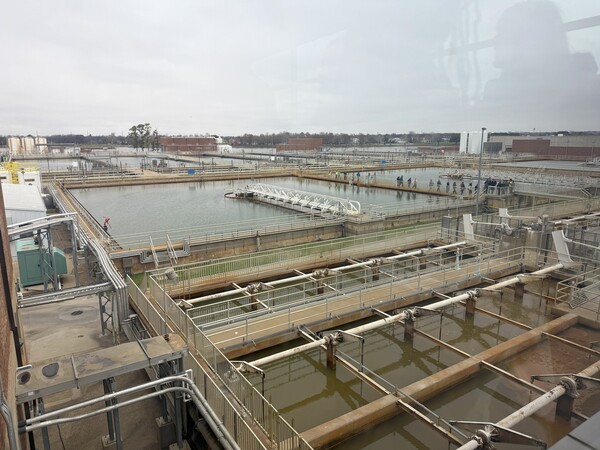
글로벌 물산업을 위한 생성형 AI(GenAI)의 역할’을 하는 ‘WRF 프로젝트 5321’ 이 미국 물환경연맹(WEF), 미국수도협회(AWWA), 카무스 에드워즈 컨설팅(Karmous Edwards Consulting) 및 전 세계 22개 수도·하수도 운영 기관의 지원을 받아 개발되었다. [사진출처(Photo source) = 미국수도협회(AWWA)]
생성형 인공지능(Generative AI)은 이미 조직이 정보를 찾고, 데이터를 분석하며, 구성원들을 지원하는 방식을 변화시키고 있다.
그렇다면 매일 상수도 및 하수도 시스템을 운영하는 실무자들에게 생성형 AI는 어떤 의미를 가질까?
‘워터 리서치 파운데이션(The Water Research Foundation, WRF)’이 무료로 공개한 보고서는 물산업 전반에서 확인된 20가지 이상의 실제 활용 사례를 통해 이 질문에 대한 답을 제시한다.
WRF 프로젝트 5321의 ‘글로벌 물산업을 위한 생성형 AI(GenAI) 역할’은 미국 물환경연맹(Water Environment Federation, WEF), 미국수도협회(American Water Works Association, AWWA), 카무스 에드워즈 컨설팅(Karmous Edwards Consulting) 및 전 세계 22개 상수도·하수도 운영 기관의 지원을 받아 개발되었다.
이 보고서는 다양한 규모의 운영 기관들이 도입 과정, 데이터 거버넌스, 인력 교육, 보안, 그리고 공정한 접근성을 고려하면서 어떻게 생성형 AI를 실험해 볼 수 있는지 탐구한다.
빠르게 발전하는 기술을 실질적인 지침으로 전환
이 프로젝트는 지방자치단체의 상수도 및 하수도 운영기관(Utility)들이 생성형 AI와 공개형 거대 언어 모델(LLM)을 이해하기 위한 공통의 기반을 마련하도록 돕기 위해 기획되었다.
보고서는 △검색 증강 생성(RAG), △에이전트형 AI(Agentic AI), △비정형 데이터, △광학 문자 인식(OCR), △음성 기반 애플리케이션, △컴퓨터 비전과 같은 핵심 개념을 설명하고, 이를 실제 운영 기관의 사례들과 연결한다.
또한, 생성형 AI 도입을 시작하려는 기관들을 위한 지침을 제공하고 향후 연구를 위한 로드맵을 제시한다. 이 프로젝트의 목표는 단순히 새로운 기술 하나를 소개하는 데 그치지 않는다.
오히려 운영 기관들이 생성형 AI에 대한 인식을 높이고, 지식을 공유하며, 책임감 있게 아이디어를 시험해 보고, 효율성과 운영 성과를 개선할 수 있는 활용 방안을 찾도록 돕는 것이다.
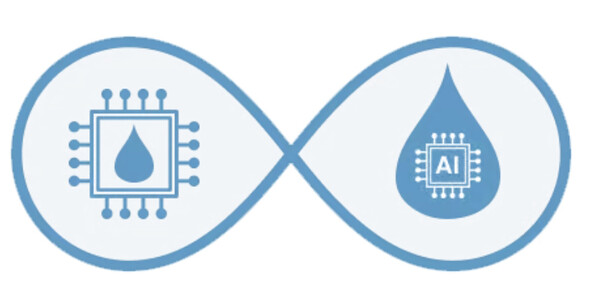
지속 가능한 관리와 디지털 인프라는 서로를 강화하여 긍정적인 결과를 가져올 수 있다고 믿는다. 목표는 AI 인프라가 물을 최대한 효율적으로 사용하도록 보장하는 'AI를 위한 물(Water for AI)'과 AI 기술을 활용하여 시급한 물 부족 문제와 물 관리 과제를 해결하는 '물을 위한 AI(AI for Water)' 등 두 가지이다. [그림출처(picture source) = 워터 AI 넥서스(Water-AI Nexus™)]
현장에서 생성형 AI가 활용되는 모습
■ 운영자를 지원하는 지속적인 모니터링
미국 버지니아주의 햄튼 로즈 위생 구역(Hampton Roads Sanitation District)에서는 하수도 시설 전반에서 배관 외부 누수, 부식, 사람의 출입, 연기, 화재 등을 감지하기 위한 컴퓨터 비전 프로토타입이 개발되고 있다.
이 기술의 목적은 운영자의 현장 순찰을 대체하는 것이 아니라, 지속적인 모니터링과 적시 알림을 통해 이를 보완하는 것이다. 초기 단계에서는 현장 적용이 가능한 데이터셋(Dataset) 구축, 분류 및 이상 징후 탐지 모델 개발, 그리고 기존 운영 시스템과의 연동 가능성을 검토하는 데 집중하고 있다.
실험실에서 장갑을 벗지 않고도 절차에 접근하기
캘리포니아 남부 오렌지 카운티 하수처리국(South Orange County Wastewater Authority)에서는 실험실 기술자를 위한 음성 인식 AI 비서인 '보이스 표준작업 절차(Voice SOP)'를 검토하고 있다.
이 도구를 사용하면 직원들은 장갑을 벗지 않고도 표준 작업 절차(Standard Operating Procedures, SOP)를 검색하고 들을 수 있다. 수동 작업을 줄임으로써 시간을 절약하고, 정확한 절차 준수를 지원하며, 장갑 착용이 제한된 환경에서 작업 흐름을 개선할 수 있다.
■ 책임 있는 도입을 위한 공동의 길
이 프로젝트는 또한 두 가지 광범위한 분야별 우선순위, 즉 지속 가능하고 회복력 있는 물의 미래를 위한 AWWA의 ‘Water 2050 비전’과 물 순환 전반에 걸쳐 자원의 절감, 회수 및 재생을 강조하는 WEF의 순환 물 경제 이니셔티브를 연결한다.
이러한 관점들은 기술이 사람을 지원하고, 분야 목표를 달성하며, 신중하게 도입될 때 가장 큰 가치를 창출한다는 핵심 메시지를 강화한다.
WRF 프로젝트 5321
‘WRF 프로젝트 5321(Water Research Foundation Project 5321)’은 기본 지침과 실제 운영 사례를 결합하여 물 전문가들에게 실질적인 출발점을 제공한다. 이 보고서는 GenAI가 어떤 분야에 적용될 수 있는지, 그리고 책임감 있는 구현을 위해 무엇이 필요한지 알아보고자 하는 유틸리티(Utility) 회사들이 무료로 이용할 수 있는 공개 자료이다.
WRF 프로젝트 5321이 ‘글로벌 물산업 분야에서의 생성형 AI(GenAI)의 역할’은 미국수도협회(AWWA), 물환경연맹(WEF), 카무스 에드워즈 컨설팅(Karmous Edwards Consulting)의 연구진이 협력하여 수행하는 프로젝트이다.
이 프로젝트는 공공 대규모 언어 모델(LLM)을 기반으로 한 생성형 AI가 지자체 상수도 및 하수도 유틸리티(운영 기관)에서 어떤 역할을 할 수 있는지에 대한 기초적인 이해를 구축하는 것을 목표로 한다.
이 프로젝트는 물산업 전반의 주요 이니셔티브들을 연결한다. 지속 가능하고 회복력 있는 물의 미래를 위해 혁신을 추진하는 AWWA의 ‘Water 2050’ 비전을 뒷받침하는 동시에, 물 순환 전반에 걸쳐 자원의 절감, 회수, 재생을 강조하는 WEF의 ‘순환 물 경제(Circular Water Economy)’ 이니셔티브와도 맥을 같이 한다. 이러한 관점들을 통합함으로써, ‘WRF 프로젝트 5321’은 물산업의 지속적인 발전과 미래의 도전 과제에 대응할 수 있는 역량 강화에 기여한다.
이 연구 프로젝트는 지자체 상수도 및 하수도 유틸리티가 생성형 AI/LLM을 도입하고 이를 통해 가치를 창출할 수 있도록, 관련 인식을 높이고 지식을 공유하며 실험을 촉진하는 것을 목표로 한다. 또한, 효율성과 운영 성과를 개선하기 위한 생성형 AI/LLM의 실질적인 활용 방안을 탐구한다.
이 프로젝트의 네 가지 주요 목표는 다음과 같으며, 이를 통해 유틸리티 기관들이 생성형 AI/LLM 기술에 대한 기초적인 이해를 갖추도록 돕는다.
· 공통 용어 체계 및 정의 구축 검색 증강 생성(RAG), 에이전트형 AI(Agentic AI), 비정형 데이터의 역할, 데이터 정제 및 분석, 광학 문자 인식(OCR), 음성 기반 애플리케이션, 컴퓨터 비전 등 핵심 개념을 탐구한다.
· 실질적인 활용 사례 발굴 공개된 오픈 소스 LLM을 활용하여, 잘 정리된 사례 연구(Use cases)를 통해 생성형 AI/LLM의 실질적인 적용 방안을 제시한다.
· 유용한 가이드라인 개발 전 세계 물 관련 유틸리티 기관들이 생성형 AI를 도입하고 활용하는 과정에서 참고할 수 있는 유용한 지침을 마련한다.
· 연구 로드맵 수립 물산업 분야에서 생성형 AI/LLM이 향후 어떤 역할을 할 수 있을지에 대한 연구 로드맵을 개발한다.
AI 개념 및 정의
‘WRF 프로젝트 5321’은 생성형 AI(GenAI) 및 거대언어모델(LLM)에 관한 정보를 공유함으로써 물 분야 전문가들의 인식을 제고하는 것을 핵심 목표로 한다. 이 프로젝트는 챗GPT(ChatGPT)-5, 클로드(Claude), 제미나이(Gemini) 등 대중이 이용 가능한 LLM 기반의 기존 생성형 AI 도구들을 어떻게 안전하고 효과적으로 활용할 수 있는지 보여준다.
연구팀은 정기적인 지식 교류, 웨비나, 워크숍을 통해 생성형 AI와 LLM이 일상적인 운영을 지원하고, 업무 흐름을 최적화하며, 의사결정을 강화하는 데 어떻게 기여할 수 있는지에 대한 통찰을 얻었다.
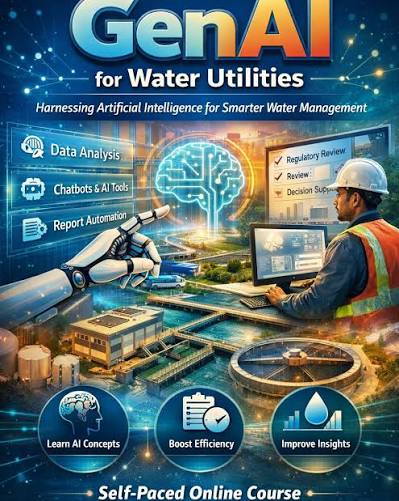
생성형 AI, 이미 조직이 정보 찾고, 데이터 분석하며, 구성원들을 지원하는 방식을 변화시키고 있다. 워터 타워(The Water Tower)는 지지 카무스-에드워즈(Gigi Karmous-Edwards, Karmous Edwards Consulting)와 리사 하니(Lisa Haney, Blue Bridge Strategies LLC)와 협력하여 상수도 사업자를 위한 생성형 AI(Generative AI)에 초점을 맞춘 새로운 자율 학습 과정을 개발했다. [사진출처(Photo source) = 워터 타워(The Water Tower)]
생성형 AI(GenAI)는 단순히 기존 데이터셋에서 데이터를 분류하거나 이미 존재하는 정보를 바탕으로 질문에 답하는 것을 넘어, 새로운 콘텐츠를 생성할 수 있는 인공지능(AI) 모델의 한 유형을 의미한다. 이러한 모델은 학습한 패턴과 예시를 바탕으로 텍스트나 기타 형태의 미디어로 새로운 콘텐츠를 만들어낼 수 있다.
인공지능(AI)은 컴퓨터 과학의 광범위한 분야로, 일반적으로 인간의 지능이 필요한 작업을 수행할 수 있는 지능형 기계를 개발하는 데 중점을 둔다. 이러한 작업에는 문제 해결, 패턴 인식, 의사결정, 언어 이해 등이 포함된다.
AI는 머신러닝(Machine Learning), 딥러닝(Deep Learning), 자연어 처리(Natural Language Processing), 트랜스포머(Transformer) 아키텍처 기반의 LLM 등 다양한 하위 분야를 포괄하며, 각 분야는 자동화와 지능형 컴퓨팅의 발전에 기여하고 있다.
[원문보기]
From Possibility to Practice: How Generative AI Could Support the Water Sector
A global research project focused on practical applications, responsible adoption, and lessons from utilities
Generative artificial intelligence is already changing how organizations find information, analyze data, and support their teams.
But what could it mean for the people who operate water and wastewater systems every day? A freely available report from The Water Research Foundation (WRF) begins to answer that question with more than 20 real-world use cases from across the sector.
WRF Project 5321, The Role of Generative AI (GenAI) for the Global Water Sector was developed with support from the Water Environment Federation (WEF), and the American Water Works Association (AWWA), Karmous Edwards Consulting, and 22 global utilities.
The report explores how utilities of different sizes can experiment with GenAI while keeping implementation, data governance, workforce training, security, and equitable access in view.
Turning a fast-moving technology into practical guidance
The project is designed to help municipal water and wastewater utilities build a shared foundation for understanding GenAI and public large language models.
It explains essential concepts-including retrieval-augmented generation, agentic AI, unstructured data, optical character recognition, voice applications, and computer vision?then connects those concepts to documented utility use cases.
Just as important, the research offers guidance for utilities beginning their GenAI journey and outlines a roadmap for future research. Its goal is not simply to introduce another technology. It is to help utilities increase awareness, share knowledge, test ideas responsibly, and identify applications that can improve efficiency and operational outcomes.
What GenAI can look like on the ground:
Continuous monitoring that supports operators
At Hampton Roads Sanitation District in Virginia, a computer-vision prototype is being developed to detect conditions such as leaks outside pipes, corrosion, human presence, smoke, and fire across wastewater facilities.
The goal is to supplement?not replace?operator shift rounds with continuous monitoring and timely alerts. Early work is focused on site-ready datasets, classification and anomaly-detection models, and potential connections to existing operations.
Hands-free access to procedures in the lab
At the South Orange County Wastewater Authority in California, Voice SOP is being explored as a voice-activated AI assistant for laboratory technicians. The tool would allow staff to retrieve and hear standard operating procedures without removing their gloves. By reducing manual interruptions, the approach could save time, support accurate procedure adherence, and improve workflows in glove-restricted environments.
A shared path toward responsible adoption
The project also connects two broader sector priorities: AWWA’s Water 2050 vision for a sustainable and resilient water future and WEF’s Circular Water Economy initiative, which emphasizes reducing, recovering, and regenerating resources across the water cycle. Together, these perspectives reinforce a central message: technology creates the most value when it supports people, advances sector goals, and is introduced with care.
By pairing foundational guidance with examples from utility operations, WRF Project 5321 gives water professionals a practical place to start. The report is now available as a free, publicly accessible resource for utilities ready to explore where GenAI may fit-and what responsible implementation should require.
Executive Summary
The Water Research Foundation (WRF) project 5321, The Role of Generative AI (GenAI) for the Global Water Sector, brings together researchers from the American Water Works Association (AWWA), Water Environment Foundation (WEF), and Karmous Edwards Consulting to build a foundational understanding of the role that GenAI powered by public large language models (LLMs) could play for municipal water and wastewater utilities.
The project connects major sector-wide initiatives. It supports AWWA’s Water 2050 vision of advancing innovation for a sustainable and resilient water future, while also aligning with WEF’s Circular Water Economy initiative, which emphasizes reducing, recovering, and regenerating resources across the water cycle. By integrating both perspectives, WRF project 5321 contributes to the water sector's ongoing evolution and its ability to meet future challenges.
This research project aims to increase awareness, share knowledge, and facilitate experimentation with GenAI/LLMs to support municipal water and wastewater utilities in adopting and gaining value from GenAI/LLMs. This project explores practical applications of GenAI/LLMs to improve efficiency and operational outcomes.
The four objectives of this project are to help utilities develop a foundational understanding of GenAI/LLMs techniques by:
- Building a common vocabulary and definition of terms. The project explores key concepts such asretrieval augmented generation (RAG), Agentic AI, the role of unstructured data, data cleansing andanalytics, optical character recognition (OCR), voice applications, and computer vision
- Identifying practical applications of GenAI/LLMs using available public and open source LLMs viawell-documented use cases.
- Developing useful guidelines for global water utilities on their GenAI journey.
- Developing a research roadmap for the future role of GenAI/LLMs in the water sector.
AI Concepts and Definitions
At its core, WRF project 5321 will share information about GenAI/LLMs to raise awareness among water professionals showcasing how existing GenAI tools powered by public facing LLMs such as ChatGPT-5, Claude, Gemini, etc., can be safely and effectively leveraged.
Through regular knowledge exchanges, webinars, and workshops, the research team gained insights into how GenAI/LLMs can support daily operations, optimize workflows, and enhance decision-making.
GenAI refers to a subset of artificial intelligence (AI) models that can generate new content, rather than just classifying data from existing data sets or answering questions based on existing information. These models can create new content in the form of text or other forms of media based on patterns and examples they have been trained on.
AI is a broad field in computer science that focuses on developing smart machines capable of performing tasks that typically require human intelligence. These tasks include problem-solving, pattern recognition, decision-making, and language understanding.
AI encompasses various subfields, including machine learning, deep learning, natural language processing, and transformer-architecture-based LLMs, each contributing to advancements in automation and intelligent computing.
Machine learning (ML) is a subset of AI that enables systems to learn and improve from data via algorithms that analyze large datasets, detect patterns, and make predictions.
A subset of ML is deep learning (DL), which uses neural networks designed to mimic the human brain's functioning by detecting layers of patterns. DL models are particularly effective for tasks like image recognition, speech processing, and complex pattern recognition.
Natural language processing (NLP) is another crucial AI field that enables computers to understand, interpret, and generate human language. It is the foundation for chatbots, translation services, and text analysis tools.
Within NLP, LLMs represent a significant advancement, as it allows AI models to generate new human-like content, such as text, images, videos, and even code, based on input data.
LLMs are a powerful subset of GenAI that have been trained on massive amounts of data such as content from the internet and textbooks. LLMs are a subset of GenAI, meaning all LLMs are a form of GenAI, but not all GenAI models are LLMs. GenAI refers to any AI model that creates new, original content, including text, images, music, and code.
For example, Midjourney and DALL-E are GenAI models that create images,
but they are not LLMs because they do not create new content of text form. However, multimodal LLMs are a more advanced type of LLM that handles multiple data types and therefore referred to as multimodal.
This project primarily focuses on the practical applications of GenAI by experimenting with existing public LLMs. The research explores how these GenAI/LLMs tools can support water utilities in areas such as data cleansing, summarizing unstructured documents, and detecting anomalies through AI-powered computer vision, and more.
By leveraging the capabilities of LLMs, utilities can improve operational efficiencies, enhance decision-making, and facilitate knowledge sharing across their organizations.
[출처 = 워터 AI 넥서스(Water-AI Nexus™)(https://water-ai-nexus.org/news/from-possibility-to-practice-how-generative-ai-could-support-the-water-sector/) / 2026년 10월 23일]
[보고서 원문 = https://water-ai-nexus.org/wp-content/uploads/gen-ai-catalyst-for-water-sector-transformation.pdf]
|  즐겨찾기 추가
 시작페이지로 설정
























