[필리핀] 필리핀 과학기술부, 한국형 MBR 하수처리 실증시설 공개
세부 라푸라푸시에 하루 50㎥ 규모 하수처리시설 구축
막 왕복운동 기술 적용해 오염물 부착·전력 사용 저감
호텔·리조트 적용 및 처리수 재이용 가능성 검토
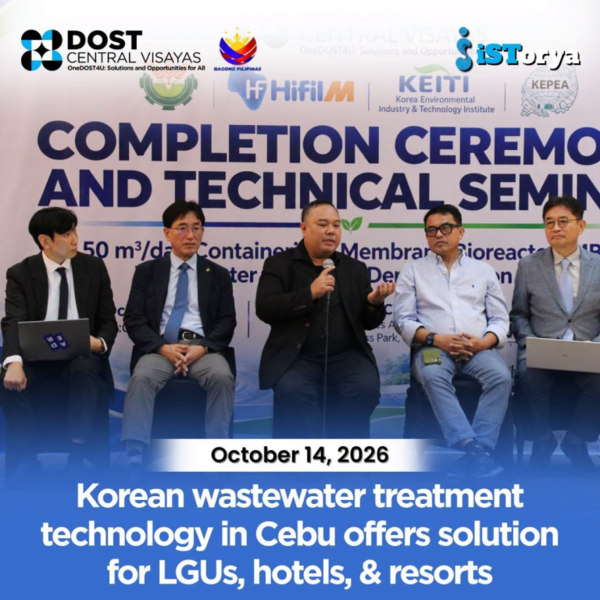
필리핀 과학기술부(DOST) 제7지역사무소는 지난 14일 한국의 막분리 기술을 적용한 하루 50㎥ 처리 규모의 컨테이너형 막분리생물반응조(MBR) 하수처리 실증시설을 세부주 라푸라푸시(Lapu-Lapu City)에 구축했다고 밝혔다. [사진출처(Photo Source) = 필리핀 과학기술부(DOST)]
필리핀 과학기술부(DOST) 제7지역사무소는 지난 14일 한국의 막분리 기술을 적용한 하루 50㎥ 처리 규모의 컨테이너형 막분리생물반응조(MBR) 하수처리 실증시설을 세부주 라푸라푸시(Lapu-Lapu City)에 구축했다고 밝혔다.
이번 사업은 수처리용 분리막과 MBR 시스템을 개발·생산하는 한국 기업 하이필엠(HifilM)과 필리핀 수키 트레이딩(Suki Trading)·빅메탈(Vic Metal), 한국환경기술사회(KEPEA)가 참여한 협력사업으로, 한국의 국가 연구개발사업을 통해 개발된 기술을 필리핀 현지 환경에서 검증하기 위해 추진됐다.
실증시설은 하루 최대 5만L의 하수를 처리할 수 있으며, 길이 약 12m의 컨테이너 내부에 주요 처리공정을 집약한 것이 특징이다. 별도의 대규모 시설을 설치하기 어려운 호텔과 리조트 등 공간이 제한된 사업장에서도 활용할 수 있도록 설계됐다.
해당 시설에는 생물학적 처리와 정밀여과를 결합한 MBR 기술이 적용됐다. 먼저 하수에 포함된 고형물과 기름 성분을 제거한 뒤, 산소 공급 여부에 따라 구분된 4단계 생물학적 처리공정에서 미생물을 이용해 유기물과 오염물질을 분해한다. 이후 약 0.1㎛(마이크로미터) 크기의 미세한 기공을 가진 분리막으로 잔여 입자와 미생물을 걸러낸다.
특히 하이필엠이 개발한 왕복운동형 분리막 시스템은 기존 방식과 달리 분리막을 좌우로 움직여 표면에 오염물질이 쌓이는 현상을 억제한다. 기술 개발사에 따르면 이러한 구조는 막 세정에 필요한 공기 공급을 줄여 전력 사용량을 낮출 수 있다.
지난 8월 실시한 예비 현장 측정에서도 긍정적인 처리 성능이 확인됐다. 처리수의 화학적산소요구량(COD)은 필리핀의 관련 배출기준을 충족했으며, 질산성질소 농도는 일반적으로 약 10㎎/L로 기준치인 20㎎/L를 밑돌았다. 총인(T-P) 농도도 2㎎/L 이하로 측정됐다.
사업 참여기관들은 추가 시험을 통해 처리수의 조경용 관개수 활용 등 재이용 가능성도 검토하고 있다. 향후에는 필리핀 내 호텔과 리조트 등을 대상으로 하루 50㎥ 및 100㎥ 규모의 표준화된 하수처리 시스템 도입을 추진할 계획이다.
한편, 필리핀 과학기술부는 14일 세부시에서 실증시설 준공 기념식과 기술 세미나를 개최했다. 행사에서는 시설 구성과 시운전 결과, 현지 적용 가능성 등이 논의됐으며, 15일에는 라푸라푸시 실증시설 현장 방문이 예정됐다.
필리핀 과학기술부는 이번 실증사업이 현지 관광·숙박업계의 하수처리 수요에 대응하고, 한국의 환경기술을 활용한 수자원 보호 및 지속 가능한 하수관리 확대에 기여할 것으로 기대하고 있다.
[원문보기]
Korean wastewater treatment technology in Cebu offers solution for LGUs, hotels, & resorts
CEBU CITY, Philippines, October 14, 2026 — Hotels, resorts, and other establishments generate wastewater every day from kitchens, bathrooms, laundry areas, and other operations. Before this water can be released into the environment, it must be properly treated to prevent pollution and protect surrounding bodies of water.
For businesses, particularly those in the tourism and hospitality industry, the challenge is finding a wastewater treatment system that meets environmental standards while remaining practical to install and operate.
A new wastewater treatment demonstration plant in Lapu-Lapu City, Cebu, offers a potential solution through a compact system designed to treat up to 50,000 liters of wastewater per day.
The Department of Science and Technology (DOST) Central Visayas, in partnership with South Korea-based HifilM Inc., Suki Trading Corporation/Vic Metal Fabrication and Environmental Services Inc., and the Korea Environmental Professional Engineers Association (KEPEA), highlight the technology during the Completion Ceremony and Technical Seminar for the 50-cubic-meter-per-day Containerized Membrane Bioreactor (MBR) Wastewater Treatment Demonstration Plant today, October 14, at the City Sports Club Cebu.
The demonstration plant uses Korean membrane technology that combines biological treatment and fine filtration to remove pollutants from wastewater.
Unlike conventional wastewater treatment facilities that may require several separate structures, the system is housed inside a 40-foot container, offering a compact design that could be suitable for establishments with limited space.
How does the technology work?
The technology uses a process called Membrane Bioreactor (MBR), which combines natural biological treatment with a special filtering system.
First, wastewater passes through equipment that removes larger waste materials, including solid debris and grease.
The water then undergoes biological treatment, where helpful microorganisms break down organic waste and certain pollutants. The system uses four treatment stages, with and without oxygen, to help remove contaminants.
Finally, the water passes through specially designed membranes with extremely small openings measuring approximately 0.1 micrometer, much smaller than the width of a human hair.
These membranes hold back tiny particles and microorganisms while allowing treated water to pass through.
One feature of the HifilM technology is its moving membrane system. Instead of relying on air to clean the membrane surfaces, the membranes move back and forth to help prevent the buildup of dirt and other materials that can block filtration.
According to the technology developer, this design can reduce power requirements for membrane cleaning.
For hotel and resort operators, the technology offers a possible approach to treating wastewater within their properties rather than relying on large treatment structures.
Early tests show promising results
Based on provisional field measurements reported in August 2026, the system shows promising wastewater treatment performance.
Results indicate that the treated water’s chemical oxygen demand, an indicator of the amount of pollution in wastewater, remains below the applicable Philippine standard.
Nitrate nitrogen levels, which are monitored because excessive nutrients can contribute to water pollution, are typically around 10 milligrams per liter, below the 20-milligram-per-liter limit.
Total phosphorus levels are also measured at or below 2 milligrams per liter.
Beyond treating wastewater for safe discharge, the project is also examining whether the treated water can eventually be reused for purposes such as irrigation, subject to further assessment.
Such applications could be particularly relevant to hotels and resorts that maintain landscaped areas and other facilities requiring regular water use.
Bringing wastewater treatment technology closer to local businesses
The demonstration plant forms part of a Korean national research and development project, with field testing in the Philippines.
HifilM Inc. provides the technology and membrane system, while Suki Trading/Vic Metal provides the demonstration site and supports local operations. KEPEA facilitates cooperation between Korean and Philippine partners, with DOST providing technical support and certification-related assistance.
During today’s technical seminar, DOST Central Visayas Regional Director Dr. Tristan L. Abando discusses the need for the technology, while HifilM Inc. presents how the system works.
Mr. Victoriano Ocon, Chief Executive Officer of Suki Trading/Vic Metal, shares insights on local deployment, while Mr. Soon Myung Hong, Chairperson of KEPEA, discusses the wider applications of the technology.
The activity also includes discussions on the system’s configuration, commissioning results, and potential applications in the country. A demonstration plant site visit is scheduled for October 15 in Lapu-Lapu City.
Following further testing, the project partners are looking into the possible introduction of standardized wastewater treatment systems with capacities of 50 and 100 cubic meters per day for hotels and resorts in the Philippines.
For businesses in Cebu and other parts of Central Visayas, the demonstration provides an opportunity to assess whether this type of technology is suitable for their wastewater treatment needs.
The project also supports efforts to bring research-based technologies closer to local industries while promoting responsible wastewater management and environmental protection.
As the tourism and hospitality sectors continue to operate in coastal and urban communities, practical wastewater treatment technologies could help businesses manage their environmental responsibilities while protecting the water resources on which these communities depend.
[출처 = 필리핀 과학기술부(DOST)(https://region7.dost.gov.ph/korean-wastewater-treatment-technology-in-cebu-offers-solution-for-lgus-hotels-resorts/) / 2026년 10월 14일]
|  즐겨찾기 추가
 시작페이지로 설정
























