[미국] “미국·캐나다 지자체 상하수도관 시장, 2035년까지 993억달러 규모”
미국 글로벌 시장조사기관 블루필드 리서치, ‘2026∼2035년 미국·캐나다 지자체 상하수도관 시장 규모’ 보고서서 예측
미국과 캐나다의 향후 10년간(2026∼2035년)의 배관 투자는 보수 및 교체에 초점 맞출 것으로 예상
상하수도관망 확장보다는 인프라 재정비에 중점 둔 새로운 투자 사이클 접어들어
최근 주택 건설 둔화·노후된 인프라·변화하는 자재 선호도가 공공시설 자본 지출의 우선순위 바꿔나
재정비·보수가 전체 투자 비중 9.7%에서 19.8%로 거의 2배 가까이 증가 전망
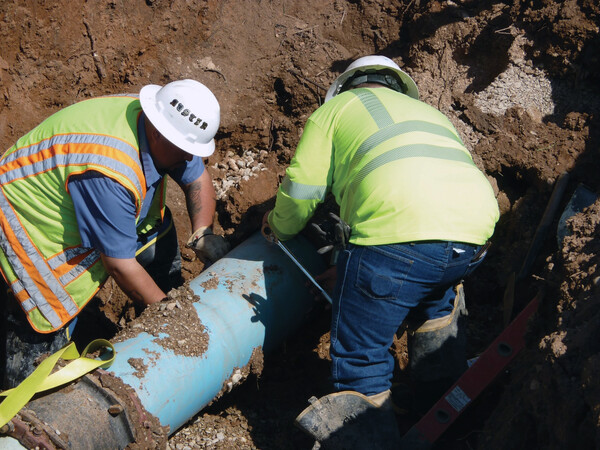
블루필드 리서치(Bluefield Research)가 8월 10일 발표한 새로운 보고서 『2026∼2035년 미국·캐나다 지방자치단체 상수도 및 하수도 배관 시장 전망』에 다르면, 올해부터 오는 2035년까지 지방자치단체 배관에 대한 자본 지출이 993억 달러(약 140조8천173억 원)에 이를 것으로 전망했다. [사진출처(Photo source) = 텍사스 오스틴워터(Texas Austin Water)]
세계적인 물 시장 데이터 및 분석 기관인 미국 보스턴에 있는 블루필드 리서치(https://www.bluefieldresearch.com/)의 새로운 전망에 따르면, 미국과 캐나다의 상하수도관 시장은 상하수도관망 확장보다는 인프라 재정비에 중점을 둔 새로운 투자 사이클에 접어들고 있다. 최근 주택 건설 둔화, 노후된 인프라, 변화하는 자재 선호도가 공공시설 자본 지출 우선순위를 바꾸고 있다.
블루필드 리서치(Bluefield Research)가 8월 10일 발표한 새로운 보고서 『2026∼2035년 미국·캐나다 지방자치단체 상수도 및 하수도 배관 시장 전망(U.S. & Canada Municipal Drinking Water and Wastewater Pipe Forecasts, 2026∼2035)』에 다르면, 올해부터 오는 2035년까지 지방자치단체 배관에 대한 자본 지출이 993억 달러(약 140조8천173억 원)에 이를 것으로 전망했다.
블루필드 리서치의 분석에 따르면 연간 총 자본 지출(CAPEX)은 2026년 90억7천만 달러(약 12조8천622억 원)에서 2035년 108억 8천만 달러(약 15조4천311억 원)로 소폭 증가할 것으로 예상되지만, 재정비 및 보수가 전체 투자에 차지하는 비중은 9.7%에서 19.8%로 거의 두 배 가까이 증가할 것으로 전망했다.
블루필드 리서치의 리스 티스데일(Reese Tisdale) 사장 겸 CEO는 “배수관 및 집수관은 상하수도 시설 투자 지출의 약 45%를 차지하며, 이 분야에서 단일 인프라 항목으로는 가장 큰 비중을 차지한다”고 말했다.
티스데일 CEO는 특히 “이러한 규모 때문에 상하수도 시설의 투자 우선순위 변화는 특히 중요하다. 제조업체, 시공업체, 유통업체, 엔지니어링 회사들에게 있어 기회는 변화하고 있다”라면서 “수요가 발생하는 분야뿐만 아니라 향후 10년 동안 상하수도 시설에서 우선시할 제품, 자재, 서비스 또한 변화하고 있다”고 강조했다.
신규 건설보다 보수 및 교체 투자가 더 빠르게 성장할 전망
미국과 캐나다의 향후 10년간(2026∼2035년)의 배관 투자는 보수 및 교체에 초점을 맞출 것으로 예상된다. 신규 건설은 여전히 투자 금액 기준으로 가장 큰 비중을 차지하지만, 보수 및 교체 투자가 증가함에 따라 자본 지출에서 차지하는 비중은 감소하고 있다. 이러한 추세는 미국(94%)과 캐나다(6%)에 걸쳐 설치된 452만 마일(약 727만4천235km)의 노후화된 상하수도관 대부분이 설계 수명에 근접했거나 이미 초과했기 때문이다.
이러한 변화를 이끄는 두 가지 요인이 있다. 하나는 2021년 최고점에서 크게 하락하여 정체된 주택 시장으로, 신규 건설 물량이 감소하고 있다는 점이고, 다른 하나는 자산 노후화로 인한 보수 및 교체 지출이 가속화되고 있다는 점이다.
티스데일 CEO는 “안타깝게도 자본 예산이 줄어든다고 해서 자산 노후화 과정이 멈추는 것은 아니다”라면서 “자산 상태 평가 및 계획을 미루는 공공시설은 비용을 회피하는 것이 아니라, 계획된 자본 프로그램에서 긴급 수리 및 운영 예산으로 비용을 전가하는 것일 뿐”이라고 말했다.
프로젝트 유형별 자본적 지출 파이프, 2026∼2035년
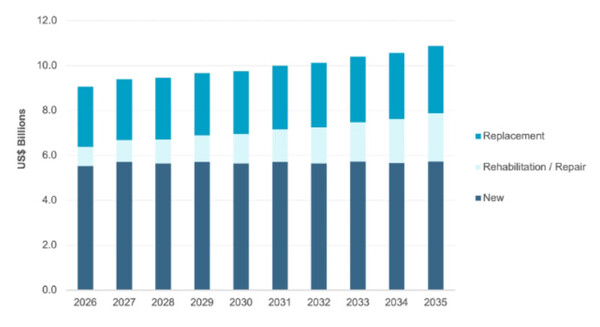
[그래픽 출처(graphic source) = 블루필드 리서치(Bluefield Research)]
플라스틱 파이프, 장기 지속될 것으로 예상되는 금속 파이프 대체 추세
주철관, 강관 등 금속 파이프에서 플라스틱 파이프로의 전환은 경기 순환이 아닌 구조적인 변화이다. 폴리염화비닐(PVC) 파이프는 향후 10년 동안 전체 지출에서 차지하는 비중이 31.9%에서 34.5%로 증가할 것으로 예상되는 반면, 연성 주철관은 30.3%에서 25.9%로 감소할 것으로 전망된다.
이러한 변화는 선벨트 지역과 같은 성장 시장에서 저렴한 파이프를 선호하는 경향을 반영하는 반면, 대도시에서는 여전히 연성 주철 파이프에 대한 의존도가 높다. 특수 플라스틱은 PVC 자체보다 훨씬 빠른 속도로 시장 점유율을 확대하고 있는데, 고밀도 폴리에틸렌(High-Density Polyethylene, HDPE)과 분자 배향 폴리염화비닐(Polyvinyl Chloride Pipe, PVCO) 파이프는 모두 작은 기반에서 더 빠른 속도로 성장하고 있다. 관세 변동성은 자재 비용 전반에 걸쳐 불확실성을 더하고 있다.
티스데일 CEO는 “자재에 대한 논의는 전통적인 방식과 새로운 방식이 공존하는 양상을 보인다”라면서 “부동산 개발업자들이 설치 인건비, 부식 저항성, 장기 유지보수 비용을 비교할 때, 플라스틱 파이프 공급업체가 유리한 경우가 더 많아 이러한 경제성은 수명 주기 비용과 관계없이 당분간 변하지 않을 것으로 예상된다”고 말했다.
규모와 성장에는 서로 다른 지리적 지도가 필요
지리적으로 파이프 시장의 기회는 양분되어 있다. 텍사스, 캘리포니아, 플로리다는 인구 규모와 상대적으로 빠른 성장세 덕분에 미국 전체 지출의 약 28%를 차지하고 있다. 반면, 위스콘신, 유타, 캐나다 브리티시컬럼비아는 연간 3% 이상의 성장률을 기록하며 전체 시장 평균인 2%를 크게 웃돌고 있다.
이는 규모의 경제를 제공하는 시장과 평균 이상의 성장 기회를 제공하는 시장간의 차이를 보여준다. 예를 들어 유타는 2010년부터 2020년까지 도시 지역의 급속한 확장과 농촌 인구의 상당한 증가를 동시에 경험하며, 이로 인해 도시와 농촌 지역 모두에서 인프라에 대한 압력이 가중되었다.
미국에서는 북동부와 중서부 지역의 배관망이 가장 오래되었고 연성 주철과 같은 기존 자재에 의존하는 반면, 빠르게 성장하는 남부와 서부 지역은 자산 수명 주기가 짧아 예상보다 빠른 교체 시기가 도래하는 플라스틱 자재 위주의 새로운 시스템을 갖추고 있다.
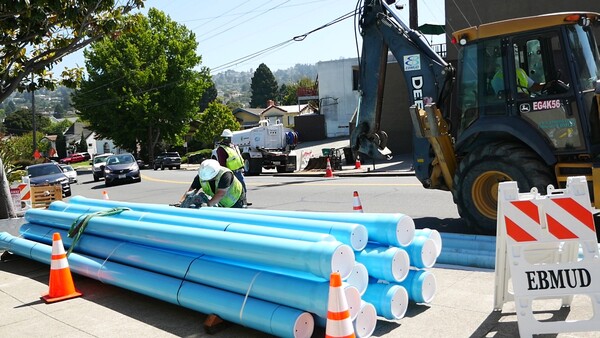
미국 및 캐나다에서는 주철관, 강관 등 금속 파이프에서 플라스틱 파이프로의 전환은 경기 순환이 아닌 구조적인 변화이다. 폴리염화비닐(PVC) 파이프는 향후 10년 동안 전체 지출에서 차지하는 비중이 31.9%에서 34.5%로 증가할 것으로 예상되는 반면, 연성 주철관은 30.3%에서 25.9%로 감소할 것으로 전망된다. [사진출처(Photo source) = 아메리칸워터(American Water) / PPI PIPE)]
연방 자금 지원 감소 속, 유틸리티 기업들이 차세대 인프라 재건 중심축으로 부상
이러한 변화들을 종합해 볼 때, 향후 10년(2026∼2035년)은 유틸리티 기업들의 실행력과 포트폴리오 조정이 핵심이 될 것으로 예상된다. 미국 연방 정부의 자금 지원은 예상보다 배관 인프라 시장에 큰 변화를 가져오지 못했다.
이는 부분적으로 주 정부 차원의 사업 추진 속도와, 기존 인프라를 넘어 과불화화합물(PFAS)과 같은 신종 오염물질 문제 해결 등 광범위한 사업 영역이 필요하기 때문이다.
「인프라 투자 및 일자리 창출법(Infrastructure Investment and Jobs Act, IIJA)」과 「미국 구제금융법(American Rescue Plan Act , ARPA)」에 따른 자금 지원이 계획대로 종료됨에 따라, 유틸리티 기업들은 요금 조정 및 기타 재정 수단에 의존해야 할 상황이다.
재건, 하수처리 시설, 플라스틱 배관, 대구경 송수관에 집중하는 공급업체들이 시장의 다음 단계를 주도할 것으로 보인다. 주택 착공 증가와 안정적인 자재 가격은 시장 역학에 영향을 미치겠지만, 기존 관망의 노후화 속도가 교체 속도보다 빠르다는 근본적인 필요성은 변하지 않을 것이다.
티스데일 CEO는 “전반적으로, 상수도 부문은 물론 국가 전체로 수십 년 만에 가장 대규모의 지속적인 자본 계획을 추진하고 있다”라면서 “시장 역학은 여러 측면에서 변화하고 있지만, 재정적 유연성, 더욱 발전된 상태 평가 도구, 그리고 시공 능력을 갖춘 공급업체와 계약업체가 향후 투자 사이클에서 가장 큰 비중을 차지하게 될 것”이라고 말했다.
블루필드 리서치(Bluefield Research)는 인프라, 정책, 기술 분야를 아우르며 지방자치단체와 산업 부문을 포함한 글로벌 물 시장에 관한 데이터, 분석, 인사이트를 제공하고 있다.
[원문보기]
Infrastructure Renewal Reshapes US$99.3 Billion Municipal Pipe Market in the U.S. & Canada
10 August 2026, Boston, Massachusetts: The municipal pipe market in the United States and Canada is entering a new investment cycle defined by infrastructure renewal rather than network expansion, according to a new forecast from Bluefield Research. A recent housing construction slowdown, aging infrastructure, and shifting material preferences are reshaping utility capital spending priorities.
Bluefield’s new report, U.S. & Canada Municipal Drinking Water and Wastewater Pipe Forecasts, 2026?2035, projects municipal pipe capital expenditures of US$99.3 billion between 2026 and 2035. The analysis shows annual total CAPEX increasing modestly from US$9.07 billion in 2026 to US$10.88 billion in 2035, but rehabilitation and repair will nearly double its share of total investment, rising from 9.7% to 19.8%.
“Distribution and collection pipe represents roughly 45% of utility capital spending, making it the largest single infrastructure category in the sector,” says Reese Tisdale, President & CEO at Bluefield Research.
“That scale makes shifts in utility investment priorities especially important. For manufacturers, contractors, distributors, and engineering firms, the opportunity is changing-not just in where demand emerges, but in the products, materials, and services utilities will prioritize over the next decade.”
Rehabilitation and Replacement to Grow Faster Than New Construction
Renewal-focused work is forecast to drive the next decade of pipe investments. While new construction remains the single largest investment category by dollar value, its share of capital spending declines as rehabilitation and replacement grow. This trend is fueled by an aging installed base of 4.52 million miles of water and wastewater pipe across the United States (94%) and Canada (6%), much of it approaching or past its design life.
Two forces are driving this shift: a housing market that has plateaued well below its 2021 peak, slowing new build-out volumes, and asset age data that is converting into rehabilitation and replacement spend at an accelerating pace.
“Unfortunately, asset age doesn’t pause just because a capital budget does,” Tisdale explains. “Utilities that defer condition assessments and asset planning don’t avoid costs?they simply shift them from planned capital programs to emergency repairs and operating budgets.”
Plastic Displaces Traditional Materials in Sustained Multi-Year Shift
The shift from metal to plastic pipe is structural, not cyclical. Polyvinyl chloride (PVC) is expected to increase its share of total spend from 31.9% to 34.5% over the next decade, while ductile iron declines from 30.3% to 25.9%. The shift reflects a preference for lower-cost pipe in growth markets like the Sunbelt states, tempered by continued reliance on ductile iron in large urban centers.
Specialty plastics are gaining share even faster than PVC itself: high-density polyethylene (HDPE) and molecularly oriented polyvinyl chloride pipe (PVCO) are both growing from smaller bases at a quicker pace. Tariff volatility adds a further layer of uncertainty across material costs.
“The material story is an old school, new school discussion,” Tisdale notes. “When property developers compare installation labor, corrosion resistance, and long-term maintenance, plastic pipe suppliers are winning more often than not. These economics aren’t likely to change anytime soon, irrespective of lifecycle costs.”
Scale and Growth Require Different Geographic Maps
Geographically, the pipe market opportunity is bifurcated. Texas, California, and Florida anchor roughly 28% of U.S. spend because of their large populations and relative pace of growth, while Wisconsin, Utah, and British Columbia, Canada are each growing faster than 3% annually, above the total market average of 2%.
This highlights a distinction between markets that offer scale and those that offer above-average growth opportunities. Utah, for example, recorded both rapid urban expansion and significant rural population gains from 2010 to 2020, creating pressure on infrastructure across both settings.
In the U.S., the Northeast and the Midwest carry the oldest pipe networks and lean on legacy materials like ductile iron, while the fast-growing South and West have younger, plastic-heavy systems where shorter asset lifecycles will create earlier-than-expected replacement opportunities.
Utilities Anchor the Renewal Decade as Federal Funding Fades
Taken together, these shifts point to a decade defined by utility execution and portfolio alignment. U.S. Federal funding has proven to be less transformative for the pipe infrastructure market segment than anticipated.
This is partly due to the pace of roll-out at the state level and the breadth of needs beyond hard infrastructure, including emerging contaminants like per- and polyfluoroalkyl substances (PFAS).
Funding from the Infrastructure Investment and Jobs Act (IIJA) and American Rescue Plan Act (ARPA) is winding down, as prescribed, leaving utilities to rely on rate adjustments and other financial instruments.
Suppliers focused on rehabilitation, wastewater infrastructure, plastic pipes, and larger-diameter transmission will be better positioned for the market’s next phase. An uptick in housing starts and stable material costs will influence the market dynamics, but neither changes the underlying replacement need created by a well-established network aging faster than it is being replaced.
“Collectively, utilities are running the largest sustained capital planning exercise the water sector, if not the country, has seen in decades,” adds Tisdale. “While the market dynamics are evolving in a number of ways, vendors and contractors that show up with financing flexibility, more advanced condition assessment tools, and delivery capacity will be the ones that capture the greatest share of this investment cycle going forward.”
About Bluefield Research
Bluefield Research provides data, analysis, and insights on global water markets, covering the municipal and industrial sectors across infrastructure, policy, and technology. As a leading provider of water market intelligence, Bluefield helps strategic decision-makers understand where the water market is going?and why.
The Insight Report, U.S. & Canada Municipal Drinking Water and Wastewater Pipe Forecasts, 2026?2035, provides a data-driven perspective on how market trends, policy disruptions, and strategic pivots are reshaping the landscape for investments in pipe infrastructure. The full report is available for purchase and can be downloaded immediately from Bluefield’s website.
[출처 = 블루필드 리서치(Bluefield Research)(https://www.bluefieldresearch.com/ns/infrastructure-renewal-reshapes-us99-3-billion-municipal-pipe-market-in-the-u-s-canada) / 2026년 8월 10일]
|  즐겨찾기 추가
 시작페이지로 설정
























