태양광을 이용한 해수담수화는 햇빛을 활용해 지속 가능하게 신선한 물을 생산하는 유망한 방법이다. 하지만 기존 시스템은 기름이 많은 바닷물을 담수화할 때, 기름이 특수한 막을 막아 제대로 작동하지 못한다.
현재 한국과 싱가포르의 연구진이 협력해 기름 제거와 태양광 해수담수화를 결합한 다기능 하이드로겔 막(Multifunctional Hydrogel Membrane)을 개발했다. 이 막은 안정적이고 효율적인 담수 생산을 유지하면서 99.99% 이상의 기름 제거율을 달성해, 실제 기름이 많은 해수를 처리하는 유망한 전략임을 입증했다.
세계 인구가 증가하고 산업이 확장됨에 따라, 아프리카·중동·동남아시아의 많은 국가들이 담수 부족 위기에 직면해 있다. 깨끗한 물을 지속 가능하게 생산하는 방법을 찾는 것이 시급한 과제가 되었으며, 태양열 해수담수화가 가장 유망한 해결책 중 하나가 될 수 있다.
햇빛을 이용해 바닷물을 증발시키고 정화하는 이 기술은 물 부족 문제를 겪는 지역에서 효율적인 담수 공급원이 될 수 있다. 하지만, 바닷물에는 소금뿐만 아니라 더 많은 것이 들어 있다. 항구와 산업 지역 인근의 연안 해역은 종종 기름으로 오염되어 해수담수화 시스템에 사용되는 특수 막(Membrane)을 막을 수 있다.
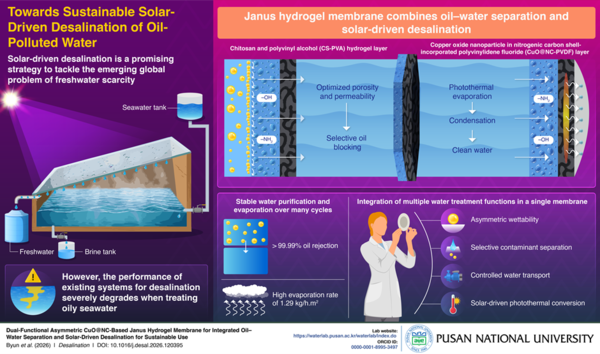
[그림 1] 양면 막이 해수담수화의 두 가지 핵심 기능 결합
이 혁신적인 설계는 태양광을 이용하여 기름이 섞인 해수를 담수화하는 실용적이고 확장 가능한 방법을 제시한다. [그림출처(picture source) = 부산대학교 환경공학과]
많은 실험적 담수화 플랫폼들이 유망한 결과를 보여주었지만, 대부분은 실험실 조건에서 깨끗한 해수를 사용해 시험되었다. 따라서 실제 해수에서 얼마나 잘 작동할지는 아직 불확실하다.
이 문제를 해결하기 위해 부산대학교 환경공학과 정상현 교수가 이끄는 연구팀이 태양광 구동 담수화를 위한 새로운 다기능 하이드로겔 멤브레인을 개발했다. 이들의 연구는 2026년 6월 1일 온라인에 공개되었으며, 오는 10월 15일 발간되는 국제학술지 『Desalination』 제636권에 게재될 예정이다. 연구진은 기름 분리와 담수화를 별개의 공정으로 나누지 않고, 두 가지를 모두 수행할 수 있는 단일 막 구조를 설계했다.
이 연구논문은 오는 10월 15일 발간되는 국제학술지 『Desalination』 제636권에 게재될 예정이다. 사진은 『Desalination』 제636권 표지. [사진출처(Photo source) = 『Desalination』]
제안된 막은 ‘야누스(Janus)’ 구조를 가지고 있는데, 이는 ‘서로 다른 특성을 지닌 두 면을 가진다’는 뜻이다. 한쪽 면은 물을 끌어당기는 친수성으로, 키토산과 폴리비닐알코올 하이드로겔(Hydrogel)로 만들어졌으며, 물은 통과시키면서 기름 방울을 밀어낸다. 반대쪽은 물을 밀어내는(소수성) 성질을 가지며, 탄소 껍질로 감싸진 구리 산화물 나노입자가 나노섬유 층에 박혀 있다.
이 면은 햇빛을 흡수해 열로 바꾸고, 표면에서 물이 증발하도록 만든다. 각 층이 하나의 역할에 집중하기 때문에, 단일 층 설계에서 발생할 수 있는 기름 배출과 열 발생 간의 간섭이 없다.
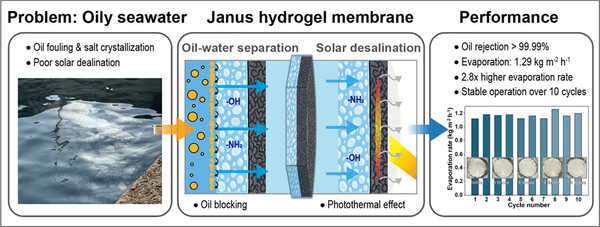
실험 결과, 제안된 막은 오염된 해수에서 99.99% 이상의 기름을 제거했으며, 다양한 크기의 기름 방울과 반복 사용에도 안정적인 성능을 유지하는 것으로 나타났다.
태양열 해수담수화 과정에서 이 막은 ㎡당 시간당 1.29㎏의 물을 증발시키는 성능을 보였는데, 이는 기존 단일층 막보다 거의 세 배에 달하는 수치이다.
정상현 교수는 “재생 가능한 태양 에너지를 활용하고 오염물질 분리와 담수 생산을 하나의 멤브레인 플랫폼에 통합함으로써, 우리 기술은 에너지 소비와 운영 복잡성, 2차 폐기물 발생을 줄여 보다 지속 가능한 수처리와 담수 생산에 기여할 잠재력을 지니고 있다”라고 말했다.
연구진은 이번 연구에서 개발된 막이 미래 수처리 기술을 위한 보다 폭넓은 설계 전략을 부각시킨다고 믿고 있다. 정상현 교수는 “담수화의 구체적 적용을 넘어서, 이 연구의 더 큰 의미는 하나의 멤브레인 구조 안에 여러 처리 기능을 합리적으로 통합할 수 있음을 보여준 데 있다”고 설명했다.
[그림 2] 기름기 있는 바닷물-야누스 하이드로겔 멤브레인-성능
이 연구논문은 오는 10월 15일 발간되는 국제학술지 『Desalination』 제636권에 게재될 예정이다. 사진은 『Desalination』 제636권 표지. [사진출처(Photo source) = 『Desalination』]실험 결과, 제안된 막은 오염된 해수에서 99.99% 이상의 기름을 제거했으며, 다양한 크기의 기름 방울과 반복 사용에도 안정적인 성능을 유지하는 것으로 나타났다. [그림출처(picture source) = 『Desalination』]
이러한 다기능 시스템은 오염된 연안 해역과 산업폐수에 태양광을 이용한 수처리를 보다 실용적으로 만들고, 농축된 염수에서 유용한 자원을 회수하는 노력도 지원할 수 있다. 이 분야에 대한 추가 연구가 전 세계 어디서나 담수를 쉽게 이용할 수 있는 미래로 이어지길 기대한다.
정상현 부산대학교 환경공학과 교수는 2013년 시드니 공과대학교(University of Technology Sydney)에서 토목 및 환경공학 박사 학위를 받았으며, 부산대에 합류하기 전에 사우디아라비아 킹 압둘라 과학기술대학교(KAUST)에서 근무했다.
정 교수는 160편 이상의 SCIE(Science Citation Index Expanded) 논문을 발표했으며, 막 기반 담수화, 수처리 및 재이용 분야에서 15건의 특허를 보유하고 있다. 그의 연구 분야는 해수담수화, 막 공정, 산업폐수 처리, 태양광 기반 수처리, 오염물 제어, 그리고 신종 오염물 제거에 집중되어 있다.
[원문보기]
Pusan National University Study Advances Solar Desalination With Multifunctional Membrane
Researchers develop an innovative membrane technology to sustainably address challenges associated with desalination
Solar-driven desalination is a promising way to produce freshwater sustainably using sunlight. However, existing systems struggle when desalinating oily seawater because oil fouls their specialized membranes.
Now, researchers from Korea and Singapore have collaboratively developed a multifunctional hydrogel membrane that combines oil removal with solar-powered desalination. The membrane achieved over 99.99% oil rejection while maintaining stable and efficient freshwater production, demonstrating a promising strategy for treating real-world oily seawater.
As the world’s population grows and industry expands, many countries in Africa, the Middle East, and Southeast Asia are facing a freshwater scarcity crisis. Finding sustainable ways to produce clean water has become an urgent priority, and solar desalination may be one of the most promising routes available. By using sunlight to evaporate and purify seawater, this technology could serve as an efficient source of freshwater in areas facing water shortages.
However, seawater contains more than just salt. Coastal waters near ports and industrial areas are often contaminated with oil, which can clog the specialized membranes used in desalination systems.
Although many experimental desalination platforms have shown promising results, most have been tested using clean saltwater under laboratory conditions. Thus, it remains unclear how well they would actually perform with real-world seawater.
To address this challenge, a research team led by Professor Sanghyun Jeong from the Department of Civil and Environmental Engineering, Pusan National University, Republic of Korea, has developed a new multifunctional hydrogel membrane for solar-driven desalination.
Their study was made available online on June 1, 2026, and will be published in Volume 636 of the journal Desalination on October 15, 2026. Rather than treating oil separation and desalination as separate processes, the researchers designed a single membrane architecture that does both.
The proposed membrane has a ‘Janus’ architecture, meaning it has two sides with different properties. One side is water-attracting (hydrophilic) and made from a chitosan and polyvinyl alcohol hydrogel; it lets water through while repelling oil droplets. The other side is water-repelling (hydrophobic) and contains copper oxide nanoparticles wrapped in a carbon shell, embedded in a nanofiber layer.
This side absorbs sunlight, converts it into heat, and drives water evaporation at its surface. Because each layer focuses on one task, oil rejection and heat generation do not interfere with each other, which can happen in single-layer designs.
Experiments revealed that the proposed membrane removed over 99.99% of oil from contaminated seawater while maintaining stable performance against different oil droplet sizes and repeated use.
During solar desalination, it achieved an evaporation rate of 1.29 kilograms of water per square meter per hour, which is nearly three times higher than that of a conventional single-layer membrane.
“By harnessing renewable solar energy and integrating contaminant separation with freshwater production in a single membrane platform, our technology has the potential to reduce energy consumption, operational complexity, and secondary waste generation, contributing to more sustainable water treatment and freshwater production,” says Prof. Jeong.
The researchers believe that the membrane developed in this study highlights a broader design strategy for future water treatment technologies, as Prof. Jeong explains, “Beyond the specific application of desalination, the broader significance of this work lies in demonstrating how multiple treatment functions can be rationally integrated within a single membrane architecture.”
Such multifunctional systems could help make solar-powered water treatment more practical for contaminated coastal waters and industrial wastewater, while also supporting efforts to recover useful resources from concentrated brines.
Further research in this field will hopefully lead to a future in which freshwater is easily accessible everywhere in the world.
About Professor Sanghyun Jeong
Dr. Sanghyun Jeong is a Professor of Environmental Engineering at Pusan National University (PNU), Republic of Korea. He earned his PhD in Civil and Environmental Engineering from the University of Technology Sydney in 2013. Before joining the PNU, he worked at KAUST and Sungkyunkwan University.
He has published over 160 SCIE papers and holds 15 patents in membrane-based desalination, water treatment, and reuse. He serves as Associate Editor of Process Safety and Environmental Protection and holds leadership roles in several Korean environmental societies.
His research focuses on desalination, membrane processes, industrial wastewater treatment, solar-driven water treatment, fouling control, and emerging contaminant removal.
 즐겨찾기 추가
 시작페이지로 설정