[EU] “AI 구동 글로벌 데이터센터, 온실가스 배출량 증가·물 고갈·토지 소멸 등 수십억명의 천연자원 위협”
2030년까지 AI 물 사용량 93억㎥로 13억명 수요와 맞먹어…전력 사용량은 6억5천만명 사용량의 3배 예상
AI 구동하는 글로벌 데이터센터, 2030년에 945테라와트시(TWh)의 전력 소비할 것으로 예상
유엔대학 수자원·환경·보건연구소((UNU-INWEH,) 과학자들, 『AI 에너지 사용의 환경 비용 : 탄소, 물 및 토지 발자국』 보고서서 밝혀
투명성·설계 효율성·형평성 및 환경 정의·생애 주기 책임·글로벌 협력·지속가능한 사용 등 6가지 원칙에 기반한 책임 있는 AI 생태계 구축을 촉구

유엔대학 수자원·환경·보건연구소(UNU-INWEH) 과학자들은 새로운 보고서 『AI 에너지 사용의 환경 비용 : 탄소, 물 및 토지 발자국』에서 인공지능(AI)은 기술의 강렬하고 빠르게 증가하는 에너지 소비로 인해 토지, 물, 기후 결과의 급증을 주도하고 있어, 긴급하고 다중 이해관계자가 참여할 수 있는 조치를 촉구하고 있다. 사진은 보고서 공동저자들. [사진출처(Photo source) = 유엔대학 수자원·환경·보건연구소(UNU-INWEH)]
오는 2030년에는 인공지능(AI, Artificial Intelligence)을 구동하는 글로벌 데이터 센터는 945테라와트시(TWh)의 전력을 소비할 것으로 예상된다. 이는 파키스탄, 방글라데시, 나이지리아의 연간 전력 사용량을 합친 것의 세 배에 달하는 수치로, 이 세 나라는 총 6억5천만 명이 넘는 인구가 거주하고 있다.
이들의 물 발자국은 사하라 이남 아프리카 13억 명 전체 인구의 기본 연간 가정용 물 수요와 같으며, 토지 면적은 1만4천500평방킬로미터(㎢)를 초과하여 면적이 인도네시아 자카르타 대도시권의 약 두 배에 달하며, 3천200만 명 이상의 인구가 거주한다.
이러한 충격적인 발견은 유엔대학 수자원·환경·보건연구소(UNU-INWEH, United Nations University Institute for Water, Environment and Health)의 새 보고서 『AI 에너지 사용의 환경 비용 : 탄소, 물 및 토지 발자국(Environmental Cost of AI's Energy Use: Carbon, Water and Land Footprints)』에서 자세히 다루고 있다.
연구자들은 이전에 데이터 센터의 온실가스 배출에 대해 경고한 바 있다. 하지만 유엔 과학자들은 이제 AI와 데이터 센터의 환경 비용을 탄소 배출만으로는 이해할 수 없다고 주장한다. 보고서에서 그들은 전 세계 AI 전기 사용량의 탄소, 물, 토지 발자국을 정량화하고, 세계 20대 데이터 센터 허브에서 이 발자국간의 큰 차이를 강조한다.
“이 보고서는 전 세계 수십억 명의 삶을 개선하는 기술적 혁신인 AI에 대한 비판이 아니다”라고 조사팀을 이끈 UNU-INWEH 국장인 카베 마다니(Kaveh Madani) 교수는 말했다.
그는 특히, “책임감 있게 사용하고, 의도치 않은 영향을 적극적으로 해결하여 지속 가능하고 공정하게 만들 것을 촉구한다”라면서 “우리는 우리 시대의 기술 혁명의 중추가 지구적 한계 내에서 발전하도록 보장할 수 있는 제한된 기간을 가지고 있으며, AI 발전을 위한 핵심 광물을 제공하는 공동체와 그 인프라 및 전자 폐기물을 호스팅하는 공동체들도 그 혜택 을 누릴 수 있도록 보장할 수 있다”고 강조했다.
탄소·물·토지 등 세 발자국은 잘못 측정되고 있다
보고서는 AI의 환경 비용이 체계적으로 잘못 측정되고 있음을 지적한다. 대부분의 기존 평가는 대규모 모델 훈련과 관련된 탄소 배출량에 초점을 맞추고 있다. 하지만, AI 시스템을 훈련하거나 운영하는 데 사용되는 1킬로와트시(KWh)의 전기는 냉방과 발전, 그리고 에너지 인프라와 공급망에서 오는 토지 발자국도 함께 지니고 있다.
탄소·물·토지 등 세 발자국은 같은 방향으로 움직이지 않는다. 예를 들어, 석탄에서 바이오에너지로 전환하면 전기의 탄소 발자국을 평균 70% 줄일 수 있지만, 물 발자국은 30배 이상, 토지 발자국은 100배 증가할 수 있다.
보고서는 ‘저탄소(low-carbon)’가 자동으로 ‘저수자원(low-water)’ 또는 ‘저평지(low-land)’가 아니며, AI 지속가능성을 단일 지표로 평가하면 상충이 숨겨져 이미 물이나 토지 스트레스를 겪고 있는 지역에 환경 부담을 전가할 수 있다고 경고한다.
인프라 수준에서는 수치가 빠르게 누적된다. 글로벌 데이터 센터는 2025년에 약 448TWh의 전력을 소비한 것으로 추정된다. 만약 국가로 취급된다면, 그들은 프랑스에 이어 사우디아라비아보다 앞서 세계 11번째로 큰 전력 소비국이 되었을 것이다.
UNU-INWEH 연구원이자 보고서 주저자인 미리엄 아첼(Miriam Aczel) 박사는 “탄소 측면에서 가장 친환경적으로 보이는 선택지가 물이나 토지에 얼마나 나쁜 결과를 낳는지 가장 놀랐던 점입니다”라고 말했다.
아첼 박사는 이어 “만약 우리가 AI 지속 가능성을 단지 탄소만으로 판단한다면, 재생 에너지가 AI 인프라를 깨끗하게 만든다고 생각할 수 있지만, 이는 한 문제를 해결하면서 다른 문제를 만들어내는 것이고, 종종 요구하지 않은 곳에서 문제를 일으키는 것”이라고 덧붙였다.
추론, 효율성 반동 효과
일반적으로 대중의 논의는 주로 대규모 모델을 훈련시키는 데 필요한 에너지에 집중되어 왔다. GPT-3(Generative Pre-trained Transformer 3) 훈련에는 1.3기가와트시(GWh)의 전력이 필요한 것으로 추정되며, 추정에 따르면 GPT-4는 50∼70 GWh 사이를 소비한 것으로 추정된다.
하지만 보고서는 이러한 인식이 구식임을 드러낸다. 모델이 배포되면, 일상적인 사용자 질문에 응답하기 위해 모델을 지속적으로 실행하는 추론이 주된 비용이 되며, 전체 AI 에너지 사용량의 80∼90%를 차지한다.
챗GPT(ChatGPT)만 해도 하루 약 25억 개의 프롬프트를 처리하는 것으로 추정되며, 이는 단일 제품에 연간 약 383GWh의 전력을 의미한다. 관련 탄소 배출을 상쇄하려면 10년간 260만 그루의 나무 묘목이 필요하며, 이는 미국 맨해튼(Manhattan) 크기의 땅을 덮을 수 있는 충분한 나무이다. 물발자국은 사하라 이남 아프리카에서 약 50만 명의 최소 연간 가정용 물 수요와 맞먹으며, 토지 발자국은 800개 이상의 축구장 크기에 해당한다.
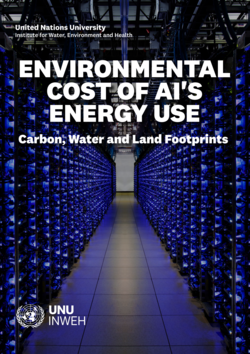
2030년 데이터센터의 물사용량은 9조3천억 리터(93억㎥)로 사하라 이남 아프리카 13억 명의 기본 연간 가정용 물 수요와 동일하다. [사진출처(Photo source) = 유엔대학 수자원·환경·보건연구소(UNU-INWEH)]
비디오 생성은 새롭게 떠오르는 환경 위기
각 쿼리(Per-query ) 에너지는 작업에 따라 수십 배 차이가 난다. 일반적인 대화형 챗쿼리(chat query)는 기본 텍스트 분류보다 약 200배 더 많은 에너지를 소모한다. 단일 AI 이미지를 생성하는 데는 기준선의 약 1천450배가 필요할 수 있다.
짧은 AI로 생성된 단일 동영상은 20만 개의 스팸 분류에 달하는 전기를 소비할 수 있다. 모델 선택, 신속한 길이, 출력 형식 및 해상도 모두 실질적으로 발자국을 형성한다. 하지만, 이러한 결정의 대부분은 사용자가 보지 못하는 제품 기본값으로 인해 보이지 않게 내려진다.
보고서는 반동 효과(제본스 역설, Jevons Paradox)를 언급하며, 모델이 더 효율적이 될수록 비용이 저렴해지고 더 자주 사용된다고 경고한다. 토큰, 해상도, 기본 출력 길이에 명시적인 제한이 없으면, 쿼리당 수준의 개선은 순수한 볼륨 증가에 쉽게 사라진다.
최근 2026년 스톡홀름 수상작(Stockholm Water Prize Laureate)으로 선정된 공동 저자인 마다니(Madani) 교수는 “많은 사람들이 기술이 발전하고 프로세스가 더 효율적이 됨에 따라 AI의 환경 발자국이 줄어든다고 생각한다. 하지만 이것은 전체 문제의 일부에 불과하다”라면서 “더 효율적이고 저렴한 AI와 에너지는 AI 소비를 늘려, 효율성 향상을 통해 절약하는 것보다 훨씬 더 큰 발자국을 만들어낸다”고 말했다.
지역 비용과 먼 이익
AI의 대규모 글로벌 확장이 가져오는 이점과 부담은 매우 불평등하다. 보고서에 나오는 여러 현장 사례들은 전 세계적으로 분산된 AI 서비스가 얼마나 강한 지역 압력을 초래하는지를 보여준다.
아일랜드에서는 2023년 데이터 센터가 전체 계량 전력의 21%를 차지해 모든 도시 가구를 초과했다. 국가 전력망 운영자는 더블린 주변의 신규 승인을 2028년까지 중단했으며, 이는 아일랜드를 AI 인프라 성장이 에너지 계획보다 앞서 나아갈 때 어떤 일이 일어나는지에 대한 구체적이고 문서화된 사례가 되었으며, 다른 나라들이 향하고 있는 방향을 미리 보여주는 사례가 되었다.
멕시코 케레타로(Queretaro)에서는 확장되는 컴퓨팅 인프라가 장기간의 가뭄 속에서 물 공급을 사용하고 있다. 우루과이에서는 물 집약적인 데이터 센터 계획이 2023년 가뭄과 맞물려 몬테비데오(Montevideo)의 담수 비축량이 고갈되어 수돗물이 마시기 위험해졌다.
더불어, AI 인프라는 2030년까지 매년 최대 250만 톤의 전자 폐기물을 생성할 수 있으며, 이 중 상당수는 제한된 안전장치가 있는 저소득 경제에서 처리되고, 중요한 광물은 환경 감독이 약한 관할구역에서 채굴된다.
UNU-INWEH의 지리공간·기후 및 인프라 분석 프로그램 매니저이자 보고서 공동 저자인 미르 마틴(Mir Matin) 박사는 “데이터 센터가 건설되는 곳과 물 스트레스가 가장 심한 곳을 비교하면 어떤 경우에는 같은 지역이 보이는 경향이 있다”고 말했다.
마틴 박사는 특히 “이 사이트들 근처에 사는 커뮤니티가 반드시 그곳에서 운영되는 AI를 사용하는 것이 아니라 그 비대칭성이 문제”라면서 “고치지 않으면, 어떤 곳은 비용을 부담하고 다른 곳은 이익을 차지하는 옛 패턴을 반복할 뿐이다”라고 말했다.
디지털 격차 : AI 컴퓨팅은 90%가 두 나라에 집중되어 있다
AI 인프라는 환경적 비용을 동반하지만, 경제적, 안보적, 주권 측면에서 큰 이점도 있어 부유한 국가들이 더 많은 데이터 센터를 건설하도록 유도한다. 전 세계에 AI 전문 데이터 센터를 보유한 국가는 32개국에 불과하며, 그 용량의 90%가 2개국에 집중되어 있고, 현재 150개국 이상이 주권 AI 컴퓨팅에 거의 또는 전혀 접근하지 못하고 있다.
보고서는 이를 단순한 경제적 격차가 아니라 환경 정의 문제로 규정한다. 배제된 국가들은 중요한 광물 채취와 전자 폐기물 부담을 짊어지고 전략적 이익은 다른 곳으로 흘러간다는 것이다.
유엔대학(UNU, United Nations University) 총장 겸 유엔 사무차장인 칠리지 마르왈라(Tshilidzi Marwala) 교수는 “AI를 구축하는 글로벌 시스템은 또한 지속 가능하고 공정하게 이를 통치해야 한다”고 말했다.
마르왈라 유엔 사무차장은 특히 “세계 특권층에 집중된 AI 인프라 개발은 AI의 공정한 발전에 심각한 도전을 제기하는 큰 디지털 격차를 만들고 있다. AI는 분명히 번영과 인간의 복지를 증진시킬 수 있다. 이제는 기술적인 문제가 아니라 이를 공정하게 수행하는지는 거버넌스 문제이다”라고 강조했다.
지속 가능성과 형평성을 위한 로드맵
이 보고서는 △투명성 △설계 효율성 △형평성 및 환경 정의 △생애 주기 책임 △글로벌 협력 △지속 가능한 사용 등 여섯 가지 원칙에 기반한 책임 있는 AI 생태계를 구축할 것을 촉구한다. 실질적인 권고 사항은 각 주요 이해관계자 그룹을 대상으로 한다.
- 정부는 에너지 계획, 수자원 거버넌스, 토지 이용 허가에 AI 인프라를 통합하고, 표준화된 환경 발자국 보고를 요구해야 한다.
- 산업 및 AI 개발자들은 모델 선택, 기본 출력, 라우팅 결정을 발자국 결정 요인으로 간주하고 설계상 효율성을 개선해야 한다.
- 사용자와 배포 조직은 목적에 맞는 사용을 채택해야 하며, 가장 가벼운 모델과 가장 낮은 에너지 포맷을 선택해야 한다.
- 데이터 센터 운영자와 유틸리티는 위치 선정과 에너지 조달을 환경 발자국 결정으로 간주하고 누적 영향 평가를 적용해야 한다.
- 투자자들은 전기, 탄소, 물, 토지 발자국을 AI 인프라 포트폴리오에서 중요한 위험으로 간주해야 한다.
- 지역사회와 시민사회는 데이터 센터 위치 결정에 조기에 참여해야 하며, 강제 가능한 투명성과 불만 처리 메커니즘을 마련해야 한다.
- 국제기구는 조화로운 측정 기준을 지원하고, 국경을 넘는 부담 전가에 대한 인센티브를 줄이며, 제외된 지역에서 컴퓨팅 역량을 강화해야 한다.
보고서에 나타난 숫자
 ■ 945테라와트시(TWh) 2030년까지 전 세계 데이터 센터 전력 수요는 전 세계 전력 사용량의 거의 3%에 달하며, 프랑스 2025년 소비량의 약 두 배에 달한다.
■ 9조3천억 리터(93억㎥) 2030년 데이터센터 전기의 관련 물발자국은 사하라 이남 아프리카 13억 명의 기본 연간 가정용 물 수요와 동일하다.
■ 1만4천500㎢ 2030년 데이터 센터 전력의 토지 면적은 자카르타 대도시권의 약 두 배에 달하며, 3천200만 명 이상의 인구가 거주하고 있다.
■ 80%∼90% 학습이 아닌 배포된 모델 실행인 추론에 의해 소비되는 전체 AI 에너지 사용량의 추정 비중이다.
■ 25억 단일 제품에 대해 연간 약 383GWh의 전기량을 추정하는 것으로 추정된다.
■ 1천450명× 기본 텍스트 분류에 비해 일반적인 AI 생성 이미지의 에너지 요구량이다.
■ >90% AI 전문 클라우드 컴퓨팅의 점유율은 미국과 중국 두 나라에 집중되어 있다.
■ 250만 톤 2030년까지 AI 관련 전자 폐기물 예상 연간 수량은 매년 거의 250개의 에펠탑을 폐기하는 것과 같다.
유엔 대학교 물·환경·보건 연구소(UNU-INWEH) 소개
올해로 운영 30주년을 맞이한 유엔대학교 물·환경·보건 연구소(UNU-INWEH)는 유엔대학(UNU)을 구성하는 13개 기관 중 하나이며, UNU는 유엔의 학술기관이다. ‘유엔의 물 관련 싱크탱크’로 알려진 UNU-INWEH는 전 세계의 중요한 물, 환경, 보건 문제를 다룬다. 연구, 교육, 역량 개발, 지식 확산을 통해 연구소는 유엔과 회원국들이 우려하는 시급한 글로벌 지속 가능성 및 인적 안보 문제 해결에 기여하고 있다.
본부는 캐나다 온타리오주 리치먼드 힐에 있으며, 1996년부터 캐나다 정부의 주최와 지원을 받아왔다. UNU-INWEH는 전 세계적인 임무와 유엔 기관, 국제기구, 정부간의 광범위한 파트너십을 바탕으로, 캘거리, 함부르크, 뉴욕, 룬드, 프리토리아에 위치한 UNU 허브와 국제 지부 네트워크를 통해 운영되고 있다.
[원문보기]
Rising Emissions, Depleting Water and Vanishing Land-UN Scientists: AI Is Threatening Natural Resources for Billions
By 2030, AI's water use will match the needs of 1.3 billion people while its power use triples that of 650 million, UN University investigation warns
Richmond Hill, Ontario, Canada (3 June 2026) - By 2030, the global data centres powering artificial intelligence are projected to consume 945 terawatt-hours of electricity. This is nearly triple the combined annual electricity use of Pakistan, Bangladesh, and Nigeria-countries collectively home to more than 650 million people.
Their associated water footprint will equal the basic annual domestic water needs of all 1.3 billion people in Sub-Saharan Africa, and their land footprint will exceed 14,500 square kilometers, roughly twice the Jakarta metropolitan area, home to more than 32 million people.
These stark findings are detailed in the new report, Environmental Cost of AI's Energy Use: Carbon, Water and Land Footprints, by the United Nations University Institute for Water, Environment and Health (UNU-INWEH).
Researchers have previously warned about the greenhouse gas emissions of data centers before. But the UN scientists now argue that the environmental costs of AI and data centers cannot be understood through carbon emissions alone.
In their report, they quantify the carbon, water and land footprints of AI's electricity use across the globe and highlight the big differences between these footprints in the world’s 20 largest data center hubs.
"This report is not a case against artificial intelligence, a technological transformation that is improving the lives of billions of people around the world," said Professor Kaveh Madani, Director of UNU-INWEH who led the investigation team.
"It is a call for using it responsibly and addressing its unintended impacts proactively to make it sustainable and equitable. We have a narrow window to ensure that the backbone of the technological revolution of our era develops within planetary limits, and that the communities who provide the critical minerals for advancing AI and the ones that host its infrastructure and e-waste are also among those who benefit from it."
A footprint that is being mismeasured
The report finds that AI's environmental cost is being systematically mismeasured. Most existing assessments focus on the carbon emissions associated with training large models. Yet every kilowatt-hour of electricity used to train or run an AI system also carries a water footprint, from cooling and power generation, and a land footprint, from energy infrastructure and supply chains.
These three footprints do not move in the same direction. Switching from coal to bioenergy, for example, can on average cut the carbon footprint of electricity by 70 per cent, while increasing its water footprint more than thirty-fold and its land footprint a hundred-fold.
The report concludes that "low-carbon" is not automatically "low-water" or "low-land” and warns that evaluating AI sustainability through a single metric can hide trade-offs and shift environmental burdens onto regions already facing water or land stress.
The numbers compound rapidly at the infrastructure level. Global data centres consumed an estimated 448 terawatt-hours of electricity in 2025. If treated as a nation, they would have been the world's 11th largest electricity consumer, behind France and ahead of Saudi Arabia.
"What surprised us most is how often the choices that look greenest from a carbon perspective end up worse for water or for land," said Dr. Miriam Aczel, UNU-INWEH Researcher and the lead author of the report.
"If we keep judging AI sustainability by carbon alone, we might think that renewables make AI infrastructure clean but that is solving one problem while creating other problems, often in places that didn't ask for it."
Inference, efficiency, and the rebound effect
Public discussion has largely focused on the energy required to train massive models. Training GPT-3 was estimated to require 1.3 gigawatt-hours (GWh) of electricity, while estimates suggest GPT-4 consumed between 50 and 70 GWh. However, the report reveals this framing is outdated.
Once a model is deployed, inference?the continuous running of models to answer everyday user prompts?becomes the dominant cost, accounting for 80 to 90 per cent of total AI energy use. ChatGPT alone is estimated to process around 2.5 billion prompts per day, translating to roughly 383 GWh of electricity per year for a single product.
Offsetting associated carbon emissions would require 2.6 million tree seedlings grown for 10 years, enough trees to cover a land area the size of Manhattan. The water footprint is equivalent to the minimum annual domestic water needs of roughly 500,000 people in Sub-Saharan Africa, and the land footprint is equal to over 800 football fields.
Video generation as an emerging environmental crisis
Per-query energy varies by orders of magnitude depending on the task. A typical conversational chat query is around 200 times more energy-intensive than basic text classification. Generating a single AI image can require around 1,450 times that baseline.
A single short AI-generated video can consume as much electricity as 200,000 spam classifications. Model choice, prompt length, output format and resolution all materially shape the footprint. Yet most of these decisions are taken invisibly, by product defaults the user never sees.
The report invokes the rebound effect (the Jevons Paradox), warning that as models become more efficient, they become cheaper and are used more frequently. Without explicit limits on tokens, resolution, or default output length, improvements at the per-query level are easily wiped out by sheer volume growth.
"A lot of people think that the environmental footprint of AI reduces, as technology improves and processes become more efficient. But that is only a partial picture of the overall problem," said Professor Madani, a co-author of the report who was recently named the 2026 Stockholm Water Prize Laureate. "More efficient and affordable AI and energy mean more consumption of AI, making the overall footprint far bigger than what we save through efficiency gains."
Local costs, distant benefits
The benefits and burdens of the massive global expansion of AI are highly unequal. Several site-level cases in the report show how globally distributed AI services create intense local pressures. In Ireland, data centres accounted for 21% of total metered electricity in 2023, exceeding all urban households.
The national grid operator has paused new approvals around Dublin until 2028, making Ireland a concrete, documented example of what happens when AI infrastructure growth outpaces energy planning ? and a preview of what other countries are heading toward.
In Queretaro, Mexico, expanding compute infrastructure is drawing on water supplies amid prolonged droughts. In Uruguay, plans for a water-intensive data centre coincided with a 2023 drought that depleted Montevideo's freshwater reserves, making tap water unsafe to drink.
Furthermore, AI infrastructure could generate up to 2.5 million tonnes of electronic waste each year by 2030, much of it processed in low-income economies with limited safeguards, while critical minerals are extracted in jurisdictions with weak environmental oversight.
"If you map where data centres are getting built against where water stress is worst, you tend to see the same regions in some instances," said Dr. Mir Matin, Manager of UNU-INWEH's Geospatial, Climate and Infrastructure Analytics Programme and a co-author of the report.
"And the communities living near these sites are not necessarily the ones using the AI being run there. That asymmetry is the issue. Without fixing it, we'll just be repeating older patterns, where some places carry the costs and other places capture the benefits."
The digital divide: AI computing is 90% concentrated in two countries
While the AI infrastructure comes with environmental costs, they also have major economic, security and sovereignty advantages that encourage the wealthier countries to build more data centers. Only 32 countries in the world host AI-specialised data centres, and 90% of that capacity is concentrated in 2 countries, while more than 150 countries currently have little or no access to sovereign AI compute.
The report frames this not just as an economic divide but as an environmental justice issue: excluded countries bear critical minerals extraction and e-waste burdens while the strategic benefits flow elsewhere.
"The global system building artificial intelligence must also govern it sustainably and fairly," said Professor Tshilidzi Marwala, Rector of the United Nations University and Under-Secretary-General of the United Nations.
"The concentrated development of AI infrastructure in the privileged areas of the world is creating a large digital divide that poses profound challenges in the equitable development of AI. AI can certainly advance prosperity and human well-being. Whether it does so equitably is now a governance question, not a technical one."
A roadmap for sustainability and equity
The report calls for a responsible AI ecosystem built on six principles: transparency; efficiency by design; equity and environmental justice; lifecycle responsibility; global cooperation; and sustainable use. Practical recommendations are directed at each major group of stakeholders:
- Governments should integrate AI infrastructure into energy planning, water governance, and land-use permitting, and require standardized environmental footprint reporting.
- Industry and AI developers should treat model selection, default outputs, and routing decisions as footprint determinants, and improve efficiency by design.
- Users and deploying organizations should adopt fit-for-purpose use - selecting the lightest model and lowest-energy format that meets the task.
- Data center operators and utilities should treat siting and energy procurement as environmental footprint decisions and apply cumulative impact assessment.
- Investors should treat electricity, carbon, water, and land footprints as material risks in AI infrastructure portfolios.
- Communities and civil society should be involved early in data center siting decisions, with enforceable transparency and grievance mechanisms.
- International institutions should support harmonized measurement standards, reduce incentives for cross-border burden shifting, and build compute capacity in excluded regions.
By the numbers
945 TWh : Projected global data-centre electricity demand by 2030, almost three per cent of projected world electricity use and roughly twice France's 2025 consumption.
9.3 trillion litres : Associated water footprint of 2030 data-centre electricity, equal to the basic annual domestic water needs of 1.3 billion people in Sub-Saharan Africa.
14,500 km² : Associated land footprint of 2030 data-centre electricity, about twice the Jakarta metropolitan area, home to more than 32 million people.
80 to 90% : Estimated share of total AI energy use consumed by inference, the running of deployed models, rather than by training.
2.5 billion : Estimated daily ChatGPT prompts, translating to roughly 383 GWh of electricity a year for a single product.
1,450× : Energy demand of a typical AI-generated image relative to basic text classification.
>90% : Share of AI-specialised cloud compute concentrated in two countries, the United States and China.
2.5 million tonnes : Projected annual AI-related electronic waste by 2030, equivalent to discarding nearly 250 Eiffel Towers each year.
REPORT IN BRIEF
AI's environmental cost is being mismeasured. Most current assessments focus on carbon emissions from training. The report argues this misses a substantial part of the picture. Every kilowatt-hour of AI electricity also carries a water footprint, from cooling and generation, and a land footprint, from infrastructure and supply chains. These three footprints can move in opposite directions, so reducing one can magnify another.
Data centres are becoming country-scale consumers of electricity, water and land. Global data-centre electricity use, estimated at 448 TWh in 2025, could reach 945 TWh by 2030. The associated water footprint is projected at 9.3 trillion litres and the associated land footprint at over 14,500 square kilometres.
Inference, not training, drives most of AI's energy use. Once a model is deployed, billions of daily user interactions consume an estimated 80 to 90 per cent of its total energy. ChatGPT alone is estimated to process around 2.5 billion prompts per day.
Per-query energy varies by orders of magnitude across tasks. A typical chat query uses around 200 times the energy of basic text classification. An AI image uses around 1,450 times. A single short AI video can match 200,000 spam classifications. Model choice and product defaults are footprint decisions.
Energy and water required to generate AI images and videos. The energy required to generate a typical AI image is enough to power a 10-watt LED bulb for 17 minutes, and the energy required for a high-complexity AI video is sufficient to run that same bulb for 42 hours. Similarly, the electricity-associated water footprint is about two tablespoons (29 mL) for a single image, but jumps to 4.1 liters for a complex video?almost equivalent to a two-day drinking water need for one person.
Efficiency improvements alone will not contain growth. The report cites the rebound effect, sometimes called the Jevons Paradox, to explain why per-query gains are typically absorbed by rising volumes. Caps on tokens, resolution and output length are needed alongside efficiency.
AI compute is geographically concentrated. Only 32 countries host AI-specialised data centres. Over 90 per cent of capacity is in two countries. More than 150 countries currently lack sovereign AI compute infrastructure.
The hardware lifecycle is the next frontier. AI infrastructure could generate up to 2.5 million tonnes of electronic waste each year by 2030. Critical minerals required for AI hardware are concentrated in regions with weaker environmental oversight, often in the Global South.
A six-principle governance framework. The report proposes a "responsible AI ecosystem" built on transparency, efficiency by design, equity and environmental justice, lifecycle responsibility, global cooperation, and sustainable use, with specific responsibilities assigned across the AI ecosystem.
KEY POLICY MESSAGES
Carbon-only metrics are no longer sufficient for AI. Disclosure standards for AI's environmental impact should require carbon, water and land footprints jointly, in standardised units, across both training and inference and across jurisdictions, so that regulators and investors can compare like with like.
Inference deserves the policy attention that training has received. Because operational use accounts for the majority of AI energy demand, governance should focus on product defaults, model selection and behavioural levers, not only on the largest training runs.
Siting decisions are environmental decisions. Where data centres are built, and from which grid they draw power, determines the carbon, water and land profile of the same workload. Permitting, environmental impact assessment and community consultation should reflect this reality.
Local capacity-planning needs to keep pace with global compute geography. The Irish, Mexican and Uruguayan cases described in the report show what happens when grid and water systems are asked to absorb workloads that serve users elsewhere. Transparent mitigation and benefit-sharing should accompany expansion.
Efficiency gains require demand-side guardrails. Without resource budgets, token-per-prompt limits, default low-resolution settings and similar guardrails, efficiency improvements will be absorbed by volume growth.
AI compute access is itself an equity issue. More than 150 countries currently lack sovereign AI compute. International institutions can help by supporting capacity-building, harmonising disclosure, and reducing incentives for cross-border burden-shifting.
The full value chain requires governance. Critical-mineral extraction at the upstream end and electronic waste at the downstream end are integral to AI's footprint and currently fall on communities that capture little of the benefit.
Investors and financial institutions can move first. Treating carbon, water and land footprints as material risks in due diligence on AI infrastructure portfolios is described in the report as one of the fastest available levers.
AI within planetary limits is achievable. The report's central argument is constructive. Capability and stewardship can grow together, but only with measurement, transparency, and shared responsibility across the ecosystem.
[출처 = 유엔대학 수자원·환경·보건연구소(UNU-INWEH)(https://unu.edu/inweh/news/environmental-cost-of-AIs-Enrgy-use-carbon-water-and-land-footprints) / 2026년 6월 3일]
[보고서 출처 = https://collections.unu.edu/eserv/UNU:10647/UNU-INWEH-Report-The_Env_Cost_of_AI-2026.pdf / 2026년 6월 3일]
|  즐겨찾기 추가
 시작페이지로 설정
























