[독일] DITF, 하수서 미세플라스틱 제거하는 섬유기반 계단식 필터 개발
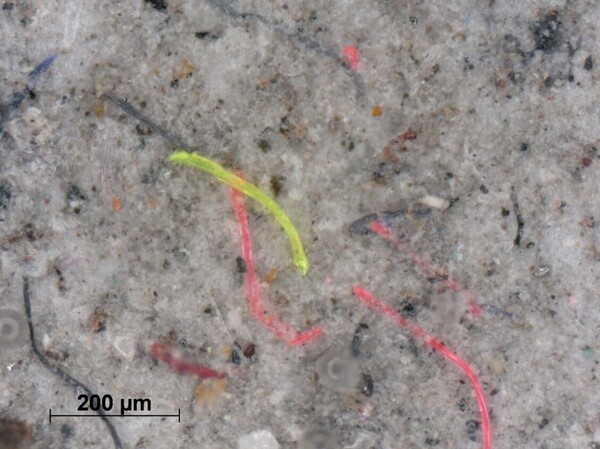
독일 덴켄도르프 섬유연구소(DITF)는 세탁 과정에서 발생하는 미세플라스틱을 제거하기 위해 섬유 기반의 계단식 필터 시스템을 개발했다. 사진은 미세플라스틱 섬유가 부착된 필터 케이크 모습. [사진제공(Photo Source) = DITF]
미세플라스틱은 이제 남극의 외딴 지역을 포함해 거의 모든 곳에서 발견된다. 먹이사슬을 통해 인체에 유입되며, 여러 연구에서 인체 건강에 부정적인 영향을 미칠 수 있음이 지적되고 있다.
주요 오염원 중 하나는 합성 섬유 직물의 세탁 과정이다. 세탁 시 다량의 미세플라스틱이 하수로 방출돼 수생 생태계로 유입된다. 이 문제를 해결하기 위해 독일 덴켄도르프 섬유연구소(DITF)는 섬유 기반의 계단식 필터 시스템을 개발했다.
세탁 1회와 섬유 1kg당 배출되는 미세섬유의 양은 약 12mg에서 1천400mg에 이르는 것으로 추정된다. 하수처리장은 이미 미세플라스틱 입자를 최대 99%까지 제거할 수 있으나, 매일 방류되는 하수의 양이 워낙 많아 여전히 환경에 상당한 영향을 미치고 있다.
지금까지 하수처리에는 다양한 기계·화학적 기술이 사용돼 왔다. 반면, 필터 캐스케이드는 주로 미세플라스틱 입자의 분석과 특성 규명에 활용됐다. 그러나 DITF 연구진은 특수 섬유 기반 필터 캐스케이드가 산업용 세탁소의 헹굼수에서도 낮은 수압 조건에서 효과적으로 미세플라스틱을 제거할 수 있음을 입증했다. 이 시스템은 설계가 단순하고 유지보수가 거의 필요하지 않다는 장점도 있다.
덴켄도르프 연구팀이 개발한 캐스케이드 미세필터는 3단계 여과 구조로 이뤄져 있다. 각 단계는 폴리프로필렌 섬유와 3D 스페이서 니트로 구성된 3차원 섬유 샌드위치 복합재를 사용하며, 단계별로 점차 작은 기공 크기를 적용해 최대 1.5μm 크기의 미세플라스틱 입자까지 제거할 수 있다.
필터는 압축 공기를 이용한 역세척 시스템으로 세척햐 성능을 복원할 수 있다. 필터 케이크가 섬유층에서 스페이서층으로 이동하기 때문에 역세척 빈도가 줄어들고, 가동 시간은 최대 155%까지 늘어난다.
산업용 세탁소와 도시 하수처리장에서 실시한 현장 시험 결과, 미세필터 캐스케이드의 분리 효율은 각각 89.7%와 98.5%로 확인됐다. 따라서 이 시스템은 미세플라스틱 오염 저감에 중요한 기여를 할 수 있다.
높은 분리 효율과 긴 필터 매체 수명은 이 시스템을 하수처리 분야의 유망한 해결책으로 만든다. 비용 효율적이고 공간 절약적이며, 다양한 적용 분야와 규모에 맞게 조정할 수 있다.
DITF에서 개발한 섬유 복합 매체는 미세플라스틱 여과 외에도 다양한 여과 요구 사항을 충족하도록 맞춤 제작될 수 있다.
[원문보기]
Textile cascade filter for removing microplastics from wastewater
Microplastics are now found almost everywhere, even in remote regions of Antarctica. They enter the human body through the food chain. Studies indicate that microplastics may have negative effects on the human health.
One important source of microplastic pollution is the washing of textiles made from synthetic fibers. During washing, significant amounts of microplastics are released into wastewater and then enter aquatic ecosystems. To address this problem, the German Institutes of Textile and Fiber Research Denkendorf (DITF) have developed a textile-based cascade filter system.
The amount of microfibers released per wash cycle and per kilogram of textiles is estimated to range from 12 and 1,400 milligrams. Wastewater treatment plants are already able to remove a large portion of microplastic particles from wastewater, with removal rates of up to 99 percent. However, because of the high volume of wastewater discharged every day, these plants can still contribute significantly to microplastic pollution in the environment.
To date, various mechanical and chemical technologies have been used in wastewater treatment. Filter cascades, on the other hand, have mainly been applied for the analysis and characterization of microplastic particles. In their study, the DITF researchers demonstrated that specialized textile-based filter cascades are also capable of effectively removing microplastics from rinse water in industrial laundries. This is possible even at low water pressure. In addition, the system has a simplified design and requires little maintenance.
The cascade microfilter developed by the Denkendorf research team consists of three filtration stages. Each stage uses a three-dimensional textile sandwich composite made of polypropylene fabric and a 3D spacer knit. The stages have progressively smaller pore sizes, allowing the removal of microplastic particles down to 1.5 μm.
A compressed-air backwashing system is integrated to clean the filter and restore its performance. Because the filter cake moves from the fabric to the spacer layer, backwashing is needed less often, and the operating time can be increased by up to 155 percent.
Field trials at an industrial laundry and a municipal wastewater treatment plant confirmed a separation efficiency of 89.7 percent and 98.5 percent for the microfilter cascade. It can thus make a significant contribution to reducing microplastic pollution.
The high microplastic separation efficiency and the long service life of the filter medium make the system a promising solution for wastewater treatment. It is cost-effective, space-saving, and can be adapted to different applications and scales.
The textile composite medium developed at the DITF can be tailored to meet a variety of filtration requirements beyond its application in microplastic filtration.
[출처 = 독일 덴켄도르프 섬유연구소(German Institutes for Textile and Fiber Research)(https://www.ditf.de/en/index/current/press-releases/detail/textile-cascade-filter-for-removing-microplastics-from-wastewater/) / 2026년 3월 30일]
|  즐겨찾기 추가
 시작페이지로 설정
























