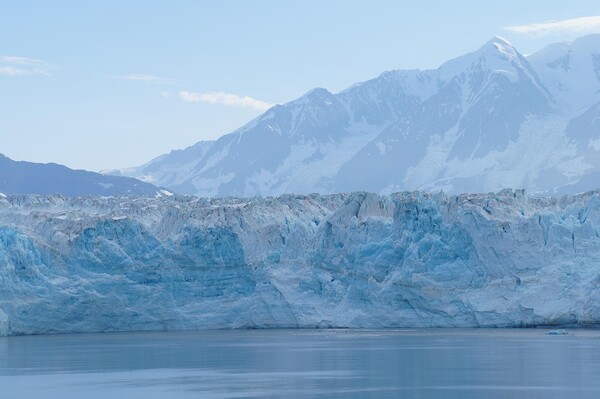
해양 온난화로 유입된 따뜻한 대서양 해수가 북동그린란드 빙류(NEGIS)의 빙저선을 불안정하게 만들며, 대규모 후퇴와 빙붕 붕괴를 촉발한 것으로 나타났다. [사진출처(Photo Source) = Pixabay]
해양 온난화가 북동그린란드 빙류(Northeast Greenland Ice Stream, NEGIS)의 대규모 후퇴를 촉발한 메커니즘이 새 연구를 통해 규명됐다. 이번 연구는 과거 변화를 추적해, 현재 진행 중인 기후 변화 속에서 NEGIS의 취약성을 이해할 수 있는 핵심 단서를 제시한다.
NEGIS는 그린란드 빙상에서 바다로 흘러드는 가장 큰 빙류다. 이 빙류에 포함된 얼음의 양은 전 세계 해수면을 약 1.1~1.4미터(m) 상승시킬 수 있을 정도다. 이에 따라 NEGIS의 안정성은 미래 해수면 상승 전망을 좌우하는 핵심 요소로 평가된다.
영국 뉴캐슬대학교(Newcastle University)와 더럼대학교(Durham University)가 주도한 이번 연구에서 연구진은 약 2만 년 전 최후빙기 극대기 이후 NEGIS의 거동을 재구성했다.
그 결과 대기 변화뿐 아니라 해양 과정이 과거 급격한 빙하 후퇴 국면에서 결정적인 역할을 했음을 밝혀냈다. 여기서 빙하 후퇴는 빙저선과 빙하 말단이 내륙 방향으로 이동하며 대규모 얼음 손실로 이어지는 과정을 의미한다.
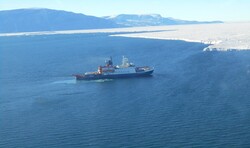
그린란드 니오그할브피에르드스피오르덴 빙하(Nioghalvfjerdsfjorden Glacier, 79N) 앞바다를 항해 중인 독일 쇄빙 연구선 RV Polarstern의 모습. 헬리콥터에서 촬영했다. [사진제공(Photo Source) = 루이즈 캘러드(Louise Callard) / 뉴캐슬대학교(Newcastle University)]
국제학술지 『네이처 커뮤니케이션(Nature Communications)』에 게재된 이번 연구는, 빙하가 기반암에서 떨어져 바다에 떠오르기 시작하는 지점인 빙저선에 주목했다. 연구에 따르면 빙저선이 따뜻한 해수에 노출될 경우, 해당 빙류와 빙붕은 후퇴와 붕괴에 훨씬 더 취약해진다.
이번 연구의 제1저자인 루이즈 캘러드(Louise Callard) 박사이자 뉴캐슬대 자연지리학 부교수는 “NEGIS가 붕괴될 경우 전 세계 해수면을 크게 상승시킬 수 있다. 따라서 이 빙류의 거동을 좌우하는 요인을 이해하는 것이 매우 중요하다”고 강조했다. 이어 “고기후 기록은 과거 변화에 대한 독보적인 자료를 제공한다”며 “이를 통해 현재 진행 중인 빙하 후퇴의 원인을 파악할 수 있다”고 덧붙였다.
그는 “이번 연구 결과는 현대 빙상이 왜 후퇴하고 있는지를 이해하는 데 있어 빙하와 해양 간 상호작용이 얼마나 중요한지를 보여준다”며 “실제 관측과 컴퓨터 모델 모두 이러한 해양 주도 과정을 반드시 반영해야 한다”고 설명했다.
연구진은 약 2만300년 전부터 1만7천600년 전 사이에 빙하의 초기 후퇴 단계가 발생했음을 확인했다. 당시 대기 온도는 현재보다 약 20~15℃ 낮은 수준이었다. 이는 이 시기의 후퇴가 대기 온난화 때문이 아니라, 따뜻한 대서양 해수가 빙류 하부까지 유입되며 빙저 용융이 강화한 데 따른 것으로 분석된다.
이후 지질학적 기록은 약 1만5천년 전, 따뜻한 대서양 해수가 더 깊숙이 유입되면서 빙붕 하부의 용융이 강화돼 뚜렷한 빙붕 붕괴 단계가 나타났다. 여기에 대기 온도의 급격한 상승이 더해지면서 빙하 표면이 빠르게 얇아졌고, 이 두 요인이 맞물리며 빙붕의 해체를 촉발했다. 그 결과 빙저선이 불안정해지며, 빙하는 결국 내측 대륙붕 방향으로 후퇴한 것으로 확인됐다.
이번 연구는 더럼대학교가 주도하는 대형 연구 프로젝트 ‘더 따뜻해진 기후 속 그린란드(Greenland in a Warmer Climate)’의 일환으로 수행됐다.
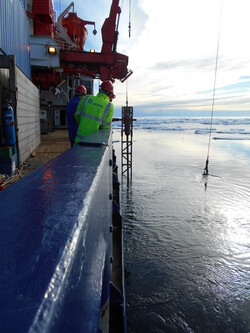
독일 쇄빙 연구선 RV 폴라슈테른(RV Polarstern)에서 중력식 코어 채취기를 투입해 해저 퇴적물 코어 시료를 수집하는 모습. [사진제공(Photo Source) = 루이즈 캘러드(Louise Callard) / 뉴캐슬대학교(Newcastle University)]
이 프로젝트의 책임연구자인 데이비드 로버츠(David Roberts) 더럼대학교 지리학 교수는 그린란드 빙상 가운데서도 민감도가 높은 NEGIS가 현재 북동대서양 지역의 빙하와 해양 간 상호작용을 좌우하는 핵심 요소라고 설명했다. 그는 이러한 이유로 과거 NEGIS가 어떻게 변화해 왔는지를 파악하는 것이 매우 중요하다고 덧붙였다.
로버츠 교수는 “빙상과 해양의 상호작용을 통제하는 핵심적인 피드백을 이해하는 것은 극지방에서 진행 중인 환경 변화를 파악하는 것뿐만 아니라, 미래 전 지구적 해수면 상승을 예측하는 데에도 중요하다”고 말했다.
이어 그는 “지난 10년간의 연구를 통해 NEGIS가 장기간에 걸쳐 얼마나 얇아졌고, 언제 어디에서 후퇴해 왔는지를 파악해 빙류와 해양 간 피드백에 대한 이해도 크게 높였다”며 “이번 연구는 그린란드에서 발생한 빙붕 붕괴를 지질학적 기록에서 인식한 초기 연구 가운데 하나로, 고해상도의 고빙하학·고해양학적 재구성이 과학계에서 얼마나 중요한지를 분명히 보여준다”고 덧붙였다.
이번 프로젝트의 해당 연구는 더럼대학교와 영국 남극조사국(British Antarctic Survey) 그리고 독일의 알프레드 베게너 연구소(Alfred Wegener Institute, AWI) 소속 과학자들이 공동으로 수행했다. 연구진은 AWI와 협력해 2016년과 2017년, 독일 쇄빙 연구선 RV 폴라슈테른(RV Polarstern)을 이용해 두 차례 해상 조사에 나섰다.
이 과정에서 해저 지형 자료와 퇴적물 코어가 수집됐으며, 이후 퇴적물 및 미화석 분석의 핵심 자료로 활용됐다. 이러한 데이터는 이번 연구의 주요 결과를 도출하는 데 기초가 됐다.
New research reveals how ocean warming triggered the large-scale retreat of the Northeast Greenland Ice Stream (NEGIS) - offering vital clues for understanding its modern-day vulnerability.
NEGIS is the largest ice stream draining the Greenland Ice Sheet into the ocean. It contains enough ice to raise global sea level by 1.1 – 1.4 metres. Its stability is therefore critical for future sea-level projections.
By reconstructing the behaviour of NEGIS over the last 20,000 years – since the end of the Last Glacial Maximum - the research team, led by Newcastle University and Durham University, showed that oceanic processes, not just atmospheric changes, played a decisive role in past episodes of rapid ice retreat.
The research, published in Nature Communications, found that when an ice stream’s grounding line (where ice lifts off from its bed and begins to float), is exposed to warm ocean water, the ice stream and its ice shelves become much more vulnerable to retreat and collapse.
Lead author Dr Louise Callard, Senior Lecturer in Physical Geography, Newcastle University, emphasised the significance of these findings: “If the Northeast Greenland Ice Stream collapses, it has the potential to significantly raise global sea levels, so knowing what controls its behaviour is crucial. The palaeo record provides an unparalleled archive of past changes, allowing us to recognise what is driving current retreat.”
“These findings highlight how important ice–ocean interactions are for understanding why modern ice sheets are retreating. Both observations and computer models must account for these ocean-driven processes.”
The team found that an initial period of retreat occurred between 20,300 and 17,600 years ago. Air temperatures were still low at this point, around -20° to -15 ° C lower than present, suggesting that warm Atlantic Water reaching the base of the ice stream was the main driver for this early retreat via enhanced melt.
The geological record then shows a period of distinctive ice shelf collapse triggered by warm Atlantic water advancing farther and enhanced sub-ice shelf melt around 15,000 yrs ago.
This was combined with a rapid rise in air temperatures which undoubtedly drove surface thinning. Together, both mechanisms drove ice shelf disintegration, ultimately causing grounding line instability and ice retreat onto the inner continental shelf.
The research took place as part of the wider project, Greenland in a Warmer Climate, led by Durham University. Professor David Roberts, the project’s Principal Investigator from Durham University, also stressed how critical it has been to understand the past dynamic behaviour of NEGIS, given this highly sensitive sector of the Greenland Ice Sheet plays a critical role in controlling contemporary ice-ocean interaction in the NE Atlantic.
“Understanding the key feedbacks that control ice sheet/ocean interaction is important not only for contemporary environmental change around the poles, but also for predicting future global sea-level rise,” Professor Roberts said.
“As part of our work on this project over the last 10 years, we have not only constrained the long term thinning and retreat history of the NEGIS, but we now have a much better understanding of ice stream/ocean feedbacks. This paper is one of the first to recognise ice shelf break-up in the geological record in Greenland and it demonstrates the critical importance of high resolution, palaeoglaciological and palaeooceanographic reconstruction to the scientific community.”
This part of the project was carried out with scientists from Durham University, the British Antarctic Survey, and the Alfred Wegener Institute (AWI), Germany. Working together with AWI colleagues the offshore team undertook two research trips on the German ice breaker RV Polarstern in 2016 and 2017.
Those trips resulted in the collection of seafloor bathymetric data and sediment cores, which later formed the focus of sedimentary and microfossil analysis, and which provided the foundation for the study’s key findings.
The research was funded by UK Natural Environment Research Council (NERC) grant NE/N011228/1.
 즐겨찾기 추가
 시작페이지로 설정