[일본] 바닷속으로 가라앉은 미세플라스틱, 어디로 흘러갈까
일본 규슈대 연구진, 해양의 다양한 수심에서 미세플라스틱 탐지·추적에 성공
수심 0~1,000m 샘플링 기법 개발… 극소 미세플라스틱 정밀 분석
표류·침강 두 경로 규명… 해양 오염 장기화 우려
국제 학술지『Environmental Science & Technology(환경과학기술)』최근호에 발표
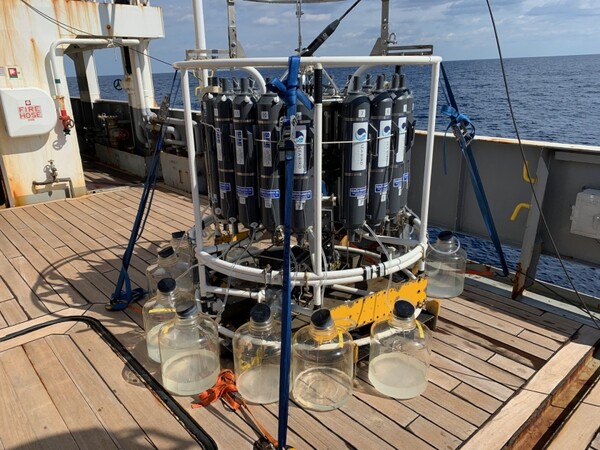
해수 채집 장비(The water sampler): 훈련선 우미타카마루(Umitaka-maru)에 설치된 다층식 채수기. 이 장비는 서로 다른 수심에서 약 50L(리터)의 해수를 채집해 극소 미세플라스틱 분석에 활용된다. [사진제공(Photo Source) = 규슈대학교(Kyushu University)]
규슈대학교(Kyushu University) 연구진은 국제 학술지『Environmental Science & Technology(환경과학기술)』최근호에 발표된 논문에서 “해양의 다양한 수심에서 극소 미세플라스틱의 분포를 보다 정확하게 분석할 수 있는 새로운 기법을 개발했다”고 밝혔다.
연구 결과, 해수 중에 떠 있는 극소 미세플라스틱의 농도는 ㎥(세제곱미터)당 1천~1만 개에 이르는 것으로 나타났다. 또 이 입자들이 심해로 가라앉는 과정에는 두 가지 뚜렷한 경로가 있다는 점도 확인했다. 일부는 거의 중성 부력을 띠며 특정 수심에서 머물러 이동했고, 다른 일부는 빠르게 가라앉아 깊은 바다까지 내려갔다.
20세기 초 플라스틱이 등장한 이후, 플라스틱 폐기물과 오염은 전 세계적인 문제로 자리 잡았다. 플라스틱은 시간이 지나면서 더 작은 조각으로 부서지는데, 그 크기가 5mm 미만이 되면 ‘미세플라스틱’이라고 불린다.
이번 연구를 이끈 이소베 아츠히코(Atsuhiko Isobe) 규슈대학교 응용역학연구소(Research Institute for Applied Mechanics) 교수는 “이 미세플라스틱이 더 분해돼 10~300 µm(마이크로미터) 크기가 되면 ‘극소 미세플라스틱’이라고 부른다. 많은 연구자가 해양 속 미세플라스틱의 분포와 이동을 조사하고 있지만, 이 정도 크기가 되면 채집과 분석이 훨씬 어려워진다”고 설명했다. 이어 그는 “극소 미세플라스틱의 존재를 평가하면서 오염·입자 손실·추가 파쇄 가능성을 최소화할 표준화된 프로토콜도 그동안 없었다”고 덧붙였다.
해양에 존재하는 미세플라스틱의 상당수는 폴리에틸렌(polyethylene)과 폴리프로필렌(polypropylene)으로 만들어졌다. 이들은 바닷물보다 밀도가 낮아 처음에는 수면 가까이에 떠 있다. 그러나 시간이 지나면서 미세플라스틱 표면에 조류나 박테리아 같은 미생물이 점차 달라붙게 되는데, 이를 ‘바이오파울링(biofouling)’이라 한다. 이 과정이 진행되면 미세플라스틱의 무게가 증가해 바닷속으로 가라앉게 된다.
이전 연구들은 그동안 극소 미세플라스틱을 채집하기 위해 주로 네트를 끌어 올리거나 서로 다른 수심의 해수를 펌프로 채수하는 방식을 사용해왔다. 그러나 이런 방법만으로는 수심별로 극소 미세플라스틱이 어떻게 분포하는지 정밀하게 파악하기에는 한계가 있었다.
이소베 교수는 “수심별 분포를 더 정확하게 파악하기 위해 북태평양 4개 해역에서 수심 0~1,000m에 걸친 12개 해양 층의 해수를 채집하는 프로토콜을 마련했다”며 “이 방법은 약 50L(리터)의 해수만으로도 분석이 가능해, 기존 펌프 방식에 비해 필요한 시료량이 1~2자릿수 적다”고 설명했다.
정확한 검출을 보장하고 공기 중 미세플라스틱에 의한 오염을 막기 위해 분석은 조사선에 설치된 클린부스에서 진행됐다. 또한 연구팀은 쉽게 파손되는 이 극소 미세플라스틱의 손상을 최소화하기 위한 별도의 프로토콜도 마련했다.
이소베 교수는 “이번 연구를 통해 극소 미세플라스틱이 표류와 침강이라는 두 가지 다른 경로를 통해 심해에 도달한다는 사실이 확인됐다”고 밝혔다. 이어 “첫 번째 경로에서는 극소 미세플라스틱이 해수와 거의 같은 중성 부력 상태에 이르며, 이후 수심 약 100~300m 지점에서 해수 밀도가 1,023~1,025㎏/㎥인 층을 따라 이동하게 된다”고 설명했다. 그는 “극소 미세플라스틱은 약 20~40년가량 이 밀도층에서 머물며 이동하는 것으로 보인다”고 덧붙였다.
다른 경로는 바이오파울링으로 밀도가 높아지면서 해저로 가라앉는 방식이다. 연구팀은 바다에서 표류하는 극소 미세플라스틱의 농도가 ㎥당 1천~1만 개 수준이라는 점도 확인했다.
이소베 교수는 “앞으로 해양 전역에 미세플라스틱이 얼마나 넓게 퍼져 있는지 규명하기 위해 더 많은 데이터를 수집할 계획이며, 이들이 해양 환경에 미치는 영향도 조사할 예정”이라고 밝혔다. 그는 “미세플라스틱의 환경 영향을 완전히 규명하려면 시간이 더 필요하지만, 이번 연구는 해양 환경이 되돌릴 수 없을 정도로 오염되고 있으며 시급한 대응이 필요하다는 사실을 보여준다”고 말했다.
이번 연구에 대한 자세한 내용은 『Environmental Science & Technology』에 실린 ‘Settling and Along-Isopycnal Subduction of Small Microplastics Into Subsurface Layers of the Western North Pacific Ocean’(마오 구로다(Mao Kuroda), 이소베 아츠히코, 우치다 게이이치(Keiichi Uchida), 하기타 류이치(Ryuichi Hagita), 하마다 사토루(Satoru Hamada)) 논문에서 확인할 수 있다.
[원문보기]
Where do microplastics go once they sink into the ocean?
Researchers succeed in detecting and tracking microplastics across varying ocean depths
Publishing in the journal Environmental Science & Technology, researchers at Kyushu University report that they have developed a new method to more accurately analyze the distribution of small microplastics in the ocean at various depths.
Their findings showed that concentrations of small microplastics suspended in the ocean range from 1,000 to 10,000 particles per cubic meter. The team also discovered that small microplastics sink to the depths of the ocean in two distinct ways: some attain near-neutral buoyancy and drift at specific depths, while others sink rapidly to the deep sea.
Since the advent of plastic in the early 20th century, plastic waste and pollution have been a global issue. As plastics degrade, they break off into smaller pieces. When they reach less than 5 mm in size, they are called microplastics.
“When these microplastics degrade further to 10-300 µm, we call them small microplastics. Many researchers are investigating the distribution and movement of microplastics in the ocean. However, when they reach that size, they become harder to collect and analyze,” explains Professor Atsuhiko Isobe of Kyushu University Research Institute for Applied Mechanics and one of the researchers who led the study.
“There was no standardized protocol to evaluate the presence of small microplastics in the ocean that could minimize contamination, particle loss, and potential fragmentation.”
Most ocean microplastics are made of polyethylene and polypropylene. These materials are less dense than seawater, so they float near the sea surface. However, over time, algae, bacteria, and other marine organisms attach to their surface in a process called biofouling. This results in the microplastic increasing in weight and sinking toward the seafloor.
Past studies that collected small microplastics from the ocean used net tows or pumped ocean water from different depths. However, researchers still lacked a detailed view of the distribution of small microplastics at different ocean depths.
“To achieve this clearer view, we developed a protocol that collected seawater from 12 ocean layers (from 0 to 1,000 m) across 4 regions in the North Pacific Ocean,” explains Isobe. “Our method required only about 50 liters of seawater, which is one to two orders of magnitude less than conventional pump sampling.”
To ensure accurate detection and prevent contamination from airborne microplastics, the analysis was conducted inside a clean booth installed on the surveying vessel. The team also developed a protocol designed to minimize the destruction of these fragile microplastics.
“Our findings revealed that small microplastics reach sea depths via two distinct pathways: drifting and sinking. In the first pathway, small microplastics reach neutral buoyancy with the seawater. They then drift in an area of the ocean where water density is between 1,023 and 1,025 kilograms per cubic meter at depths of about 100 to 300 meters,” Isobe continues. “These small microplastics will drift through this layer for approximately 20 to 40 years.”
The other way small microplastics reach the depths of the sea is by increasing their density through biofouling, causing them to sink to the seafloor. The team observed that the concentration of small microplastics drifting in the ocean ranged from 1,000 to 10,000 particles per cubic meter of seawater.
“Moving forward, we want to collect more data to clarify how widely microplastics are distributed throughout the ocean. We also intend to investigate their impact on the marine environment,” concludes Isobe.
“Understanding the environmental impact of microplastics will require more time, but our findings show that the marine environment is becoming irreversibly polluted and necessitates urgent countermeasures.”
For more information about this research, see "Settling and Along-Isopycnal Subduction of Small Microplastics Into Subsurface Layers of the Western North Pacific Ocean" Mao Kuroda, Atsuhiko Isobe, Keiichi Uchida, Ryuichi Hagita, and Satoru Hamada, Environmental Science & Technology, https://doi.org/10.1021/acs.est.5c08983
[출처 = 규슈대학교(Kyushu University)(https://www.kyushu-u.ac.jp/en/researches/view/362) / 2025년 12월 2일]
|  즐겨찾기 추가
 시작페이지로 설정
























