루앗 부옹(Luat Vuong) 캘리포니아대학교 리버사이드캠퍼스(University of California, Riverside, UCR) 말란 앤드 로즈메리 번스 공과대학(Marlan and Rosemary Bourns College of Engineering) 기계공학 부교수 연구팀은 가시광선보다 높은 주파수를 가진 빛, 특히 눈에 보이지 않는 심자외선(deep UV) 영역의 빛이 염분과 물 분자 사이의 강한 결합을 효과적으로 분리할 수 있음을 세계 최초로 입증했다.
부옹 부교수는 “우리 연구팀이 알기로는 심자외선 영역을 활용해 염수를 분리하는 개념을 제시한 사례는 아직 없다”고 말했다. 그녀는 “300~400나노미터(nm) 파장의 자외선은 일반적으로 살균에 사용하지만, 200나노미터대의 심자외선 영역 잘 알려져 있지 않다”며 “이 빛을 담수화에 어떻게 활용할 수 있을지 본격적으로 탐구한 최초의 연구팀일 것”이라고 설명했다.
실용화까지는 아직 많은 연구가 필요하지만, 이번 발견은 향후 연구와 혁신의 새로운 가능성을 열었다.
부옹 부교수 연구팀의 논문은 『ACS 어플라이드 머티리얼스 앤 인터페이시(ACS Applied Materials & Interfaces)』 최근호에 게재됐다. 연구팀은 알루미늄 나이트라이드(Aluminum Nitride)라는 단단한 흰색 세라믹으로 심지를 제작해, 특정 파장의 빛을 활용함으로써 염수를 가열하지 않고도 소금을 분리할 수 있는 원리를 입증했다.
기존의 태양열 담수화 방식이 어두운 재료로 열을 흡수해 물을 끓이는 데 의존하는 반면, 부옹 연구팀의 방식은 특정 파장의 빛을 활용해 열을 가하지 않고도 소금과 물을 분리하는 방법을 구현했다.
연구팀은 밀폐된 챔버 안에 두 개의 세라믹 심지를 넣고, 동일한 환경 조건이 유지되도록 한 뒤 실험을 진행했다. 그 결과 보라색 빛을 받은 염수 시료는 어둠 속에 두거나 붉은색·노란색·적외선 빛에 노출된 시료보다 훨씬 빠르게 증발했다.
루앗 부옹(Luat Vuong) 캘리포니아대학교 리버사이드캠퍼스(University of California, Riverside, UCR) 말란 앤드 로즈메리 번스 공과대학(Marlan and Rosemary Bourns College of Engineering) 기계공학 부교수 연구팀은 가시광선보다 높은 주파수를 가진 빛, 특히 눈에 보이지 않는 심자외선(deep UV) 영역의 빛이 염분과 물 분자 사이의 강한 결합을 효과적으로 분리할 수 있음을 세계 최초로 입증했다. [사진출처(Photo source) = 캘리포니아대학교 리버사이드캠퍼스(UCR)]
부웅은 “질화알루미늄(Aluminum nitride)은 결정 구조 덕분에 심자외선을 방출하기에 적합한 물질”이라고 설명했다.
연구팀은 이 물질이 ‘광업컨버전(photon upconversion)’ 과정을 유도하는 것으로 보고 있다. 이는 낮은 에너지의 광자 두 개가 결합해 더 높은 에너지를 가진 하나의 광자로 전환되는 현상이다.
이렇게 전환된 광자는 더 강력한 에너지를 방출하는데, 이는 염수 속 염분과 물분자의 결합을 끊을 만큼 충분한 힘이다. 만약 이 과정에서 많은 열이 발생하지 않는다면, 끓이거나 가열을 통해 증기를 만드는 기존의 태양열 담수화 방식이 아닌 비열기반의 새로운 담수화 기술 대안이 될 수 있다.
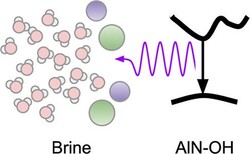
질화알루미늄(AIN-OH)을 통해 방출된 자외선이 염분과 물의 결합을 분리하는 과정. [사진제공(Photo Source) = UCR]
이러한 태양열 시스템은 막을 통과시키기 위해 고압 펌프를 사용하는 역삼투압(RO) 방식의 막대한 전력 손실을 줄이는 데 큰 도움이 될 수 있다. 또한 RO 과정에서 발생하는 고염도 염수 폐기물 문제도 해결할 수 있는데, 이 폐수는 수계에 방류될 때 해양 생태계를 위협한다.
이 심지 기술은 담수화 외에도 다양한 분야에 응용할 수 있다. 대표적으로 다른 폐기물 처리 공정이나 극한 환경에서의 광물 채취, 혹은 소금물을 이용한 증발 냉각 시스템 등으로 활용 가능하다.
그러나 부옹은 “질화알루미늄 기반의 태양열 담수화 시스템이 널리 활용되기까지는 추가적인 연구가 필요”하다고 강조했다. 이어 “다른 물질로도 비슷한 효과를 낼 수 있겠지만, 질화알루미늄은 현실적인 선택”이라며, “값이 저렴하고 구하기 쉬우며, 무독성이고 물에 잘 젖는 데다 내구성도 뛰어나다”고 말했다.
부옹 연구팀은 빛을 이용한 증발 과정을 더 깊이 이해하고 효율을 높이기 위해 시스템 구조와 제작 공정, 분광학적 도구를 설계하고 있다.
이번 프로젝트의 정식 명칭은 ‘비열기반 염수 증발을 위한 스펙트럼 선택적 계면 및 재료(Spectrum Selective Interfaces and Materials Toward Nonphotothermal Saltwater Evaporation: Demonstration with a White Ceramic Wick)’이다. 연구는 미국 국립과학재단(NSF), 교육부, 그리고 UCR의 시드 펀딩 등 여러 기관의 연구 지원을 받아 진행됐다.
박사과정생 나빈드라 싱(Navindra Singh), 주천 궈(Juchen Guo) 교수, 석사과정생 제임스 렁(James Leung). [사진제공(Photo Source) = UCR]
UCR 석사과정생 제임스 렁(James Leung)이 논문 연구의 일환으로 이번 프로젝트를 시작했다. 이후 박사과정생 나빈드라 싱(Navindra Singh)이 분석을 완료했으며, 이번 연구의 제1 저자로 참여했다.
공동 저자로는 주천 궈(Juchen Guo) 교수, 연구원 지 펑(Ji Feng)과 알마 K. 곤살레스-알칼데(Alma K. González-Alcalde), 그리고 학부생 애리얼 톨렌티노(Arial Tolentino)와 데이비드 터프트(David Tuft)가 참여했다.
[원문보기]
A team of UC Riverside researchers has identified a potential breakthrough in solar desalination that could reduce the need for energy-intensive saltwater treatment
Led by Luat Vuong, an associate professor of mechanical engineering in UCR’s Marlan and Rosemary Bourns College of Engineering, the team has demonstrated for the first time how the highest frequencies of light—specifically invisible deep UV light—can be effectively leveraged to break the stubborn bonds between salt and water.
“To our knowledge, nobody else has yet articulated this deep UV channel for salt-water separation,” Vuong said. “UV light -- on the border of the violet visible range-- **in the wavelength range of 300-400 nanometers is used for disinfection, but this deep UV channel around 200 nanometers is not well known. We may be the first to really think about how you can leverage it for desalination.”
While much work remains before practical applications are developed, the discovery provides a clear path for further research and innovation.
Published in ACS Applied Materials & Interfaces, the study by Vuong and her colleagues details how the team made a wick from aluminum nitride—a hard, white ceramic—to separate salt from water by harnessing specific light wavelengths that interact with salt water without heating the bulk liquid. Unlike traditional solar desalination methods, which rely on dark materials to absorb heat and boil water, Vuong’s approach could bypass the need for thermal processes altogether.
The experiments involved placing pairs of ceramic wicks in an enclosed chamber, with each allowed to equilibrate or adjust to similar environmental conditions. Under violet light, evaporation rates of salt water increased significantly compared to control samples kept in the dark or exposed to red, yellow, or infrared light.
“Aluminum nitride is well suited for emitting deep UV light due to its crystalline structure,” Vuong explained.
The material may be triggering a process called “photon upconversion,” in which low-energy photons combine into a single high-energy photon. That upconverted photon delivers a more powerful punch, potentially strong enough to break the salt-water bonds.
If this upconversion process occurs without generating excess heat, the approach could offer a non-photothermal alternative to traditional solar desalination systems that boil or heat salt water to produce vapor, which then condenses into fresh water.
Such solar systems also could reduce the heavy electricity demands of reverse osmosis systems, which use high-pressure pumps to force salt water through membranes. The system could also address the concentrated reverse-osmosis brine waste, which is toxic to marine life when discharged into waterways.
Other potential applications for the wicking approach may be for other waste management processes, harvesting minerals in extreme environments, or replacing “swamp” coolers with salt water evaporation systems.
Still, Vuong emphasized that further research is needed before aluminum nitride-based solar desalination systems can be engineered for widespread use.
“Other materials may be designed to be just as effective, but aluminum nitride is practical. It is inexpensive, widely available, non-toxic, highly hydrophilic, and durable,” Vuong said.
Moving forward, Vuong’s group is design
ing system architectures, fabrication processes, and spectroscopic tools to better understand and enhance the light-driven evaporation.
The project, titled “Spectrum Selective Interfaces and Materials Toward Nonphotothermal Saltwater Evaporation: Demonstration with a White Ceramic Wick,” is supported through a range of research efforts and funding agencies, including the National Science Foundation, the Department of Education, and UCR seed funding.
UCR master’s student James Leung initiated this project as his thesis effort. UCR doctoral student Navindra Singh completed the analysis and is the lead author of the study. Other co-authors include UCR Professor Juchen Guo, researchers Ji Feng and Alma K. González-Alcalde, and undergraduate students Arial Tolentino and David Tuft.
 즐겨찾기 추가
 시작페이지로 설정