[미국] 내무부, 2025년 핵심 광물 목록 발표
USGS, 2025년 핵심 광물 목록 발표…보론·인·우라늄 등 10개 광물, 신규 핵심 광물로 지정
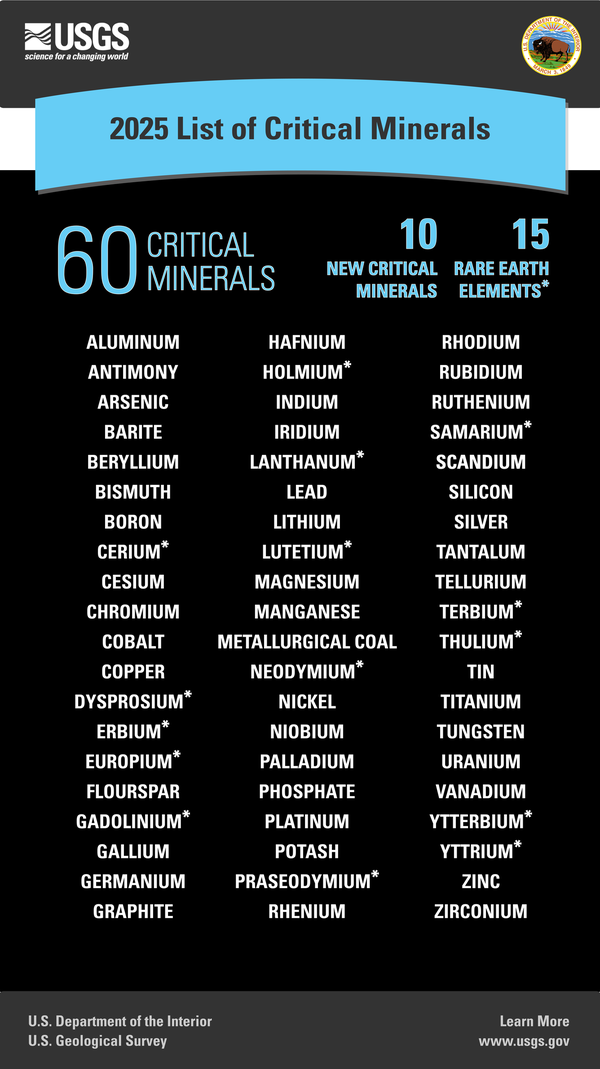
2025년 핵심 광물 목록. [자료출처 = 미국 지질조사국(U.S. Geological Survey)]
내무부(Department of the Interior)는 미국 지질조사국(USGS)을 통해 오늘 2025년 핵심 광물(Critical Minerals) 최종 목록을 발표했다고 밝혔다. 이 목록에는 공급망 중단으로 인한 잠재적 위험에 직면한 미국 경제와 국가 안보에 필수적인 60개의 핵심 광물을 담고 있다.
핵심 광물은 미국 「에너지법(Energy Act)」에 따라 △미국의 경제적 또는 국가 안보에 필수적 △제품 제조에 필수적인 기능 수행 △혼란에 취약한 공급망 등 세 가지 조건에 포함되는 광물을 말하며, 이번 목록은 연방 기관의 광물 안보 강화를 지시하는 2017년 행정명령(EO 13817)에 따라 시작된 이후 세 번째 목록이다.
더그 버검(Doug Burgum) 내무부 장관은 "2017년 트럼프 대통령은 미국의 경제와 국가 안보를 강화하는 데 필요한 광물 자원을 먼저 파악한 후 확보하는 목표를 세웠다. 2025년 핵심 광물 목록은 외국의 적대국에 대한 의존도를 낮추고 국내 생산을 확대하며 미국의 혁신을 이끌어낼 수 있는 명확한 데이터 기반 로드맵을 제공한다"면서 "광물 업계 및 주 정부 파트너들과 협력하여 에너지, 국방, 기술 공급망에 필요한 광물이 미국에서 채굴 및 가공되도록 하고 있으며, 미국은 다시 한번 광물 강국으로 거듭나고 있다"고 말했다
미국 지질조사국은 광물 공급 중단이 미국 경제와 국가 안보에 어떤 영향을 미칠 수 있는지 평가하기 위해 업데이트된 방법을 사용하여 2025년 목록 초안을 개발했다. 최종 목록에는 새로운 데이터, 대중의 피드백 및 기관 간 권고 사항을 바탕으로 붕소(boron), 구리(copper), 납(lead), 제철용 석탄(metallurgical coal), 인(phosphate), 탄산칼륨(potash), 레늄(rhenium), 실리콘(silicon), 은(silver), 우라늄(uranium) 등 10가지 새로운 광물이 핵심 광물로 추가됐다.
특히, 이번 목록에는 희토류 원소의 중요성이 강조됐다. 희토류는 공급 차질이 발생할 경우 미국 경제에 가장 큰 비용을 초래하는 핵심 광물의 일부로, 스마트폰, 하드 드라이브, 첨단 방위 시스템과 같은 기술에 필수적이다.
올해 목록에는 △세륨(CERIUM) △디스프로슘(DYSPROSIUM) △에르븀(ERBIUM) △유로퓸(EUROPIUM) △가돌리늄(GADOLINIUM) △홀뮴(HOLMIUM) △란탄늄(LANTHANUM) △루테튬(LUTETIUM) △네오디뮴(NEODYMIUM) △프라세오디뮴(PRASEODYMIUM) △사마륨(SAMARIUM) △테르븀(TERBIUM) △툴륨(THULIUM) △이테르븀YTTERBIUM) △이트륨(YTTRIUM) 등 15개 희토류가 핵심 광물로 지정됐다.
한편, 미국은 지난해 사용하는 희토류의 80%를 수입했다. 올해 트럼프 행정부는 공급망 강화를 위해 미국 생산에 투자하고 호주, 일본, 말레이시아, 태국 등의 파트너를 통해 공급망을 확보하는 과감한 조치를 취하고 있다.
미국 지질조사국은 「에너지법」에 따라 최소 3년에 한 번씩 핵심 광물 목록을 발표하고 있으며, 미국 내 광물 자원량을 지도화하고 지질학적 특성이 광물의 품질, 규모, 그리고 채굴 가능성에 미치는 영향을 더 잘 이해하기 위한 과학 연구를 진행하고 있다.
[원문보기]
Interior Department releases final 2025 List of Critical Minerals
The Department of the Interior, through the U.S. Geological Survey, today published the final 2025 List of Critical Minerals, outlining 60 minerals vital to the U.S. economy and national security that face potential risks from disrupted supply chains.
“In 2017, President Trump set a goal of first identifying and then securing the mineral resources needed to bolster America’s economy and national security. The 2025 List of Critical Minerals provides a clear, data-driven roadmap to reduce our dependence on foreign adversaries, expand domestic production and unleash American innovation,” said Secretary of the Interior Doug Burgum.
“By working with the mineral industry and state partners, we are ensuring that the minerals powering our energy, defense, and technology supply chains are mined and processed in the United States, which is becoming a mineral powerhouse once again.”
The U.S. Geological Survey developed the draft 2025 List using updated methods to assess how disruptions in mineral supply could affect the U.S. economy and national security. The final List adds 10 new minerals—boron, copper, lead, metallurgical coal, phosphate, potash, rhenium, silicon, silver, and uranium—based on new data, public feedback and interagency recommendations.
“USGS mineral science is a national asset—and the Energy Act President Trump signed in 2020 directs us to incorporate expertise from the public and from agencies outside the Department of the Interior when developing this List,” said Andrea Travnicek, Assistant Secretary of the Interior for Water and Science.
“Industry, the public and other agencies including the Departments of Agriculture, Energy and War helped to ensure the 2025 List of Critical Minerals includes the minerals needed to protect the nation's food and energy supplies as well as defense and the economy as a whole.”
The 2025 List marks the third List since the effort began under a 2017 Executive Order (EO 13817) directing federal agencies to strengthen mineral security. The Energy Act of 2020 requires the List to be reviewed at least every three years to reflect new data and changing supply conditions. Accordingly, the List is not static; it is intended to be dynamic and will be updated at least every two years to reflect evolving circumstances.
Today’s publication highlights the importance of rare earth elements, a subset of critical minerals whose supply disruption would impose the highest cost on the U.S. economy, which are essential to technologies like smartphones, hard drives, and advanced defense systems. In 2024, the U.S. imported 80% of the rare earth elements it used.
This year, the Trump administration has taken decisive steps to bolster our supply chains: investing in U.S. production and securing access through partners in Australia, Japan, Malaysia, and Thailand. Meanwhile, the USGS is mapping new domestic deposits and advancing the science to better understand how geology influences their quality, size, and viability for extraction.
“This is the most comprehensive, science-based assessment yet of the minerals our nation relies on,” said Ned Mamula, USGS director. “Critical minerals underpin industries worth trillions of dollars, and import dependence puts key sectors at risk. This work helps secure the materials needed for U.S. economic growth and technological leadership.”
[출처 = 미 내무부(Department of the Interior)(Interior Department releases final 2025 List of Critical Minerals | U.S. Department of the Interior) / 11월 7일]
|  즐겨찾기 추가
 시작페이지로 설정
























