[해외연구보고서] 시카고대, PFAS 빠르게 감지하는 초소형 센서 개발
컴퓨터 시뮬레이션 및 기계학습 활용해 고감도·선택적 분자 프로브 설계
초소형 센서, 가정에서도 몇 분안에 1천조분의 1 수준 PFAS 검출
EPA 신규 기준, PFOS 및 PFOA 기준치 모니터링에 활용 가능
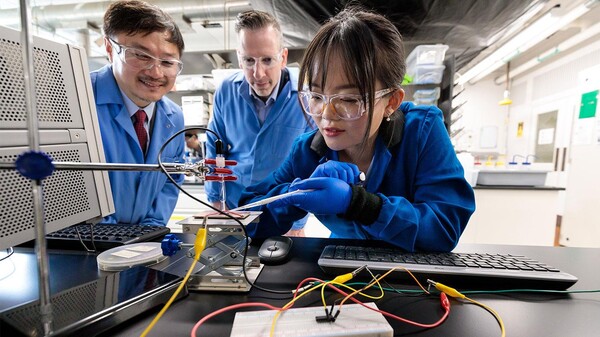
미국 시카고대학교 프리츠커 분자공학과(UChicago PME)와 아르곤 국립연구소(Argonne National Laboratory) 연구진이 '영원한 화학물질'로 알려진 PFAS를 물속에서 극미량까지 검출할 수 있는 새로운 방법을 공동 개발했다. 사진은 왼쪽부터 천쥔홍(Junhong Chen) 시카고대 프리츠커 분자공학과 교수, 세스 달링(Seth Darling) 아르곤 국립연구소와 시카고대의 선임 연구원, 왕위친(Yuqin Wang) 시카고대 프리츠커 분자공학과 대학원생이 새로운 센서를 살펴보고 있는 모습. [사진제공(Photo Source) = John Zich, University of Chicago]
미국 시카고대학교 프리츠커 분자공학과(UChicago PME)와 아르곤 국립연구소(Argonne National Laboratory) 연구진이 '영원한 화학물질'로 알려진 PFAS를 물속에서 극미량까지 검출할 수 있는 새로운 방법을 공동 개발했다. 이 기술은 휴대용 기기를 통해 보급될 예정이며, 특수 프로브(Probe)를 활용해 인체에 유해할 수 있는 일부 PFAS의 농도를 정밀하게 수치화한다.
천쥔홍(Junhong Chen) 시카고대 프리츠커 분자공학과 교수이자 아르곤 국립연구소의 수자원 전략 책임자는 "이러한 오염물질의 농도를 측정하는 기존 방법은 몇 주가 소요되고, 최첨단 장비와 전문지식을 필요로 한다"며 "우리의 새로운 센서 장치는 이 같은 오염물질을 단 몇 분 만에 측정할 수 있다"고 설명했다.
이 기술은 학술지 『네이처 워터(Nature Water)』에 소개됐으며, 올림픽 규격 수영장 속 모래 한 알에 비유될 정도로 극미량인 250ppq(1천조분의 1)의 수준의 PFAS도 검출할 수 있다.
이는 미국 환경보호청(EPA)이 최근 새로운 기준을 제시한 가장 독성이 강한 PFAS인 PFOA와 PFOS를 음용수에서 모니터링하는 데 유용하게 활용될 수 있다.
앤드류 퍼거슨(Andrew Ferguson) 시카고대 프리츠커 분자공학과 교수는 "PFAS 감지 및 제거는 시급한 환경 및 공중 보건 과제"라며 "컴퓨터 시뮬레이션과 기계학습은 이러한 분자들이 분자 센서에 어떻게 결합하는지를 이해하는 데 매우 강력한 도구임이 입증됐으며, 더 민감하고 선택적인 분자 프로브를 설계하기 위한 실험적 노력을 이끌 수 있다"고 말했다.
연구진은 이번 성과가 궁극적으로 소비자들이 직접 자신이 마시는 물을 검사하고, 생활 환경과 섭취하는 물에 대해 더 나은 선택을 할 수 있도록 기여할 것으로 기대하고 있다.
세스 달링(Seth Darling) 아르곤 국립연구소와 시카고대의 선임 연구원은 "PFAS는 일반적으로 극미량으로 존재하지만, 물에 녹아 있는 다른 물질들과 구별되는 특정한 분자적 특성을 갖고 있다"며 "우리의 프로브는 바로 그 특성을 인식하도록 설계됐다"고 말했다.
검출 과제
PFAS는 기름과 물에 강한 내성을 지닌 화학물질로, 논스틱(Non-stick) 조리기구, 패스트푸드 포장재, 소방용 폼, 방수 코트, 얼룩 방지 카펫 등 다양한 소비재와 산업용 제품에 사용된다. 이러한 물질은 자연적으로 분해되지 않고 환경과 인체에 시간이 지남에 따라 축적되기 때문에 흔히 '영원한 화학물질'로 불린다.
최근 몇 년간의 연구에서는 PFAS가 암, 갑상선 질환, 면역 체계 약화 등 여러 건강 문제와 관련이 있다는 사실이 밝혀졌다. 이러한 결과를 바탕으로 EPA는 PFOS와 PFOA에 대한 새로운 기준치를 제안했다.
천 교수는 "이러한 기준을 실제로 적용하는 데 있어 가장 큰 문제는 PFAS를 검출하는 과정이 매우 어렵고 시간이 오래 걸린다는 점"이라며 "현재로서는 단순히 물샘플을 채취해 가정에서 바로 검사할 수 있는 방법이 없다"고 설명했다.
현재 PFAS 농도를 측정하는 데 있어 가장 표준적인 방법은 액체 크로마토그래피-이중질량분석법(liquid chromatography/tandem mass spectrometry, LC-MS/MS)으로, 이는 화학물질을 분리하고 각각의 특성을 분석할 수 있는 고가의 실험실 검사다.
보다 빠르고 저렴한 PFAS 검출법을 개발하려는 연구자들은 여러 난관에 직면해 있다. 우선, PFAS는 물속에서 흔히 존재하는 수십 가지 다른 오염물질보다 훨씬 낮은 농도로 존재하는 경우가 많다. 또한 수천 종에 달하는 다양한 PFAS 화학물질은 화학 구조가 아주 조금씩만 다르지만 건강에 미치는 영향과 규제 측면에서는 중요한 차이를 보인다.
연구진은 지난 15년 동안 컴퓨터 칩 기반의 고감도 휴대용 센서를 개발해 왔다. 천 교수는 이미 이 기술을 수돗물의 납 검출 센서에 활용하고 있으며, 연구진은 같은 방식이 PFAS 검출에도 활용될 수 있을 것이라고 판단했다. 이 기술을 PFAS에 맞에 응용하려는 제안은 미국 국립과학재단(NSF)의 ‘오대호 수자원 혁신 엔진(Water Innovation Engine in the Great Lakes)’ 프로젝트의 연구 과제로 선정됐다.
AI 설계
천 교수가가 개발한 센서의 핵심 원리는 PFAS 분자가 장치에 부착되면 실리콘 칩 표면을 흐르는 전기 전도도가 변한다는 것이다. 그러나 그와 동료들은 독성이 있는 PFOS와 같이 단 하나의 PFAS를 선택적으로 반응하도록 만드는 방법을 찾아야 했다.
이를 위해 천 교수와 퍼거슨 교수, 달링 선임 연구원을 비롯한 연구진은 기계학습을 활용해 선세 장치에 부착될 수 있는 특수 프로브를 선별하고, 이상적으로는 목표로 하는 PFAS에만 결합하도록 설계했다. 2021년 연구진은 인공지능(AI)을 활용한 프로브 설계를 지원받기 위해 시카고대 데이터·컴퓨팅 센터(UChicago Center for Data and Computing)로부터 디스커버리 챌린지 어워드(Discovery Challenge Award)를 수상했다.
천 교수는 "이러한 맥락에서 기계학습은 수많은 화학 프로브를 빠르게 분류하고 각각의 PFAS에 결합할 가능성이 가장 높은 후보를 예측할 수 있는 도구"라고 설명했다.
이번 연구에서 연구팀은 컴퓨터로 예측한 프로브 중 하나가 실제로 PFOS에 선택적으로 결합한다는 사실을 보여줬다. 이는 수돗물에 흔히 존재하는 다른 화학물질이 훨씬 높은 농도로 존재하는 경우에도 정확하게 작동했다.
PFOS가 포함된 물이 장치를 통과하면, 이 화학물질은 새로운 프로브에 결합해 칩의 전기 전도도를 변화시킨다. 전도도의 변화량은 PFOS의 농도에 따라 달라진다.
새로운 장치의 측정값이 정확한지 확인하기 위해 연구진은 EPA와 협력해 EPA가 승인한 LC-MS/MS를 사용했다. 이를 통해 농도를 확인하고, 새로운 장치가 검출한 수치와 일치함을 검증했다. 연구진은 또한 이 센서가 여러 차례의 검출과 세척 과정을 거친 뒤에도 정확성을 유지한다는 사실을 입증해 실시간 모니터링에 활용될 가능성을 보여줬다.
천 교수는 "우리의 다음 단계는 다른 종류의 PFAS 화학물질에 대한 새로운 프로브를 예측하고 합성하며, 이를 어떻게 대규모로 확장할 수 있는지 보여주는 것"이라고 말했다. 이어 "그 이후에는 같은 접근법을 활용해 감지할 수 있는 대상이 무궁무진하다. 음용수 속의 화학물질부터 하폐수 속의 항생제와 바이러스까지 모두 가능하다"고 덧붙였다.
[원문보기]
Tiny sensors rapidly detect ‘forever chemicals’ in water
New portable test can find different PFAS chemicals, including those now regulated by the E.P.A.
They linger in our water, our blood and the environment—so-called "forever chemicals” that are notoriously difficult to detect.
But researchers at the University of Chicago Pritzker School of Molecular Engineering (UChicago PME) and Argonne National Laboratory have collaborated to develop a novel method to detect miniscule levels of the substances known as PFAS in water.
The method, which they plan to share via a portable, handheld device, uses unique probes to quantify levels of PFAS “forever chemicals,” some of which are toxic to humans.
“Existing methods to measure levels of these contaminants can take weeks, and require state-of-the-art equipment and expertise,” said Junhong Chen, Crown Family Professor at the UChicago Pritzker School of Molecular Engineering and lead water strategist at Argonne. “Our new sensor device can measure these contaminants in just minutes.”
The technology, described in the journal Nature Water, can detect PFAS present at 250 parts per quadrillion—like one grain of sand in an Olympic-sized swimming pool.
That gives the test utility in monitoring drinking water for two of the most toxic “forever chemicals,” perfluorooctanoic acid (PFOA) and perfluorooctanesulfonic acid (PFOS), for which the U.S. Environmental Protection Agency (E.P.A.) recently proposed new limits.
“PFAS detection and elimination is a pressing environmental and public health challenge,” said Andrew Ferguson, professor of molecular engineering at UChicago PME. “Computer simulations and machine learning have proven to be an incredibly powerful tool to understand how these molecules bind to molecular sensors and can guide experimental efforts to engineer more sensitive and selective molecular probes.”
The result may eventually be that consumers can test their own water and make better choices about their environment and what they consume.
“Even though they are typically present at miniscule concentrations, PFAS do have certain molecular characteristics that differentiate them from other things dissolved in water—and our probes are designed to recognize those features,” said Seth Darling, a senior scientist at both Argonne and UChicago.
A detection challenge
PFAS are oil- and water-resistant chemicals that are used for a wide range of consumer and industrial products, including non-stick pots and pans, fast food packaging, firefighting foam, raincoats and stain-resistant carpeting. They’re often called “forever chemicals” as they’re incredibly long-lasting and do not naturally degrade, but instead accumulate in the environment and people’s bodies over time.
In recent years, studies have linked PFAS to health concerns, including cancers, thyroid problems and weakened immune systems. Considering some of these findings, the E.P.A. proposed the new limits for PFOS and PFOA.
“The problem with enforcing these limits is that it’s very challenging and time-consuming to detect PFAS,” said Chen. “You currently can’t just take a sample of water and test it at home.”
The gold standard for measuring PFAS levels is an expensive laboratory test known as liquid chromatography/tandem mass spectrometry, which separates chemical compounds and provides information on each one.
Researchers attempting to make their own faster and cheaper PFAS tests face a few challenges. For one, PFAS chemicals are often present in water at much lower concentrations than dozens of other, more common contaminants. In addition, there are thousands of different PFAS chemicals with only slight variations between their chemical structures—but important differences in their health effects and regulations.
Chen’s team has been developing highly sensitive, portable sensors on computer chips for the past 15 years. Chen is already using the technology in a lead sensor for tap water and his lab group suspected the same method could be used in PFAS sensing. Their proposal to adapt it for PFAS became part of the National Science Foundation Water Innovation Engine in the Great Lakes.
Designed by AI
The gist of Chen’s sensor is that if a PFAS molecule attaches to his device, it changes the electrical conductivity that flows across the surface of the silicon chip. But he and his colleagues had to figure out how to make each sensor highly specific for just one “forever chemical”—such as toxic PFOS.
To do this, Chen, Ferguson, Darling and the rest of their team turned to machine learning to help select unique probes that could sit on the sensing device and ideally bind only the PFAS of interest. In 2021, they won a Discovery Challenge Award from the UChicago Center for Data and Computing to support their use of artificial intelligence in designing their probes.
“In this context, machine learning is a tool that can quickly sort through countless chemical probes and predict which ones are the top candidates for binding to each PFAS,” said Chen.
In the new paper, the team showed that one of these computationally-predicted probes does indeed selectively bind to PFOS—even when other chemicals common in tap water are present at much higher levels.
When water containing PFOS flows through their device, the chemical binds to the new probe and changes the electrical conductivity of the chip. How much the conductivity changes depends on the level of PFOS.
To ensure the readings from the new device were correct, the team collaborated with E.P.A. and used its approved liquid chromatography/tandem mass spectrometry methods. This confirmed concentrations and verified the levels were in line with what the new device detected. The team further showed that the sensor could maintain its accuracy even after many cycles of detection and rinsing, suggesting the potential for real-time monitoring.
“Our next step is to predict and synthesize new probes for other, different PFAS chemicals and show how this can be scaled up,” said Chen. “From there, there are many possibilities about what else we can sense with this same approach—everything from chemicals in drinking water to antibiotics and viruses in wastewater.”
[출처 = 미국 시카고대학교(University of Chicago)(https://news.uchicago.edu/story/tiny-sensors-rapidly-detect-forever-chemicals-water) / 2025년 10월 14일]
|  즐겨찾기 추가
 시작페이지로 설정
























