[일본] 일본 도호쿠대, 초음파 처리 탄소 나노튜브 촉매 개발
탄소 나노튜브 촉매, 선택적 비라디칼 경로 사용으로 오염물질 효과적으로 식별 후 분해
산업 및 도시 오염물질 5분 이내 제거…빗물·강물 등 분산형 수원 현장서 처리 가능
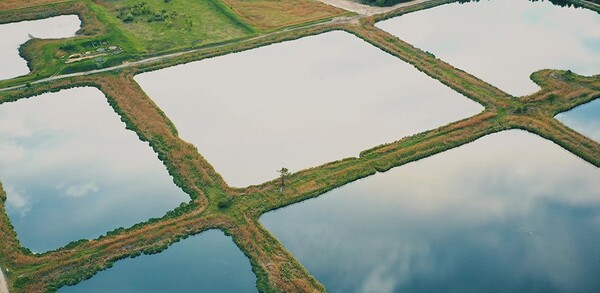
도호쿠대학교(Tohoku University) 연구진은 초음파 처리 탄소 나노튜브(CNT)를 이용해 특정 오염물질을 효과적으로 식별하고 분해하는 반응 경로를 개발했다. 이는 물절약에 기여할 획기적인 기술이다. [사진제공(Photo Source) = Tohoku University]
물은 지구상에서 가장 귀중한 자원 중 하나다. 담수는 인간과 생태계에 필수적이지만, 홍수로 오염될 위험이 있다. 이미 물부족 문제가 심각한 상황에서 한 방울의 물도 소중히 사용해야 한다.
다행히도 고도 산화 공정(AOP)을 활용하면 오염된 수원을 깨끗한 담수로 재생할 수 있다. 도호쿠대학교(Tohoku University) 연구진은 초음파 처리 탄소 나노튜브(CNT)를 이용해 특정 오염물질을 효과적으로 식별하고 분해하는 반응 경로를 개발했다. 이는 물절약에 기여할 획기적인 기술이다.
그림 1. 초음파 처리된 CNT 촉매의 합성 및 특성 분석
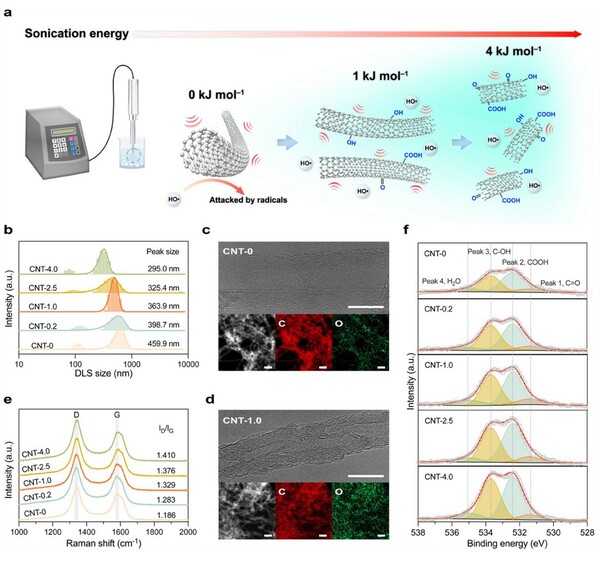
a) 초음파 처리된 CNT 촉매의 합성 과정 개략도. b) 동적 광산란(DLS) 분석을 통해 측정한 초음파 처리 CNT 촉매의 크기 분포. c) CNT-0 및 d) CNT-1.0의 형태 및 화학적 조성 (TEM 이미지, 스케일 바 = 10 nm) 및 해당 에너지 분산 X선(EDX) 매핑 (스케일 바 = 20 nm). e) 초음파 처리된 CNT 촉매의 라만(Raman) 스펙트럼. f) O 1s XPS 스펙트럼. [그림출처(Picture Source) = Xin Yang 외]
이 연구는 지난 5월 21일 국제 학술지 『어드밴스트 머터리얼즈(Advanced Materials)』에 게재됐다. 연구를 이끈 하오 리(Hao Li) 도호쿠대 첨단재료연구소(WPI-AIMR) 교수는 "기존 AOP(산화촉매 반응) 방식은 비선택적으로 작용해 오염물질뿐만 아니라 원래의 수질 성분도 문작위로 분해하는 문제를 안고 있었다"며 "새로운 방법은 선택적인 비라디칼 경로를 사용해 이러한 문제를 해결했다"고 설명했다.
새로운 비라디칼 경로는 일중항산소(Singlet Oxygen)와 빠른 직전자 전달 반응을 이용해 일반적인 산업 및 도시 오염물질을 5분 이내에 제거할 수 있다. 특히, 제거 속도가 4.80 µmol g−1 s−1로 매우 빠르며, 다양한 수질 조건(다양한 pH 수준이나 여러 유기물질 존재)에서도 안정적으로 작용한다.
리 교수는 "이번 연구 방법의 또 다른 장점은 생산된 촉매의 확장 가능성과 우수한 성능, 연속적인 수처리 시스템과의 통합 가능성이다. 실생활에서 쉽게 응용할 수 있을 것"이라고 말했다.
현재 대규모 정수시설은 높은 비용과 복잡한 다단계 처리 과정을 요구하지만, 이번 연구에서 제안된 방식은 빗물이나 강물 등 분산형 수원을 보다 효율적인 현장에서 처리할 수 있다. 또한 AOP에서 사용되는 고체 산화제는 보관과 운반이 용이해 필요할 때 즉시 수원에 공급할 수 있다.
향후 연구에서는 촉매의 장기적인 안정성과 오염 방지 성능을 강화하고, 더욱 광범위한 오염물질, 특히 전자 부족 유기물을 처리하는 방안을 모색할 예정이다. 또한 촉매 표면 기능을 조정해 반응성을 더욱 향상시키는 연구도 진행될 전망이다. 이러한 새로운 담수 생산 방식은 수자원 회복 기술의 발전에 기여할 것으로 기대된다.
이번 연구의 핵심 데이터는 하오 리 교수 연구실에서 개발한 세계 최대 규모의 촉매 플랫폼이자 데이터베이스인 디지털 촉매 플랫폼(DigCat)에서 확인할 수 있다.
[원문보기]
A Fresh New Way to Produce Freshwater: Sonicated Carbon Nanotube Catalysts
Water is one of the most precious resources on the planet. Freshwater is vital for humans, animals, and plants - but it can become contaminated from overflowing stormwater and surface water. We are already starting to feel the squeeze on our tight water supply, so we can't afford to waste a single drop.
Thankfully, contaminated water sources can be rejuvenated again as freshwater via advanced oxidation processes (AOPs). Researchers at Tohoku University made a breakthrough by using sonicated carbon nanotubes (CNTs) to enable a reaction pathway that can pinpoint specific contaminants and break them down to help save our water.
The findings were published in Advanced Materials on May 21, 2025.
"Previously used AOP methods were nonselective, and degraded both pollutants and background water constituents indiscriminately," explains Professor Hao Li of Tohoku University's Advanced Institute for Materials Research (WPI-AIMR). "Our method overcomes this by using a more selective nonradical pathway."
The nonradical pathway uses singlet oxygen and rapid, direct electron transfer. This process allows for common industrial and municipal pollutants to be removed within five minutes, at an unprecedented removal rate (4.80 µmol g−1 s−1). This strategy also works effectively under varied water conditions, such as different pH levels and in the presence of different organic matter.
"Another benefit of our method is that the catalysts produced can be scaled up, they show superior catalytic performance and are easily integrated into flat membranes and hollow fiber devices for continuous water filtration. This makes the technology practical and adaptable for real-world applications," remarks Li.
In addition, centralized treatment plants are expensive and usually require multi-step, complex water treatment processes. The method proposed in this study targets distributed water sources (like stormwater or river water), as an efficient, point-of-use treatment technology. Solid oxidants used in AOPs are easy to store and transport, so they can be brought right to the water source in question.
The next steps of this project will focus on enhancing the long-term stability and anti-fouling performance of the catalysts in real water conditions, expanding their applicability to a broader range of contaminants--particularly electron-deficient organics--and further engineering surface functional groups to improve catalytic activity. This fresh take on freshwater production represents a potentially huge improvement in techniques for replenishing an indispensable resource.
The key data are available in the Digital Catalysis Platform (DigCat), the largest catalysis platform and database developed by the Hao Li Lab.
[출처 = 일본 도호쿠대학교(TOHOKU UNIVERSITY)(https://www.tohoku.ac.jp/en/press/fresh_new_way_to_produce_freshwater_sonicated_carbon_nanotube_catalysts.html) / 2025년 6월 5일]
|  즐겨찾기 추가
 시작페이지로 설정
























