[캐나다] 워터루대, 박테리아 DNA 조작해 미세 플라스틱 제거
PET 플라스틱, 미세 플라스틱으로 분해돼 먹이사슬로 유입…인간 건강에 악영향 미쳐
하수처리장서 흔히 발견되는 박테리아에 PET 생분해 하는 DNA 추가해 조작
『마이크로비얼 바이오테크놀로지』에 게재
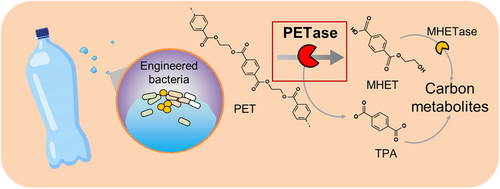
워터루대학교(University of Waterloo) 연구팀은 하수에서 발견되는 여러 종류의 박테리아에 DNA를 추가해 카펫, 의류, 음식 및 음료 용기에 흔히 사용되는 플라스틱 폴리에틸렌테레프탈레이트(PET)를 생분해할 수 있도록 조작했다. [그림제공(Picture Source) = Microbial Biotechnology]
미세 플라스틱은 하수처리장에서 제거되지 않은 채 하천으로 방류돼 환경에 오랫동안 남아있을 수 있다.
워터루대학교(University of Waterloo) 연구팀은 하수에서 발견되는 여러 종류의 박테리아에 DNA를 추가해 카펫, 의류, 음식 및 음료 용기에 흔히 사용되는 플라스틱 폴리에틸렌테레프탈레이트(PET)를 생분해할 수 있도록 조작했다.
PET 플라스틱은 환경에서 분해되는 데 수백 년 걸린다. 시간이 지남에 따라 5㎜ 미만의 플라스틱 조각인 미세 플라스틱으로 분해돼 먹이 사슬로 유입된다. 이러한 플라스틱의 화학 물질은 인슐린 저항성, 암 및 생식 건강 저하에 영향을 미친다.
마크 오코인(Marc Aucoin) 워터루대 화학공학과 교수는 "물시스템에 이미 존재하는 박테리아를 프로그래밍함으로써 미세 플라스틱을 제거하는 바이오로봇으로 만들 수 있다"며 "물 속의 미세 플라스틱은 항생제 내성의 확산을 촉진하기 때문에 이 획기적인 발견은 이러한 우려도 해결할 수 있다"고 말했다.
연구진은 박테리아가 증식할 때 유전 물질을 서로 공유한다는 특징에 주목했으며, 이를 활용해 박테리아에 새로운 특성을 도입시킴으로써 미세 플라스틱을 분해할 수 있도록 조작했다.
브라이언 잉걸스(Brian Ingalls) 워터루대 응용 수학과 교수는 "다음 단계로 모델링을 사용해 박테리아가 다양한 환경 조건에서 새로운 유전 정보를 얼마나 잘 전달하는지, 그리고 얼마나 효과적으로 플라스틱을 분해할 수 있는지 확인할 것"이라며 "장기적인 비전은 하수처리시설에서 미세 플라스틱을 대규모로 분해하는 것"이라고 말했다.
연구진은 하수처리정에서 연구를 시작했지만, 바다에 축적되는 플라스틱 폐기물을 정화할 방법도 찾고자 한다고 밝혔다.
아론 입(Aaron Yip) 워터루대 화학공학과 박사과정 후보생은 "자연 환경에서 플라스틱을 먹는 조작된 박테리아를 사용할 때의 위험성을 평가할 것"이라며 "현재 하수처리장에서 미세 플라스틱을 분해하는 것이 더 안전하다. 하수처리장은 이미 하수 내 박테리아를 중화하도록 설계돼 있어 환경으로 물을 방류하기 전에 조작된 박테리아가 죽을 수도 있다"고 설명했다.
이 연구는 『마이크로비얼 바이오테크놀로지(Microbial Biotechnology)』에 게재됐다.
[원문보기]
Removing microplastics with engineered bacteria
Researchers altered bacteria found in wastewater treatment, where microplastics can enter environment
Microplastics can go right through wastewater treatment plants, and researchers have engineered bacteria commonly found in there to break down this pollution before it can persist in the environment.
Researchers from the University of Waterloo added DNA to several species of bacteria found in wastewater, allowing them to biodegrade polyethylene terephthalate (PET), a common plastic found in carpet, clothing and containers for food and beverages.
PET plastics take hundreds of years to degrade in the environment. Over time, they break down into microplastics, pieces of plastic less than 5 mm long, which enter the food chain. Chemicals in these plastics are associated with insulin resistance, cancer and decreased reproductive health.
“Think of these bacteria that already exist in water systems to clean up microplastics as biorobots that can be programmed to get the job done,” said Dr. Marc Aucoin, a professor in the Department of Chemical Engineering. “Microplastics in water also enhance the spread of antibiotic resistance, so this breakthrough could also address that concern."
The researchers use a natural process referred to as “bacterial sex,” where bacteria share genetic material with each other when multiplying. It enables the introduction of a new trait into the target bacteria, giving them the ability to break down microplastics.
“As next steps, we will use modelling to understand how well the bacteria transfer the new genetic information under different environmental conditions and thus how effectively they can break down the plastics,” said Dr. Brian Ingalls, a professor in the Department of Applied Mathematics. “The long-term vision is to break down microplastics in wastewater treatment plants at scale.”
While the researchers will start with wastewater facilities, they also hope to find ways to clean up the plastic waste accumulating in oceans.
"We will assess the risks of using engineered, plastic-eating bacteria in the natural environment" said Aaron Yip, a PhD candidate in the Department of Chemical Engineering. "Right now, microplastic degradation in wastewater treatment plants is a safer application to target. Many of these facilities are already designed to neutralize bacteria in wastewater, which would kill any engineered bacteria prior to discharging water back into the environment.”
The study, “Degradation of polyethylene terephthalate (PET) plastics by wastewater bacteria engineered via conjugation," appears in Microbial Biotechnology.
[출처 = 워터루대학교(University of Waterloo)(https://uwaterloo.ca/news/removing-microplastics-engineered-bacteria) / 2025년 1월 8일]
[출처 = 『마이크로비얼 바이오테크놀로지(Microbial Biotechnology)』(https://enviromicro-journals.onlinelibrary.wiley.com/doi/full/10.1111/1751-7915.70015)]
|  즐겨찾기 추가
 시작페이지로 설정
























