[미국] 텍사스 A&M 연구팀, 티베트 빙하서 납 검출…광범위한 인간활동 드러내
1974년부터 상당 수준 납 오염 발견…2000~2007년에 절정
산업화 이후로 인간 활동으로 인한 납 배출량 증가…산업화 이전 대비 두배
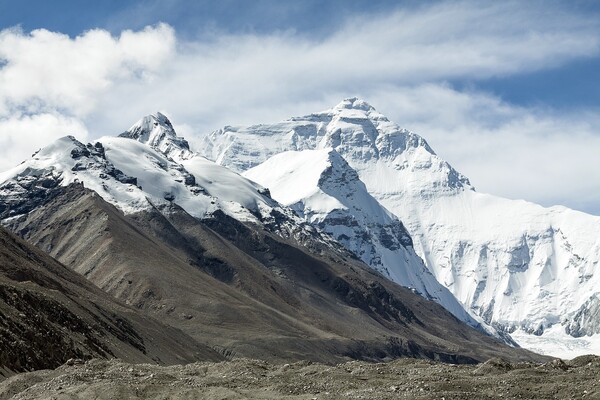
티베트 고원은 지구상에서 가장 높고 가장 큰 고원으로 '세계의 지붕'이라고 불린다. 미국 텍사스 A&M 대학교(Texas A&M University)의 프랑코 마르칸토니(Franco Marcantonio) 연구팀은 굴리야 빙하(Guliya Ice Cap)에 대한 연구에서 1974년부터 빙하에 상당한 수준의 납 오염이 시작됐으며, 2000년~ 2007년 사이의 납 오염이 절정에 이르렀다는 사실을 발견했다. [사진출처(Photo source) = 픽사베이(Pixabay)]
티베트 고원의 빙하는 지구에서 가장 고립된 지역이자 사람의 손길이 닿지 않은 장소 중 하나다. 이 빙하는 수백만 명의 사람들에게 물을 공급하고 중요한 환경적 역할을 한다.
미국 국립과학재단(NSF)의 지원을 받는 연구진은 빙하에서 납(Pb) 형태의 오염을 추적했으며, 연구 결과를 『자연 커뮤니케이션 지구와 환경(Nature Communications Earth and Environment)』에 게재됐다.
티베트 고원은 지구상에서 가장 높고 가장 큰 고원으로 '세계의 지붕'이라고 불린다. 미국 텍사스 A&M 대학교(Texas A&M University)의 프랑코 마르칸토니(Franco Marcantonio) 연구팀은 굴리야 빙하(Guliya Ice Cap)에 대한 연구에서 1974년부터 빙하에 상당한 수준의 납 오염이 시작됐으며, 2000년~ 2007년 사이의 납 오염이 절정에 이르렀다는 사실을 발견했다.
연구팀은 3만6천 년 전 샘플에서 납 동위 원소를 측정했다. 이 빙하는 연구팀에게 현대 납 오염 수준을 산업화 이전의 수준과 비교할 수 있는 역사적 기록의 역할을 한다.
연구팀은 이번 연구에서 "납은 고대 문명에서 수천 년 동안 사용돼 왔지만, 1920년대에 이르러서야 산업혁명이 일어나고 납이 첨가된 휘발유가 도입되면서 인간 활동에서 납의 배출량이 급증했다"며 "1980년대에 이르러 배출량은 자연 및 산업화 이전의 기여도에 약 두 배나 앞질렀다"고 설명했다.
또한 "티베트 고원은 산업 활동이 매우 낮으므로 깨끗한 곳으로 여겨진다"며 "그럼에도 불구하고 납이 검출됐으며, 인간이 납을 사용한 역사는 굴리야 빙하에 담겨 있다"고 덧붙여 설명했다.
마가렛 프레이저(Margaret Fraiser) NSF 지구 과학 프로그램 책임자는 "이 연구는 인간 활동으로 인한 환경 영향의 범위와 시기에 대한 이해를 높여준다"고 언급했다.
[원문보기]
Lead pollution in a remote Tibetan glacier reveals far-reaching human activities
The Tibetan Plateau's glaciers are among the world's most remote and untouched places. Researchers say these ice fields provide water for millions of people and play a vital environmental role.
Now, geoscientists funded by the U.S. National Science Foundation have tracked pollution in the form of lead in the glaciers. The findings are reported in the journal Nature Communications Earth and Environment.
The Tibetan Plateau is often called the "Roof of the World." It's the highest and largest plateau on Earth. In a study of the Guliya Ice Cap there, Franco Marcantonio of Texas A&M University and his colleagues discovered that significant lead pollution of the ice cap began in 1974, with the highest levels between 2000 and 2007.
The team measured lead isotopes in samples dating to 36,000 years ago. The ice serves as a historical record, giving scientists a way of comparing levels of modern lead contamination to those of pre-industrial times.
"Even though Pb [lead] has been used by ancient civilizations for millennia, it was not until the Industrial Revolution and later, when leaded gasoline was introduced … in the 1920s, that the emission of Pb from human activities skyrocketed," state the scientists in their paper. "By the 1980s, emissions surpassed their natural and pre-industrial contribution by about two orders of magnitude."
The Tibetan Plateau "is considered to be a pristine place due to the very low industrial activity in the region," write the researchers. Nonetheless, lead found its way there, and its history of human use was captured in the Guliya Ice Cap.
"This study advances our understanding of the breadth and timing of environmental impacts from human activities," says Margaret Fraiser, a program director in the NSF Division of Earth Sciences.
[출처 = 미국 국립과학재단(NSF)(https://new.nsf.gov/news/lead-pollution-remote-tibetan-glacier-reveals-far-reaching) / 2024년 10월 24일]
|  즐겨찾기 추가
 시작페이지로 설정
























