[미국] 미 지질조사국, 인구 20% 이상이 PFAS로 오염된 지하수서 식수 공급받을 수 있어
새로운 예측 모델 개발…주 및 국가적 규모에 대한 추정치 최초 제공
지하수 샘플 1천238개 분석…도시 개발 및 관정 수심과 PFAS 상관관계 조사
PFAS 검사 위한 지하수 샘플링 관정 우선순위 설정에 기여할 것으로 기대

미국 지질조사국(U.S. Geological Survey, USGS)에 따르면, 48개 주에 거주하는 약 7천100만~9천500만 명(미국 전체 인구의 20% 이상)이 PFAS(과불화화합물)가 검출될 수 있는 지하수에서 식수를 공급받고 있다. [사진출처(Photo Source) = 픽사베이(Pixabay)]
미국 지질조사국(U.S. Geological Survey, USGS)에 따르면, 48개 주에 거주하는 약 7천100만~9천500만 명(미국 전체 인구의 20% 이상)이 PFAS(과불화화합물)가 검출될 수 있는 지하수에서 식수를 공급받고 있다.
예측 모델 결과는 대중, 물 공급업체 및 규제 기관이 PFAS 오염 가능성을 이해하고, 향후 연구를 안내하며, 수자원에 대한 전략적 계획을 수립하는 데 도움이 될 수 있다.
USGS 연구진은 공공 및 개인 관정에 물을 공급하는 처리되지 않은 지하수에서 PFAS 발생에 대한 전국적인 추정치를 최초로 보고했다. 이 연구는 또한 PFAS로 오염된 지하수의 영향을 받을 가능성이 있는 미 전역 인구수에 대한 최초의 추정치를 제공한다.
USGS는 보고서와 함께 사용자가 PFAS 발생 확률 추정치를 확인할 수 있도록 대화형 온라인 지도를 게시했다. 예측 결과는 개별 가구 수준이 아닌 주, 지역 및 국가적 규모에서 평가하기 위한 것이다. 확률 추정치는 지하수 내 PFAS 여부에 대한 것이며 주, 지자체 또는 개인이 식수를 처리하기 위해 취한 후속 조치는 고려하지 않았다. 이 모델에는 PFAS 농도 추정치가 포함되지 않으며, 오염물질을 확인하기 위해서는 테스트를 실시해야 한다.
이번 연구의 주저자인 안드레아 토크라노프(Andrea Tokranov)는 "이 연구의 결과는 미국에서 공공 및 개인 식수 공급에 사용되는 지하수에서 PFAS 오염이 널리 퍼져 있음을 나타낸다"며 "이 새로운 예측 모델은 사람들이 오염 여부를 모르는 상태에서 오염된 물을 마시지 않도록 향후 샘플링을 위한 지역을 우선순위를 정하는 데 도움이 될 수 있다. 이는 특히, 해당 지역의 수질에 대한 정보가 없고 공공 수도 공급업체가 제공하는 것과 동일한 검사 및 처리에 대한 접근이 어려운 개인 관정 사용자에게 중요하다"고 설명했다.
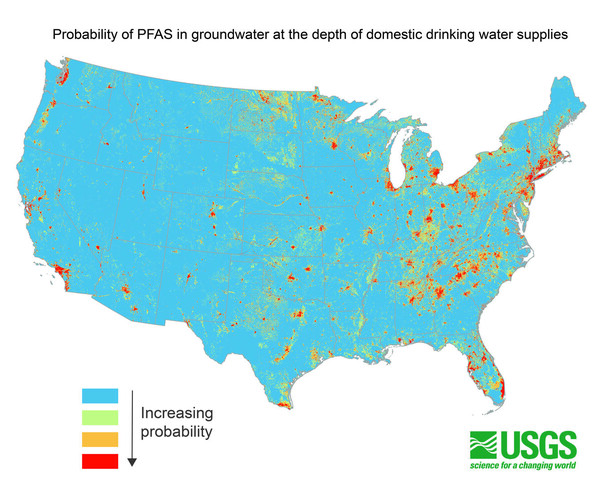
USGS의 전국적인 추정치는 개인 식수 공급 관정 수심에서의 PFAS 확률에 대한 것이다. [사진제공(Photo Source) = USGS]
잠재적으로 오염된 지하수원이 있는 공공 수도 공급에 의존하는 인구가 가장 많은 주는 플로리다와 캘리포니아다. 개인 관정과 관련해 미시간, 플로리다, 노스캐롤라이나, 펜실베이니아, 뉴욕, 오하이오가 잠재적으로 오염된 지하수에 가장 많이 의존하고 있다.
또한 이 연구는 인구 비율에 따른 데이터를 제시한다. 예를 들어, 매사추세츠주에서는 공공 수도 공급 지하수에 의존하는 인구의 86~98%가 PFAS로 오염된 원수를 사용할 수 있다. 코네티컷주에서는 개인 관정 지하수에 의존하는 인구의 67~87%가 PFAS 영향권에 있는 원수를 사용할 수 있다.
토크라노프 연구원은 "이러한 추정치를 도출하기 위해 연구팀은 USGS 연구원들이 수집한 지하수 샘플 1천238개를 분석하고 도시 개발 및 관정 수심과 같은 요인이 PFAS 발생에 어떤 영향을 미칠 수 있는지 확인했다"며 "이 정보를 바탕으로 세부적인 기계 학습 모델을 개발해 오염 가능성이 높은 지역을 식별했다. 이 정보는 인구 추정치를 설정하기 위해 특정 지역의 지하수에 의존하는 인구에 대한 기존 USGS 연구와 결합됐다"고 설명했다.
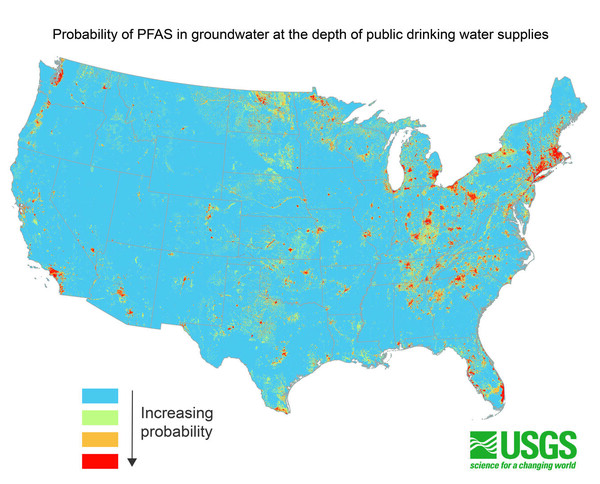
USGS의 전국적인 추정치는 공공 식수 공급 관정 수심에서의 PFAS 확률에 대한 것이다. [사진제공(Photo Source) = USGS]
연구원들은 지하수 수심이 다른 곳에서 물을 공급받으므로 공공 관정과 개인 관정에 대한 별도의 추정치를 제시한다. 지하수를 주요 수원으로 사용하는 공공 관정은 일반적으로 개인 관정보다 더 깊다.
PFAS는 1만2천 개가 넘는 종류가 있어 현재 검사 방법으로는 모두 유형을 다 검출할 수 없다. USGS 연구에서는 24가지의 일반적인 유형의 존재 여부를 검사했다. 가장 빈번하게 검출된 화합물은 PFBS로 알려진 퍼플루오로부탄 설포네이트, PFOS로 알려진 퍼플루오로옥탄 설포네이트, PFOA로 알려진 퍼플루오로옥타노에이트였다.
이 연구는 하위 48개 주에 대한 광범위한 전망을 제공하고 주 차원의 추정치를 제시한다. 연구진은 특정 도시를 자세히 살펴보거나 존재하는 PFAS 유형 또는 PFAS 농도에 대한 추정치를 제공하지 않았다.
이 연구는 『사이언스(Science)』지에 게재됐다.
[원문보기]
Millions In The U.S. May Rely On Groundwater Contaminated With PFAS For Drinking Water Supplies
Estimates according to a new USGS predictive model. Exposure to some PFAS may lead to adverse health risk.
Approximately 71 to 95 million people in the Lower 48 states – more than 20% of the country’s population – may rely on groundwater that contains detectable concentrations of per- and polyfluoroalkyl substances, also known as PFAS, for their drinking water supplies. These findings are according to a U.S Geological Survey study published Oct. 24.
The predictive model results can help members of the public, water suppliers and regulators understand the potential for PFAS contamination, guide future studies and inform strategic planning for water resources.
USGS scientists are the first to report national estimates of PFAS occurrence in untreated groundwater that supplies water to public and private wells. This research also provides the first estimate of the number of people across the country who are potentially affected by PFAS-contaminated groundwater.
Along with a scientific report, the USGS published an interactive, online map so users can see probability estimates of PFAS occurrence. Note that predictive results are intended to be evaluated at state, regional and national scales rather than at individual household levels. Probability estimates are for the presence of PFAS in groundwater and do not account for any subsequent actions taken by states, municipalities or individuals to treat drinking water. The model does not include estimates of PFAS concentrations; testing is the only way to confirm the presence of contaminants.
Exposure to certain PFAS may lead to adverse health risks in people, according to the U.S. Environmental Protection Agency. PFAS are a group of synthetic chemicals used in a wide variety of common applications, from the linings of fast-food boxes and non-stick cookware to fire-fighting foams and other purposes. PFAS are commonly called “forever chemicals” because many of them do not easily break down and can build up over time, making them a concern for drinking water quality.
“This study’s findings indicate widespread PFAS contamination in groundwater that is used for public and private drinking water supplies in the U.S.,” said Andrea Tokranov, USGS research hydrologist and lead author of this study. “This new predictive model can help prioritize areas for future sampling to help ensure people aren’t unknowingly drinking contaminated water. This is especially important for private well users, who may not have information on water quality in their region and may not have the same access to testing and treatment that public water suppliers do.”
The EPA has established legally enforceable levels, called maximum contaminant levels, for six types of PFAS in drinking water. The EPA regulates public water supplies, and some states have additional regulations for drinking water. Some homes use private water supplies, where residents are responsible for the maintenance, testing and treatment of their drinking water. Those interested in treatment processes and testing options can read EPA’s guidance or contact their state officials or water supplier.
The states with the largest populations relying on public water supplies with potentially contaminated groundwater sources are Florida and California. Regarding private wells, Michigan, Florida, North Carolina, Pennsylvania, New York and Ohio have the largest populations relying on potentially contaminated groundwater.
The study also presents data according to population percentage. In Massachusetts, for example, the source water for 86 to 98% of people who rely on groundwater from public water supplies could be contaminated with PFAS. In Connecticut, the source water for 67 to 87% of the people who rely on groundwater from private wells could be affected. Details by state can be seen in the report’s tables S6 through S8.
“To derive these estimates, the team analyzed 1,238 groundwater samples collected by USGS scientists and determined how factors such as urban development and well depth can impact PFAS occurrence,” continued Tokranov. “With that information, a detailed machine learning model was developed and used to identify which geographic areas have a higher likelihood for contamination. That information was combined with existing USGS research on the number of people in a given area who rely on groundwater for drinking water to establish population estimates.”
Scientists present separate estimates for public and private wells because they typically receive water from different groundwater depths. Public wells using groundwater as the primary water source are usually deeper than private wells.
There are more than 12,000 types of PFAS, not all of which can be detected with current tests; the USGS study tested for the presence of 24 common types. The USGS estimates consider the presence of at least one of those 24 types of PFAS. The most frequently detected compounds were perfluorobutane sulfonate known as PFBS, perfluorooctane sulfonate known as PFOS and perfluorooctanoate known as PFOA.
This research provides a broad outlook for the Lower 48 states and presents state-level estimates. Scientists did not look in detail at specific cities or provide estimates for the types of PFAS present or PFAS concentrations.
The new USGS study was published in Science.
Learn more about USGS research on PFAS by reading the USGS strategy for the study of PFAS in the environment and visiting the USGS PFAS Integrated Science Team’s website.
For more information about PFAS regulations, visit the EPA’s website on addressing PFAS.
[출처 = 미국 지질조사국(USGS)(https://www.usgs.gov/news/national-news-release/millions-us-may-rely-groundwater-contaminated-pfas-drinking-water) / 2024년 10월 24일]
|  즐겨찾기 추가
 시작페이지로 설정
























