[미국] MIT공대 연구팀, 추가 배터리 필요없는 ‘태양광 담수화 시스템’ 개발
배터리 저장 없이 태양광 재생 에너지로 식수 생산…『네이처 워터』 최근호에 게재
MIT 시스템, 에너지 저장 위한 추가 배터리 및 보조 전원 공급장치도 필요 없어…저렴한 비용으로 식수 공급 가능
태양 에너지 활용도 극대화하여 낮 동안 햇빛 변화에도 불구 대량의 깨끗한 물 생산 가능
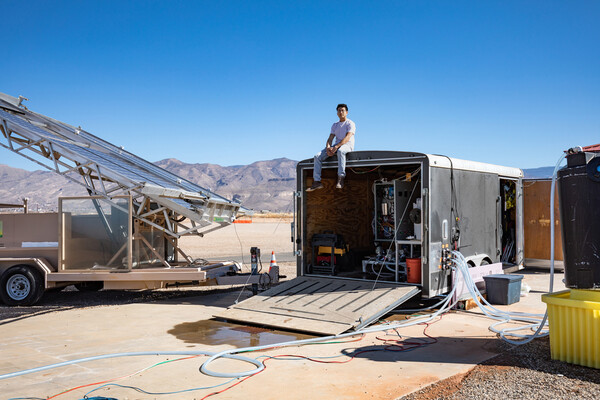
미국 MIT공대 연구팀은 추가 배터리 필요없는 ‘태양광 담수화 시스템’을 개발했다. 사진은 조나단 베셋(Jonathan Bessette)은 뉴멕시코 주 알라모고르도에 있는 브래키쉬 지하수 국립 담수화 연구시설((BGNDRF)에서 전기투석 담수화 시스템을 수용하는 트레일러 위에 앉아 있다. 이 시스템은 실제 지하수, 물탱크, 태양광 패널 등과 연결돼 있다. [사진출처(Photo source) = 매사추세츠공과대학(MIT)]
미국 매사추세츠공과대학교(Massachusetts Institute of Technology, 이하 ‘MIT’) 엔지니어들은 태양의 리듬에 따라 작동하는 새로운 담수화 시스템을 구축했다.
MIT 연구팀이 개발한 태양광 발전 시스템(solar-powered system, 이하 ‘MIT 시스템’)은 태양 에너지의 변화에 거의 근접한 속도로 물에서 염분을 제거한다. 낮 동안 일조량이 증가함에 따라 MIT 시스템은 담수화 과정을 늘리고 지나가는 구름에 반응하여 속도를 낮추거나 하늘이 맑아지면 회전하는 등 갑작스러운 햇빛의 변화에 자동으로 적응한다.
MIT 시스템은 햇빛의 미묘한 변화에 빠르게 반응할 수 있으므로 태양 에너지의 활용도를 극대화하여 낮 동안 햇빛의 변화에도 불구하고 대량의 깨끗한 물을 생산한다. 다른 태양열 담수화 설계와 달리 MIT 시스템은 에너지 저장을 위한 추가 배터리가 필요하지 않으며 그리드와 같은 보조 전원 공급장치도 필요하지 않다.
엔지니어들은 6개월에 걸쳐 뉴멕시코의 지하수 관정에서 지역사회 규모의 프로토 타입(prototype)을 테스트하여 다양한 기상 조건과 물의 종류에서 작업했다. MIT 시스템은 날씨와 가용 일조량의 큰 변동에도 불구하고 시스템 태양광 패널에서 생성되는 전기 에너지의 평균 94% 이상을 활용하여 하루에 최대 5천 리터(5㎥)의 물을 생산했다.
MIT의 게르메스하우젠(Germeshausen) 기계공학 교수이자 K. 리사 양 글로벌 엔지니어링 및 연구센터(K. Lisa Yang Global Engineering and Research Center, GEAR)의 소장인 아모스 윈터(Amos Winter) 박사는 “기존의 담수화 기술은 태양광과 같은 가변적인 전원을 원활하게 공급하기 위해 안정적인 전력이 필요하고 배터리 저장이 필요하지만, 우리 기술은 태양과 동기화하여 전력 소비량을 지속적으로 변화시킴으로써 태양광 발전을 직접적이고 효율적으로 사용하여 물을 만든다”라고 말했다.
아모스 윈터 교수는 이어 “배터리 저장 없이 재생 에너지로 식수를 만들 수 있다는 것은 엄청난 도전이다. 그리고 우리는 해냈다”고 덧붙였다.
이 시스템은 지하 저수지에서 발견되며 담수자원보다 널리 퍼져 있는 염분이 많은 물의 공급원인 염수 지하수(brackish groundwater)를 담수화하는 데 초점을 맞추고 있다. 연구진은 염수 지하수를 특히 일부 지역에서 담수 매장량이 증가함에 따라 잠재적인 식수의 거대한 미개발 공급원으로 보고 있다.
연구팀들은 새로운 재생 가능한 배터리 없는 시스템이 특히 바닷물과 전력망에 대한 접근이 제한된 내륙 지역사회에 필요한 식수를 저렴한 비용으로 공급할 수 있을 것으로 예상하고 있다.
“대부분의 인구는 실제로 해안에서 충분히 멀리 떨어져 있어 바닷물 담수화가 닿지 않는다. 그 결과 특히 외딴 저소득 지역의 지하수에 크게 의존하고 있다. 안타깝게도 이 지하수는 기후변화로 인해 점점 더 염분이 많아지고 있다”라고 MIT 기계공학 박사과정 학생인 조나단 베셋(Jonathan Bessette)은 말했다.
연구원들은 국제학술지 『네이처 워터(Nature Water)』 최근호(10월 8일자)에 ‘흐름 명령 전류 제어를 통한 직접 구동 광전지 전기 투석(Direct-drive photovoltaic electrodialysis via flow-commanded current control)’제목으로 실린 논문에서 이 새로운 시스템에 대해 자세히 보고하고 있다.
이 연구의 공동저자는 조나단 베셋(Jonathan Bessette), 아모스 윈터(Amos Winter) 및 직원 엔지니어 셰인 프랫(Shane Pratt)이다.
[그림 1] 배치 전기투석 시스템의 개념도
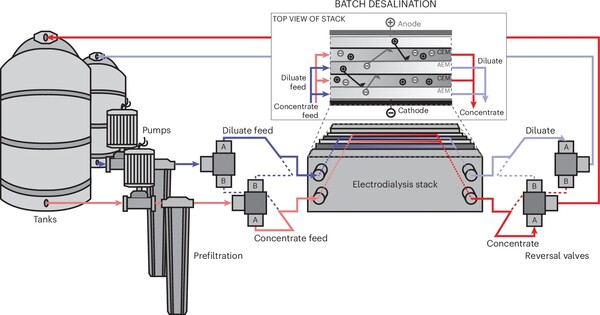
물은 배치 탱크에서 병렬 펌프를 통해 옵션 카트리지 필터로 공급된 다음 반전 밸브 네트워크를 통해 전기투석 스택으로 전달된다. 전기투석 스택에서 이온은 양이온 교환막(CEM)과 음이온 교환막(AEM) 쌍을 포함하여 선택적으로 하전된 막을 가로질러 전달된다. 밸브 네트워크의 라벨은 잠재적인 유압 경로를 보여주며, 이 설명에서 채널 구성 ‘A’는 결합되고 ‘B’는 결합 해제된다. [그림출처(picture source) = 『네이처 워터(Nature Water)』]
펌프 및 유량(Pump and flow)
MIT 시스템은 아모스 윈터(Amos Winter) 교수와 전 MIT 박사 후 연구원인 웨이허(Wei He)를 포함하여 올해 초에 보고한 이전 설계를 기반으로 했다. 이 시스템은 ‘유연한 일괄 전기투석(flexible batch electrodialysis)’을 통해 물을 담수화하는 것을 목표로 했다.
전기투석(Electrodialysis)과 역삼투압(RO)은 염수 지하수를 담수화하는 데 사용되는 두 가지 주요 방법 중 하나이다. 역삼투압을 사용하면 압력을 사용하여 염수를 막을 통해 펌핑하고 염분을 걸러낸다. 전기투석은 전기장을 사용하여 물이 다량의 이온 교환막을 통해 펌핑될 때 소금 이온을 추출한다.
과학자들은 재생 가능한 에너지원으로 두 가지 방법 모두에 전력을 공급하려고 노력해 왔다. 그러나 전통적으로 태양과 같은 자연적으로 가변되는 에너지원과 호환되지 않는 정상 전력 수준에서 작동하는 역삼투압 시스템에서는 특히 어려운 일이었다.
아모스 윈터(Amos Winter) 교수와 연구팀들은 전기투석에 집중하여 재생 가능한 태양광 발전의 변화에 대응할 수 있는 보다 유연하고 ‘시간 가변적인(time-variant)’ 시스템을 만드는 방법을 모색했다.
이전 설계에서 연구팀은 양수기(water pumps), 다량의 이온 교환막(ion-exchange membrane stack), 태양 전지판 어레이(solar panel array)로 구성된 전기 투석 시스템을 구축했다. 이 시스템의 혁신은 시스템의 모든 부분에서 센서 판독값을 사용하여 스택을 통해 물을 펌핑하는 최적의 속도와 물에서 추출되는 소금의 양을 최대화하기 위해 스택에 적용해야 하는 전압을 예측하는 모델 기반 제어 시스템이었다.
연구팀은 MIT 시스템을 현장에서 테스트했을 때 태양의 자연 변화에 따라 물 생산량을 변화시킬 수 있었다. 평균적으로 이 시스템은 태양 전지판에서 생산되는 가용 전기 에너지의 77%를 직접 사용했으며, 이는 전통적으로 설계된 태양열 전기 투석 시스템보다 91% 더 많은 양이라고 연구팀은 추정했다. 그럼에도 불구하고 연구원들은 더 잘할 수 있다고 느꼈다.
윈터 교수는 “우리는 3분마다 계산할 수밖에 없었고, 그 시간 동안 말 그대로 구름이 다가와 태양을 가릴 수 있었다”라면서 “시스템이 ‘이 높은 전력으로 달려가야겠다’고 말할 수도 있다. 하지만 지금은 햇빛이 적기 때문에 그 전력 중 일부가 갑자기 떨어졌다. 그래서 여분의 배터리로 그 전력을 보충해야 했다“고 설명했다.
[그림 2] 컨트롤러 설계 및 구현
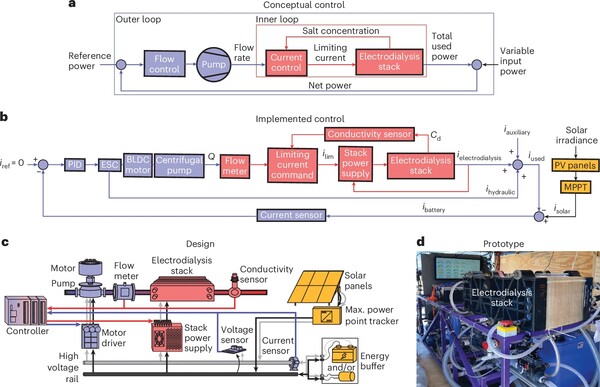
a, 내부 루프는 담수화 속도를 최대화하는 데 사용되고 외부 루프는 전력 추적에 사용되는 캐스케이드 제어와 관련된 개념적 흐름 명령 전류 제어(FCCC) 블록 다이어그램이다. 합산 연산자는 설계자의 재량에 따라 간판 관습을 일반화하기 위해 의도적으로 제외된다. b, 세부적으로 구현된 제어 체계. c, 앞서 언급한 제어 루프에서 대표 색상과 일치하는 색상을 가진 PV 기반 전기투석 담수화 시스템과 관련된 기본 하드웨어에서 제어 전략을 실현하도록 설계되었다. d, 프로토타입 커뮤니티 규모의 직접 구동 ED 시스템. [그래픽 출처(graphic source) = 『네이처 워터(Nature Water)』]
태양열 명령(Solar commands)
연구진은 최신 연구에서 MIT 시스템의 응답 시간을 단 1초로 단축하여 배터리의 필요성을 제거하려고 했다. 새로운 시스템은 초당 3∼5회 담수화 속도를 업데이트할 수 있다. 응답 시간이 빨라질수록 시스템은 추가 전원 공급 장치로 전력 지연을 보충할 필요 없이 하루 종일 햇빛의 변화에 적응할 수 있다.
민첩한 담수화의 핵심은 조나단 베셋(Jonathan Bessette)과 셰인 프랫(Shane Pratt)이 고안한 간단한 제어 전략이다. 새로운 전략은 시스템이 시스템의 태양광 패널에서 생산되는 태양광 발전량을 먼저 감지하는 ‘흐름 명령 전류 제어(flow-commanded current control)’ 중 하나이다.
패널이 시스템이 사용하는 것보다 더 많은 전력을 생산하는 경우, 컨트롤러는 자동으로 펌핑을 ‘명령(commands)’하여 전기투석 스택을 통해 더 많은 물을 밀어낸다. 동시에 시스템은 스택에 전달되는 전류를 증가시켜 추가 태양광 발전의 일부를 전환하여 더 빠르게 흐르는 물에서 더 많은 소금을 배출한다.
“태양이 몇 초마다 뜬다고 가정해 보자. 그러면 1초에 세 번씩 태양열 패널을 보고 ‘아, 전력이 더 많네? 유량과 전류를 조금 높이자’라고 말한다”면서 “다시 보고 여전히 여분의 전력이 더 있으면 다시 늘린다. 그렇게 하면서 소비 전력을 하루 종일 사용 가능한 태양열 전력과 매우 정확하게 일치시킬 수 있다. 그리고 이것을 더 빨리 반복할수록 배터리 버퍼링(battery buffering)이 덜 필요하다”고 강조했다.
엔지니어들은 새로운 제어 전략을 완전히 자동화된 시스템에 통합하여 염수 지하수를 일일 부피로 담수화하여 약 3천 명의 소규모 커뮤니티에 공급할 수 있는 양으로 담수화했다.
이들은 뉴멕시코주 알라모고르도(Alamogordo)에 있는 브래키쉬 지하수 국립 담수화 연구 시설(Brackish Groundwater National Desalination Research Facility, BGNDRF)의 여러 관정에서 6개월 동안 MIT 시스템을 작동시켰다. 이 프로토 타입은 실험 내내 광범위한 태양열 조건에서 작동하여 평균적으로 태양열 패널 전기 에너지의 94% 이상을 활용하여 담수화에 직접 전력을 공급했다.
윈터 교수는 “전통적으로 태양열 담수 시스템을 설계하는 방식에 비해 필요한 배터리 용량을 거의 100% 줄였다”라고 강조했다.
엔지니어들은 더 많은 지역사회와 심지어 전체 지자체에 저렴한 완전 태양열 식수를 공급하기 위해 시스템을 추가로 테스트하고 확장할 계획이다.
베셋은 “이번 조치는 중요한 진전이지만, 여전히 저비용의 지속가능한 담수화 방법을 지속적으로 개발하기 위해 부지런히 노력하고 있다”라고 말했다.
“이제 우리의 초점은 전 세계 여러 시장에 재생 에너지를 사용하여 담수화된 물을 공급할 수 있는 제품 라인을 테스트하고, 신뢰성을 극대화하며, 구축하는 데 있다”고 프랫은 말했다.
이 연구팀은 앞으로 몇 달 안에 기술을 기반으로 회사를 출범시킬 예정이다.
이 연구는 국립과학재단(National Science Foundation), 줄리아버크재단(Julia Burke Foundation), MIT 모닝사이드 디자인 아카데미(MIT Morningside Academy of Design)의 지원을 부분적으로 받았다. 이 연구는 베올리아 워터 테크놀로지스 앤 솔루션(Technologies and Solutions)과 자일럼 굴즈(Xylem Goulds)에서 지원을 했다.
[원문보기]
Solar-powered desalination system requires no extra batteries
Because it doesn’t need expensive energy storage for times without sunshine, the technology could provide communities with drinking water at low costs.
MIT engineers have built a new desalination system that runs with the rhythms of the sun.
The solar-powered system removes salt from water at a pace that closely follows changes in solar energy. As sunlight increases through the day, the system ramps up its desalting process and automatically adjusts to any sudden variation in sunlight, for example by dialing down in response to a passing cloud or revving up as the skies clear.
Because the system can quickly react to subtle changes in sunlight, it maximizes the utility of solar energy, producing large quantities of clean water despite variations in sunlight throughout the day. In contrast to other solar-driven desalination designs, the MIT system requires no extra batteries for energy storage, nor a supplemental power supply, such as from the grid.
The engineers tested a community-scale prototype on groundwater wells in New Mexico over six months, working in variable weather conditions and water types. The system harnessed on average over 94 percent of the electrical energy generated from the system’s solar panels to produce up to 5,000 liters of water per day despite large swings in weather and available sunlight.
“Conventional desalination technologies require steady power and need battery storage to smooth out a variable power source like solar. By continually varying power consumption in sync with the sun, our technology directly and efficiently uses solar power to make water,” says Amos Winter, the Germeshausen Professor of Mechanical Engineering and director of the K. Lisa Yang Global Engineering and Research (GEAR) Center at MIT.
“Being able to make drinking water with renewables, without requiring battery storage, is a massive grand challenge. And we’ve done it.”
The system is geared toward desalinating brackish groundwater - a salty source of water that is found in underground reservoirs and is more prevalent than fresh groundwater resources. The researchers see brackish groundwater as a huge untapped source of potential drinking water, particularly as reserves of fresh water are stressed in parts of the world.
They envision that the new renewable, battery-free system could provide much-needed drinking water at low costs, especially for inland communities where access to seawater and grid power are limited.
“The majority of the population actually lives far enough from the coast, that seawater desalination could never reach them. They consequently rely heavily on groundwater, especially in remote, low-income regions. And unfortunately, this groundwater is becoming more and more saline due to climate change,” says Jonathan Bessette, MIT PhD student in mechanical engineering. “This technology could bring sustainable, affordable clean water to underreached places around the world.”
The researchers report details the new system in a paper appearing today in Nature Water. The study’s co-authors are Bessette, Winter, and staff engineer Shane Pratt.
Pump and flow
The new system builds on a previous design, which Winter and his colleagues, including former MIT postdoc Wei He, reported earlier this year. That system aimed to desalinate water through “flexible batch electrodialysis.”
Electrodialysis and reverse osmosis are two of the main methods used to desalinate brackish groundwater. With reverse osmosis, pressure is used to pump salty water through a membrane and filter out salts. Electrodialysis uses an electric field to draw out salt ions as water is pumped through a stack of ion-exchange membranes.
Scientists have looked to power both methods with renewable sources. But this has been especially challenging for reverse osmosis systems, which traditionally run at a steady power level that’s incompatible with naturally variable energy sources such as the sun.
Winter, He, and their colleagues focused on electrodialysis, seeking ways to make a more flexible, “time-variant” system that would be responsive to variations in renewable, solar power.
In their previous design, the team built an electrodialysis system consisting of water pumps, an ion-exchange membrane stack, and a solar panel array. The innovation in this system was a model-based control system that used sensor readings from every part of the system to predict the optimal rate at which to pump water through the stack and the voltage that should be applied to the stack to maximize the amount of salt drawn out of the water.
When the team tested this system in the field, it was able to vary its water production with the sun’s natural variations. On average, the system directly used 77 percent of the available electrical energy produced by the solar panels, which the team estimated was 91 percent more than traditionally designed solar-powered electrodialysis systems.
Still, the researchers felt they could do better.
“We could only calculate every three minutes, and in that time, a cloud could literally come by and block the sun,” Winter says. “The system could be saying, ‘I need to run at this high power.’ But some of that power has suddenly dropped because there’s now less sunlight. So, we had to make up that power with extra batteries.”
Solar commands
In their latest work, the researchers looked to eliminate the need for batteries, by shaving the system’s response time to a fraction of a second. The new system is able to update its desalination rate, three to five times per second. The faster response time enables the system to adjust to changes in sunlight throughout the day, without having to make up any lag in power with additional power supplies.
The key to the nimbler desalting is a simpler control strategy, devised by Bessette and Pratt. The new strategy is one of “flow-commanded current control,” in which the system first senses the amount of solar power that is being produced by the system’s solar panels.
If the panels are generating more power than the system is using, the controller automatically “commands” the system to dial up its pumping, pushing more water through the electrodialysis stacks. Simultaneously, the system diverts some of the additional solar power by increasing the electrical current delivered to the stack, to drive more salt out of the faster-flowing water.
“Let’s say the sun is rising every few seconds,” Winter explains. “So, three times a second, we’re looking at the solar panels and saying, ‘Oh, we have more power ? let’s bump up our flow rate and current a little bit.’ When we look again and see there’s still more excess power, we’ll up it again. As we do that, we’re able to closely match our consumed power with available solar power really accurately, throughout the day. And the quicker we loop this, the less battery buffering we need.”
The engineers incorporated the new control strategy into a fully automated system that they sized to desalinate brackish groundwater at a daily volume that would be enough to supply a small community of about 3,000 people.
They operated the system for six months on several wells at the Brackish Groundwater National Desalination Research Facility in Alamogordo, New Mexico. Throughout the trial, the prototype operated under a wide range of solar conditions, harnessing over 94 percent of the solar panel’s electrical energy, on average, to directly power desalination.
“Compared to how you would traditionally design a solar desal system, we cut our required battery capacity by almost 100 percent,” Winter says.
The engineers plan to further test and scale up the system in hopes of supplying larger communities, and even whole municipalities, with low-cost, fully sun-driven drinking water.
“While this is a major step forward, we’re still working diligently to continue developing lower cost, more sustainable desalination methods,” Bessette says.
“Our focus now is on testing, maximizing reliability, and building out a product line that can provide desalinated water using renewables to multiple markets around the world," Pratt adds.
The team will be launching a company based on their technology in the coming months.
This research was supported in part by the National Science Foundation, the Julia Burke Foundation, and the MIT Morningside Academy of Design. This work was additionally supported in-kind by Veolia Water Technologies and Solutions and Xylem Goulds.
[출처= 미국 매사추세츠공과대학(MIT)(https://news.mit.edu/2024/solar-powered-desalination-system-requires-no-extra-batteries-1008) / 2024년 10월 8일]
[연구논문 출처 = 『네이처 워터(Nature Water)』(https://www.nature.com/articles/s44221-024-00314-6) / 2024년 10월 8일]
|  즐겨찾기 추가
 시작페이지로 설정
























