[미국] 바이든 행정부, 지열 에너지 확대 위한 3천100만 달러 투자
지열 발전 확대 및 산업 배출 저감 위해 6개 프로젝트 지원
 바이든 대통령과 해리스 부통령의 '인베스팅 인 아메리카(Investing in America)' 아젠다를 바탕으로 미 에너지부(Department of Energy)는 미국 전역의 지열 에너지를 발전을 확대하기 위해 최대 3천100만 달러를 지원받는 6개 프로젝트를 선정했다고 발표했다.
이 프로젝트는 향상된 지열 시스템의 건설을 개선하고, 저수지 축열기술(reservoir thermal energy storage)이 산업에 대한 에너지 수요를 어떻게 줄일 수 있는지 보여주며, DOE의 향상된 지열 시스템 비용을 2035년까지 90% 줄이겠다는 목표와 DOE의 2035년까지 최소 85% 낮은 배출량을 가진 비용 경쟁력 있는 산업 열 탈탄소화(industrial heat decarbonization) 기술을 개발하겠다는 목표를 지원한다.
제니퍼 그랜홈(Jennifer M. Granholm) "새롭고 혁신적인 지열 기술의 사용을 확대하는 것은 미국이 우리 발 아래의 열을 사용함으로써 청정 에너지 혁명의 최전선으로 계속 나아갈 수 있도록 할 것"이라면서 "이 6개 프로젝트는 바이든 대통령의 배출량 감축 목표를 달성하고, 이 부문에서 미국의 경쟁력을 강화하며, 미국 가정, 기업, 산업을 위한 청정하고 비용 효율적인 에너지 솔루션의 유형을 확장하는 데 도움을 준다"고 말했다.
지열 자원은 현재 미국에서 약 4기가와트의 전력을 생산하고 있지만, 최근 DOE 분석에 따르면 발전(EGS)은 2050년까지 미국 전력망에 적어도 90기가와트의 견고하고 유연한 전력을 제공할 수 있으며, 이는 미국 가정 6천500만 가구 이상의 전력을 공급할 수 있는 양이다. 전기를 생산하기 위한 지열 자원은 지하에 있는 뜨거운 암석 사이에서 유체가 흐르다가 증기 또는 뜨거운 물의 형태로 지표로 끌어들여야 한다.
지하 열은 어디에나 존재하지만, 많은 지역에는 적절한 물이나 열 에너지를 회수하는 데 필요한 유체 흐름을 용이하게 하는 조건이 부족하다. 이러한 경우, EGS는 에너지를 얻기 위해 인위적인 지하 저장소를 만드는 데 사용될 수 있다. 지열 자원에 활용하기 위해 EGS를 사용하려면 지하에 시추를 하고 지표로 뜨거운 물을 끌어오기 위해 관정을 사용해야 한다. 이러한 관정을 건설하고 운영하는 데 비용이 많이 들 수 있다.
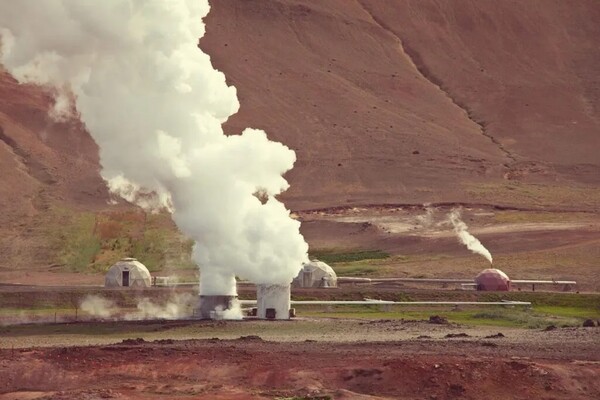
바이든 대통령과 해리스 부통령의 '인베스팅 인 아메리카(Investing in America)' 아젠다를 바탕으로 미 에너지부(Department of Energy)는 미국 전역의 지열 에너를 발전을 확대하기 위해 최대 3천100만 달러를 지원받는 6개 프로젝트를 선정했다고 발표했다. [사진출처(Photo source) = 미 에너지부(Department of Energy) 페이스북]
관정을 건설하고 성능을 평가하는 방법을 개선하면 EGS 및 기타 지열 발전 기술의 비용을 절감할 수 있어 지열 전기를 깨끗하고 비용 효율적인 선택으로 만드는 데 도움이 된다.
일반적으로 전기 에너지를 저장하는 전통적인 에너지 저장 배터리와 달리, 저수지 축열기술은 전기 없이 지하 저장고에 직접 100시간 이상 동안 열 에너지를 저장할 수 있다. 화학 물질, 식품 생산 및 임산물을 포함한 여러 산업은 재료를 유용한 제품으로 변환하는 데 사용되는 열을 생성하기 위해 에너지의 대부분을 소비하므로 따라서 저수지 축열기술는 중요한 산업 솔루션이다. RTES 실증 프로젝트는 2050년까지 산업을 탈탄소화하고 탄소중립 경제로 미국을 이끄는 데 도움이 되는 이 기술의 능력을 보여줄 것이다.
선정된 6개 프로젝트는 다음과 같다.
- 클렘슨대학교(Clemson University),488만182달러: 이 프로젝트는 고온 및 고압 관정 기록(logging)을 위한 AI 지원 광음향 이미징 툴을 개발해 액티브 쿨링(active cooling) 없이 지열 관정의 보전성(integrity)을 평가한다.
- 이노베이트 다운홀 솔루션(Innovative Downhole Solutions Inc.), 25만9천545달러: 이 프로젝트는 고온 지열 환경에서 24시간 동안 작동할 수 있는 내구성이 뛰어난 초음파 측정 도구를 개발해 건설 자재 및 관행을 평가한다.
- 로렌스 버클러 국립연구소(Lawrence Berkeley National Laboratory), 201만6천 달러: 이 프로젝트는 다운홀 전자장치 없이도 극한의 조건에서 관정보어(wellbore)의 보전성을 평가하도록 설계된 지열 시추공의 보전성 평가 도구를 개발한다.
- 로스 앨러모스 국립연구소(Los Alamos National Laboratory), 367만4천955달러: 이 프로젝트는 극한 조건에서 EGS 구성 요소를 평가하기 위한 고해상도 음향 기반 도구를 개발한다.
- 슐룸베르거 테크놀로지(Schlumberger Technology Corporation), 1천만 달러: 이 프로젝트는 시멘트(cement) 및 캐이싱(casing)의 장기적인 보전성 모델링을 위한 와이어라인(wireline) 트랙터 운반 시스템을 개발한다.
- 프로젝트 디벨롭먼트 솔루션(Project Development Solutions, Inc.), 789만9천807달러: 이 프로젝트는 베이커스필드의 컨프론트 유전(Kern Front Oil Field)에서 지하 지열 저수지와 증기 시스템을 연결하고 열을 차단하는 저수지 축열기술 실증 프로젝트를 시범 운영한다.
[원문보기]
Biden-Harris Administration Invests $31 Million to Reduce Costs and Expand Clean, Renewable Geothermal Energy
Funding will Support Six Projects to Help Bring Geothermal Power to Millions of U.S. Homes and Reduce Industrial Emissions
Building on President Biden and Vice President Harris’s Investing in America agenda, the U.S. Department of Energy (DOE) today announced the selection of six projects that will receive up to $31 million to advance geothermal energy throughout the country.
The projects will improve the construction of enhanced geothermal systems and demonstrate how reservoir thermal energy storage can reduce energy needs for industry – supporting DOE’s Enhanced Geothermal Shot™ goal to reduce the costs of enhanced geothermal systems (EGS) by 90% by 2035 and DOE’s Industrial Heat Shot™ goal to develop cost-competitive industrial heat decarbonization technologies with at least 85% lower emissions by 2035..
“Expanding the use of new and innovative geothermal technologies will allow the United States to continue pushing forward into the frontier of the clean energy revolution by using the heat beneath our feet,” said U.S. Secretary of Energy Jennifer M. Granholm. “These projects help achieve President Biden’s emissions reduction goals, strengthen U.S. competitiveness in this sector, and expand the types of clean and cost-effective energy solutions for American homes, businesses, and industry.”
Geothermal resources currently generate about four gigawatts of electricity in the United States, but a recent DOE analysis shows that advancing (EGS) could provide at least 90 gigawatts of firm, flexible power to the U.S. grid by 2050—enough to power the equivalent of more than 65 million U.S. homes.
Geothermal resources for electricity production requires fluid to flow among hot rocks in the subsurface and then be drawn to the surface in the form of steam or hot water. While underground heat exists everywhere, many locations lack adequate water or conditions that facilitate fluid flow necessary to recover that heat energy.
In those cases, EGS can be used to create a humanmade underground reservoir to tap that heat for energy. Using EGS to tap into geothermal resources requires drilling into the subsurface and using wells to draw hot water to the surface. Constructing and operating those wells can be costly.
Improving methods to build those wells and assess their performance can reduce costs for EGS and other geothermal power generation technologies, helping make geothermal electricity a clean, cost-effective option.
As opposed to traditional energy storage batteries, which typically store electrical energy, reservoir thermal energy storage (RTES) technology can store thermal energy directly in underground reservoirs for 100 or more hours without the need for electricity.
Several industries, including chemicals, food production, and forest products, consume most of their energy to generate heat used to transform materials into useful products—making RTES an important industrial solution. The RTES demonstration project will illustrate this technology’s capabilities to decarbonize the industry and help drive the nation towards a net-zero-emissions economy by 2050.
The selected projects are:
- Clemson University (Clemson, SC, $4,880,182): This project will develop an AI-enabled, photoacoustic imaging tool for high-temperature and high-pressure well logging to assess geothermal well integrity without active cooling.
- Innovative Downhole Solutions Inc. (Houston, TX, $2,509,545): This project will develop a durable ultrasonic measurement tool capable of operating for 24 hours in high-temperature geothermal environments to assess wellbore construction materials and practices.
- Lawrence Berkeley National Laboratory (Berkeley, CA, $2,016,000 ): This project will develop a tool for geothermal borehole integrity evaluation, designed to assess wellbore integrity in extreme conditions without the need for downhole electronics.
- Los Alamos National Laboratory (Los Alamos, NM, $3,674,955): This project will develop a high-resolution acoustics-based tool to provide high-fidelity data for evaluating EGS components under extreme conditions.
- Schlumberger Technology Corporation (Houston, TX, $10,000,000): This project will develop a wireline tractor-conveyed system for long-term integrity modeling of cement and casing.
- Project Development Solutions, Inc. (Bakersfield, CA, $7,899,807): This project will pilot a reservoir thermal energy storage (RTES) demonstration project at Kern Front Oil Field in Bakersfield, pairing subsurface geothermal reservoirs with a steam system and process heat off-taker.
These projects are funded by DOE’s Geothermal Technologies Office in the Office of Energy Efficiency and Renewable Energy.
Learn more about DOE’s EGS research and DOE’s low-temperature geothermal research, including RTES.
Selection for award negotiations is not a commitment by DOE to issue an award or provide funding. Before funding is issued, DOE and the applicants will undergo a negotiation process, and DOE may cancel negotiations and rescind the selection for any reason during that time.
[출처 = 미 에너지부(Department of Energy)(https://www.energy.gov/articles/biden-harris-administration-invests-31-million-reduce-costs-and-expand-clean-renewable) / 8월 26일]
|  즐겨찾기 추가
 시작페이지로 설정
























