[일본] 홋카이도대 국제 연구팀, 전기화학적 공정 사용해 NiOOH-Ni 촉매 개발
니켈 폼 표면에 니켈 옥시하이드록사이드 입자 생성해 암모니아 전환 효율 크게 향상
암모니아 전환으폐수처리·친화경 화학·수소 생산 분야에 기여할 것으로 기대
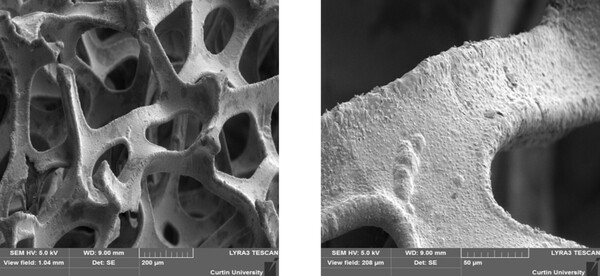
일본 홋카이도대학교 연구팀이 암모니아 전환 효율을 향상시킨 촉매를 개발했다고 밝혔다. 사진은 본 연구에서 개발된 촉매인 NiOOH-Ni을 주사전자현미경으로 확대한 모습. [사진제공(Photo Source) = Hokkaido University, Yanwen Liu et al. 『Advanced Energy Materials』]
일본 홋카이도대학교(Hokkaido University) 연구팀이 암모니아 전환 효율을 향상시킨 촉매를 개발했다고 밝혔다. 『어드밴스트 에너지 머티리얼즈(Advanced Energy Materials)』에 게재된 이 연구는 수 처리, 친환경 아질산염 및 질산염뿐 아니라 수소 생산을 크게 개선시킬 수 있는 잠재력을 가진 촉매를 개발했다.
촉매는 반응이 일어나는 경로를 보다 효율적으로 만들어 화학 반응 속도를 빠르게 하는 물질이다. 촉매는 반응을 통해 소모되거나 변형되지 않기 때문에 반복적으로 사용할 수 있으며, 산업·환경·생화학 등 다양한 분야에서 매우 중요하다.
홋카이도대와 호주 시드니 공과대학교(University of Technology Sydney) 등 여러 연구자들로 구성된 연구팀은 니켈(Ni)과 니켈 옥시하이드록사이드(NiOOH)를 결합해 NiOOH-Ni라는 촉매를 개발했다.
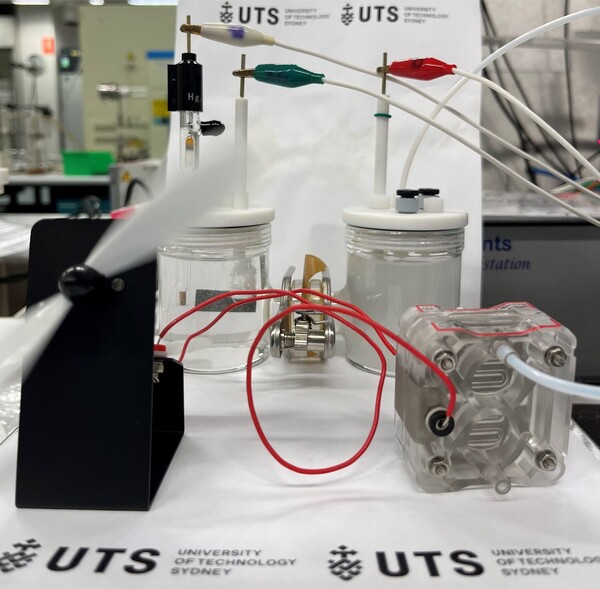
수소 생산과 암모니아 산화를 동시에 수행하기 위한 반응 전지 모습. [사진제공(Photo Source) = Hokkaido University, Liuhanwen, et al. 『Advanced Energy Materials』]
암모니아는 수역에서 과도한 조류 성장과 같은 심각한 환경 문제를 야기할 수 있으며, 이는 산소를 고갈시키고 수생 생물에 해를 끼칠 수 있다. 따라서 암모니아의 효과적인 관리와 전환은 매우 중요하지만, 암모니아의 부식성으로 처리에 어려움을 겪고 있다.
연구팀은 전기화학적 공정을 사용해 NiOOH-Ni를 개발했다. 다공성 물질인 니켈 폼을 화학 용액에 담근 상태에서 전류로 처리했으며, 이를 통해 폼 표면에 니켈 옥시하이드록사이드 입자를 생성시켰다. 니켈-산소 입자는 불규칙하고 비결정 구조임에도 불구하고 암모니아 전환 효율을 크게 향상시킨다. 이러한 촉매 설계로 기존보다 낮은 전압과 높은 전류에서 효과적으로 작동할 수 있다.
이번 연구를 주도한 정궈 황(Zhenguo Huang) 의 시드니공대 교수는 "NiOOH-Ni는 니켈 폼보다 더 잘 작동하며 반응 경로는 사용된 전기(전압)의 양에 따라 달라진다"며 "낮은 전압에서 NiOOH-Ni는 아질산염을 생성하는 반면, 높은 전압에서 질산염을 생성한다"고 설명했다.
이는 촉매의 필요에 따라 다양한 방식으로 사용될 수 있음을 나타낸다. 예를 들어, 암모니아를 덜 유해한 물질로 전환해 수를 처리하는 데 사용할 수 있다. 또한 다른 공정에서는 깨끗한 연료인 수소 가스를 생산하는 데 사용할 수도 있다. 이러한 유연성으로 NiOOH-Ni는 다양한 응용 분야에서 가치가 있다.
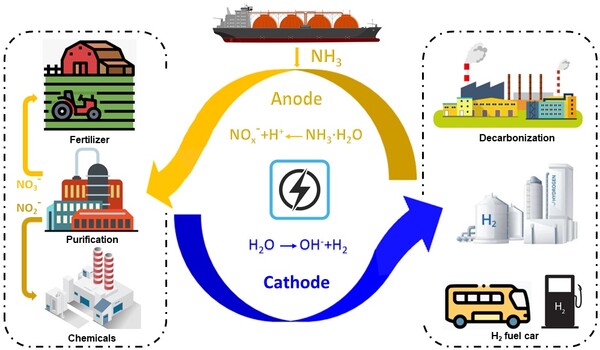
암모니아 수용액을 전기분해하면 NiOOH-Ni 양극에서는 아질산염과 질산염이 생성되고 Ni2P-Ni 음극에서는 녹색 수소가 생성된다. 이는 주변 조건에서 에너지 담체로서의 수소와 가치 있는 화학 물질로서의 아질산염과 질산염이 동시에 형성돼 현재 사용되는 열 암모니아 크래킹에 비해 장점을 제공한다. [사진제공(Photo Source) = Hokkaido University, Hanwen Liu, et al. 『Advanced Energy Materials』]
이번 연구에 참여한 안드레이 라일린(Andrey Lyalin) 홋카이도대 부교수는 "NiOOH-Ni는 놀라울 정도로 내구성이 뛰어나고 안정적이며, 여러 번 사용한 후에도 잘 작동한다"며 "이로 인해 암모니아를 전환하는 데 효과적이지 않은 백금과 같은 기존의 비싼 촉매에 대한 훌륭한 대안이 된다"고 말했다.
촉매의 장기적 신뢰성은 대규모 산업용으로 적합하며, 산업에서 폐수를 처리하고 청정 에너지를 생산하는 방식을 변화시킬 수 있다.
[원문보기]
Effective new catalyst brings hope for cleaner energy, wastewater treatment, and green chemistry
A catalyst that significantly enhances ammonia conversion could improve wastewater treatment, green chemical and hydrogen production.
A team of scientists have developed an effective catalyst with a remarkable ability to enhance the efficiency of ammonia conversion. Published in Advanced Energy Materials, the study reveals the catalyst’s potential to significantly advance wastewater treatment, green nitrite and nitrate, as well as hydrogen production.
Catalysts are substances that speed up chemical reactions by providing a more efficient route for a reaction to occur and making it easier to start and finish. Since catalysts are neither consumed nor altered in the reaction, they can be used repeatedly, and they are essential in a variety of industrial, environmental, and biochemical processes.
The team, which included researchers from Japan’s Hokkaido University, Australia’s University of Technology Sydney and elsewhere, developed the catalyst, called NiOOH-Ni, by combining nickel (Ni) with nickel oxyhydroxide.
Ammonia can cause severe environmental problems, such as excessive algal growth in water bodies, which depletes oxygen and harms aquatic life. At high concentrations, ammonia can harm humans and wildlife. Effective management and conversion of ammonia are thus critical, but its corrosive nature makes it difficult to handle.
The researchers developed NiOOH-Ni using an electrochemical process. Nickel foam, a porous material, was treated with an electrical current while immersed in a chemical solution. This treatment resulted in the formation of nickel oxyhydroxide particles on the foam’s surface. Despite their irregular and non-crystalline structure, these nickel-oxygen particles significantly enhance ammonia conversion efficiency. The catalyst’s design allows it to operate effectively at lower voltages and higher currents than traditional catalysts.
“NiOOH-Ni works better than Ni foam, and the reaction pathway depends on the amount of electricity (voltage) used,” explains Professor Zhenguo Huang from the University of Technology Sydney, who led the study. “At lower voltages, NiOOH-Ni produces nitrite, while at higher voltages, it generates nitrate.”
This means the catalyst can be used in different ways depending on what is needed. For example, it can be used to clean wastewater by converting ammonia into less harmful substances. But in another process, it can also be used to produce hydrogen gas, a clean fuel. This flexibility makes NiOOH-Ni valuable for various applications.
“NiOOH-Ni is impressively durable and stable, and it works well even after being used multiple times,” says Associate Professor Andrey Lyalin from Hokkaido University, who was involved in the study. “This makes it a great alternative to traditional, more expensive catalysts like platinum, which aren’t as effective at converting ammonia.”
The catalyst’s long-term reliability makes it suitable for large-scale industrial use, potentially transforming how industries handle wastewater and produce clean energy.
[출처 = 홋카이도대학교(Hokkaido University)(https://www.global.hokudai.ac.jp/blog/effective-new-catalyst-brings-hope-for-cleaner-energy-wastewater-treatment-and-green-chemistry/) / 2024년 8월 8일]
|  즐겨찾기 추가
 시작페이지로 설정
























