[미국] 카본 아메리카, 국립탄소포집센터서 극저온 탄소포집 기술 '프로스트CC' 성능 입증
연도 가스 압축·냉각 후 내부 이산화탄소 탈승화 지점까지 팽창…자동 냉매로 시스템 통해 저탄소 배출가스 재순환
플랜트서 발생하는 오염물질 포집 가능…24시간 가동 시작해 누적 탄소포집 가동 1천 시간 달성
설치 면적 작고 전기만 사용해 기존 플랜트 개조 용이…대량 생산 및 비용 절감
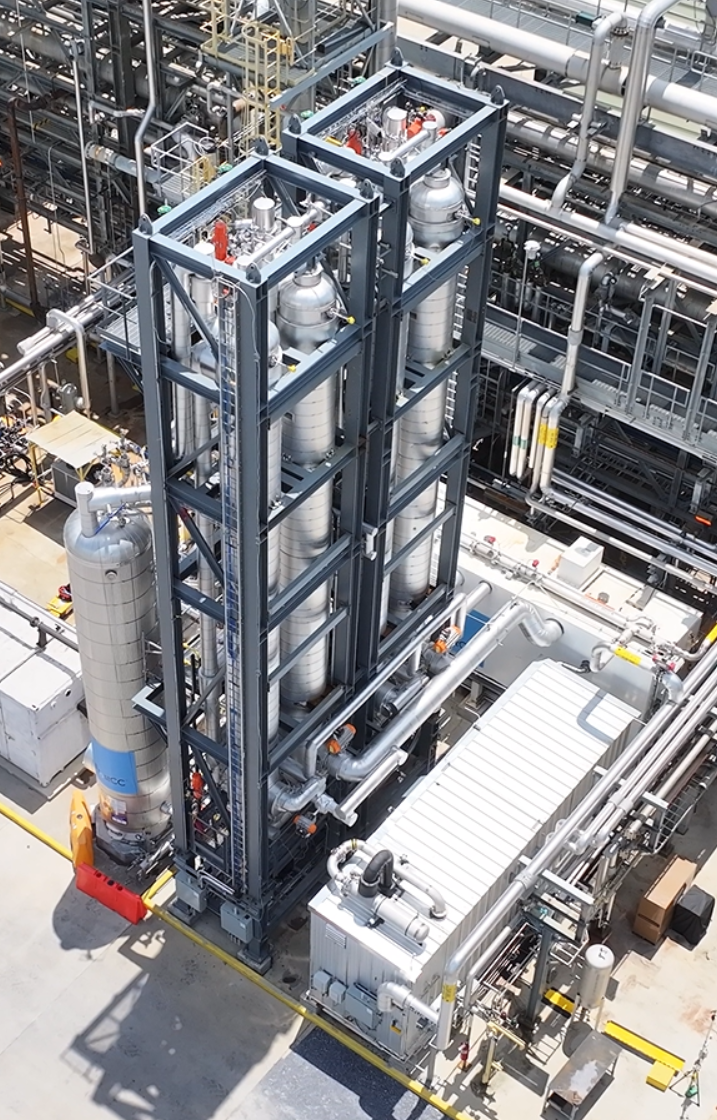
카본 아메리카(Carbon America)는 8월 1일(현지시각) 미국 앨라배마(Alabama)주 윌슨빌(Wilsonville)에 위치한 국립탄소포집센터(National Carbon Capture Center, NCCC)에서 극저온 탄소포집 기술인 '프로스트 CC(FrostCC™)'의 엔지니어링 규모 파일럿 테스트를 성공적으로 완료했다고 밝혔다. 사진은 국립탄소포집센터에 설치된 프로스트CC 시스템. [사진출처(Photo Source) = 카본 아메리카(Carbon America)]
카본 아메리카(Carbon America)는 8월 1일(현지시각) 미국 앨라배마(Alabama)주 윌슨빌(Wilsonville)에 위치한 국립탄소포집센터(National Carbon Capture Center, NCCC)에서 극저온 탄소포집 기술인 '프로스트 CC(FrostCC™)'의 엔지니어링 규모 파일럿 테스트를 성공적으로 완료했다고 밝혔다. 이 기술은 탄소포집 1천 시간에 도달하는 성능을 입증했다.
프로스트CC 기술은 탄소포집 분야에서 상당한 발전을 이뤘다. 프로스트CC는 연도 가스(Flue Gas)를 압축, 냉각해 내부 이산화탄소가 서리(탈승화)하는 지점까지 팽창시킨 뒤, 고체 이산화탄소를 나머지 연도 가스로부터 물리적으로 분리할 수 있다. 저탄소 배출가스는 자동 냉매로(Auto-refrigerant) 시스템을 통해 다시 순환된다.
프로스트CC는 내구성이 뛰어난 완전 전기 구동 솔루션으로, 거의 모든 전력 및 산업 플랜트에서 발생하는 다른 기준 오염물질을 포집할 수 있다. 특히, 이러한 혁신적인 극저온 접근방식은 공기 압축기(Expanders) 및 유사 표준 산업용 터보 장치를 활용하고, 용매나 화학물질, 물을 이용하지 않는다.
상업용 프로스트CC 제품은 열차에서 상용 장비 및 재료를 활용해 대량으로 생산할 수 있으며, 비용을 크게 절감할 수 있다. 또한, 설치 면적이 작고 전기만 사용하므로 기존 플랜트를 쉽게 개조할 수 있으며, 현장 중단을 최소화할 수 있다.
프로스트CC 기술은 미국 콜로라도주 아바다에 있는 카본 아메리카 R&D 시설에서 처음 개발됐다. 2천 시간 이상의 테스트를 비롯해 350개 이상의 테스트를 카본 아메리카의 통합 시스템에서 수행해 다양한 농도와 속도 등을 점검했다. 검증된 맞춤형 모델은 물리학의 핵심을 특성화할 뿐 아니라 기술을 최적화할 수 있도록 지속 개선되고 있다. 아르바다(Arvada)에서 수행된 테스트는 2022년 기술 준비 수준(Technology Readiness Lever, TRL) 5를 달성했다.
카본 아메리카의 NCCC 테스트 프로젝트는 두 단계로 나뉘어 진행됐다. 1단계는 압축, 탈수, 팽창, 냉기 복원에 초점을 맞췄으며, 2단계는 프로스팅 열교환기(Frosting Heat Exchangers) 및 액체 이산화탄소 시스템을 추가했다. 2024년 4월 초에 본격적으로 24시간 가동을 시작해 누적 탄소포집 가동 시간 1천 시간을 달성했다.
이번 테스트를 통해 주요 장비 및 프로세스의 성능 저하 없이 시스템의 견고성과 신뢰성을 입증했으며, 가스 공동 오염물질을 제거할 수 있는 것을 확인했다. 또한, 기술 준비 수준 6을 달성해 상용 모듈의 완전한 설계의 가능성을 입증했다.
향후 카본 아메리카는 NCCC 파일럿에 이어 표준 상용 프로스트CC 모듈의 첫 번째 버전을 배포할 계획이다. 이 모듈은 일단 입증되면 시멘트 및 철강, 펄프 및 제지, 기타 생산 플랜트 등 다양한 배출집약적 산업 전반에 걸쳐 넓은 범위에서 상업적으로 적용하기 위해 준비될 예정이다.
[원문보기]
Carbon America Advances Ultraclean Carbon Capture at the National Carbon Capture Center Using Novel Cryogenic Process
Carbon America has proved out an engineering-scale pilot of its FrostCC™ cryogenic carbon-capture technology at the National Carbon Capture Center (NCCC) in Wilsonville, Alabama. The system has achieved performance expectations, reaching 1,000 hours of carbon capture.
FrostCC™- lowering the cost of carbon capture while cleaning up criteria pollutants:
The FrostCC™ technology represents a significant advancement in the field of carbon capture. FrostCC™ compresses, cools, and expands flue gas to the point where the CO₂ within it “frosts” (changes phase from gas to solid, also known as desublimation). The solid CO₂ can then be physically separated from the rest of the flue gas constituents. The CO₂-lean exhaust gas is circulated back through the system as the auto-refrigerant.
FrostCC™ is a durable, fully electric-driven solution and intrinsically captures other criteria pollutants from nearly any power or industrial plant. The innovative cryogenic approach utilizes standard industrial turbomachinery, similar to air compressors and expanders, and eliminates solvents, chemicals, and water use. The commercial FrostCC™ product will leverage commodity equipment and materials proven at scale in versatile, standardized trains, enabling high volume manufacturing to drive down costs. Its small footprint and electric-only load enables easy retrofitting of existing plants while minimizing site host disruption.
The FrostCC™ capture technology was initially developed at the Carbon America R&D facility in Arvada, Colorado. Over 350 tests covering over 2,000 hours of testing were performed across a range of concentrations and rates at our laboratory-scale integrated system. Custom, empirically-validated models are continuously refined to characterize the core physics, as well as enable optimization of the technology. Testing at Arvada achieved technology readiness level (“TRL”) 5 in 2022.
Engineering-scale Pilot System Accomplishments:
Carbon America’s NCCC testing campaign was divided into two phases. Phase 1 focused on compression, dehydration, expansion, and cold recuperation. Phase 2 included the addition of Frosting Heat Exchangers and the liquid CO₂ system. Full system 24/7 operation began in early April 2024 and accumulated 1,000 hours of carbon capture operation. Key accomplishments include:
- Demonstrated robustness and reliability of the system, with no degradation of major equipment or processes.
- Proved co-pollutant removal from a gas flue stream.
- Further validated physics-based models and proved operational boundaries, enabling strong confidence in scalability and design of larger systems.
- Achieved technology readiness level (“TRL”) 6, enabling full design of commercial modules.
Future FrostCC™ Deployment:
Following the NCCC pilot, Carbon America plans to deploy the first iteration of the standard commercial FrostCC™ module. This module, once proven, will be ready for broad commercial application across various emission-intensive industries such as power plants, cement and steel, pulp and paper, and other production facilities.
[출처 = 카본 아메리카(Carbon America)(https://www.carbonamerica.com/news/carbon-america-advances-ultraclean-carbon-capture) / 2024년 8월 1일]
|  즐겨찾기 추가
 시작페이지로 설정
























