[미국] 예일대 연구팀, 전기막으로 더 깨끗한 식수 생산기술 개발
레아 윈터 조교수, 식수서 질산염 제거하기 위한 전략으로 ‘탄소나노튜브’로 만든 전기화된 막 사용 제안
기존 전기화학공정서 질산염 80∼90% 제거하려면 몇시간 소요…개발된 반응기 통해 15초안에 약 80%의 전환율 얻어
국제학술지 『네이처 워터(Nature Water)』 최근호에 발표
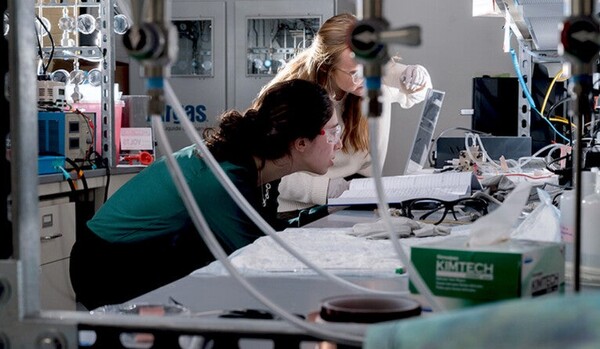
물 속의 질산염 오염은 오랫동안 우리의 환경과 건강에 위협을 주었다. 그러나 이제, 예일대 연구원들은 그것을 제거하는 효율적인 방법을 개발했다. [사진출처(Photo source) = 예일대학교(Yale University)]
물 속의 질산염(NO3-) 오염은 오랫동안 환경과 인간의 건강에 위협이 되어 왔다. 이제 예일대학교(Yale University) 연구원들은 질산염을 제거하는 효율적이고 효과적인 방법을 개발했다.
예일대 화학 및 환경공학 조교수인 레아 윈터(Lea Winter) 박사는 식수에서 질산염을 제거하기 위한 전략으로 ‘탄소나노튜브(carbon nanotubes)’로 만든 전기화된 막(electrified membranes)을 사용할 것을 제안한다.
그 결과는 국제학술지 『네이처 워터(Nature Water)』 최근호에 ‘전기화된 막 여과를 통한 고효율의 무금속 질산염 환원(Highly efficient metal-free nitrate reduction enabled by electrified membrane filtration)’이라는 제목으로 발표되었다.
윈터 조교수가 지적한 바와 같이, 물에서 질산염을 제거하는 방법에는 일반적으로 두 가지가 있다. 하나는 그것을 분리하는 것과, 또다른 하나는 그것을 파괴하는 것이다.
레아 윈터(Lea Winter) 조교수는 “만약 여러분이 질산염을 분리하고 있다면, 여러분은 불가피하게 환경으로 돌아가고 식수로 다시 돌아가는 농축된 폐기물 흐름을 갖게 될 것”이라면서 “따라서 여러분이 그것을 파괴할 수 있다면 훨씬 더 좋다”고 강조했다.
대표적인 파괴 방법에는 하수처리장에서 주로 사용되는 생물학적 탈질(biological denitrification)이 포함된다. 하지만 문제는 이 과정이 민감하기 때문에 pH(수소이온농도) 균형, 세포 함량, 온도 등의 사소한 변화만으로도 전체 과정이 중단될 수 있다는 것이다. 그리고 질산염 파괴를 미생물에 의존하기 때문에 그 과정은 상당히 느릴 수 있다.
이러한 장애물들을 극복하기 위해, 과학자들은 전기촉매법(electrocatalytic processes)을 개발했다. “이것은 훨씬 빠르며 질산염을 파괴하여 농축된 폐기물 흐름으로 끝나지 않는다”라고 윈터 조교수는 말했다.
그러나 윈터 조교수는 이러한 기술들이 공정을 더 잘 통제할 수 있게 해주지만 단점도 가지고 있다고 지적한다. 고전적인 전기화학 공정은 2차원 평판 전극을 사용한다.
“그 전극 표면에서 질산염을 효율적으로 반응시킬 수 있을 정도로 빠르게 용액에서 전극으로 질산염을 얻을 수 없다”라고 덧붙였다.
윈터의 연구소는 탄소 나노튜브와 이들을 결합하는 폴리머로 만들어진 전기화된 막을 사용함으로써 이 문제를 해결했다.
윈터 조교수는 “우리는 이 시스템들의 전극을 통해 흐르고 있지만, 여기서 중요한 것은 우리가 구멍을 가지고 있고 그 구멍들을 통해 흐르고 있다는 것뿐만 아니라, 그 구멍들의 크기가 정말 작다는 것이다”라고 말했다.
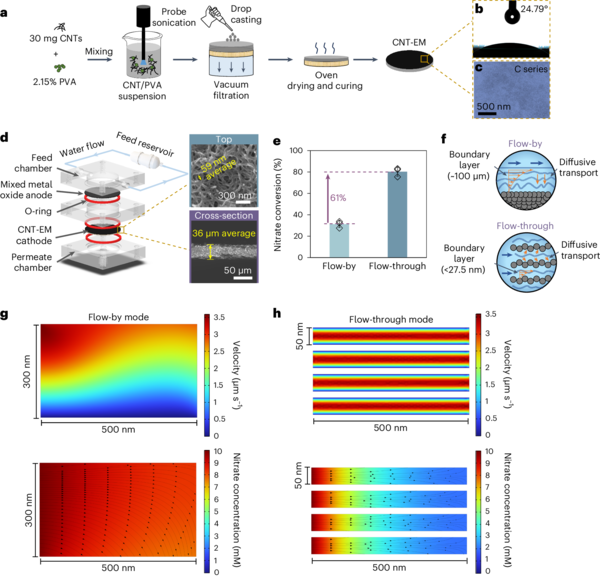
예일대 윈터 조교수의 연구실에서 개발된 막은 기공 크기가 약 50나노미터(㎚), 즉 약 2천 배 더 작은 것이 특징이다. 이는 질산염이 전극 표면에 도달하여 반응을 일으키기 전에 이동해야 하는 ‘느린(slow)’ 공간이 훨씬 더 작다는 것을 의미한다. [그림출처(picture source) = 『네이처 워터(Nature Water)』]
기존의 2차원 시스템에서 전극 표면에 가장 가까운 유체층(경계층, boundary layer)은 약 100마이크로미터(㎛)이다. 이 비교적 큰 경계층은 유체 흐름과 그에 따른 해당 층을 통한 질산염의 이동이 반응 속도 자체보다 훨씬 느리기 때문에 반응을 제한할 수 있다.
윈터의 연구실에서 개발된 막은 기공 크기가 약 50나노미터(㎚), 즉 약 2천 배 더 작은 것이 특징이다. 이는 질산염이 전극 표면에 도달하여 반응을 일으키기 전에 이동해야 하는 ‘느린(slow)’ 공간이 훨씬 더 작다는 것을 의미한다.
윈터 조교수는 “따라서 이 구성에서 우리는 이러한 확산 한계를 극복할 수 있으며 매우 흥미로운 특성을 보기 시작한다”라고 말했다.
충분한 질산염 전환을 달성하기 위해 금속이 필요한 대부분의 전기화학 시스템과 달리 윈터조교수의 막에는 금속이 포함되어 있지 않다. 확산 한계를 극복하기 때문에 탄소 나노튜브(carbon nanotubes)를 촉매로 사용하는 막은 금속 촉매와 비슷한 질산염 전환을 달성할 수 있다.
이 기술과 기존 전기화학 공정의 큰 차이점 중 하나는 질산염을 파괴하는 데 걸리는 시간을 극적으로 단축한다는 것이다.
“기존의 전기화학 공정을 살펴보면 질산염을 80% 또는 90% 제거하려면 일반적으로 몇 시간이 걸린다”라고 그녀는 말했다.
“모든 질산염이 표면에 도달하는 데 시간이 너무 오래 걸리기 때문에 반응하는 데 오랜 시간이 필요하다”라면서 “우리 시스템에서는 반응기를 통해 15초안에 약 80%의 유사한 전환율을 얻었다. 우리는 몇 시간 단위에서 15초 단위로 줄였다”라고 윈터 조교수는 강조했다.
실제 적용에서 이 기술을 테스트하기 위해 윈터의 연구팀은 예일대 캠퍼스 근처의 윈터그린(Wintergreen) 호수에서 물을 샘플링하고 소량의 질산염을 추가했다.
윈터 조교수는 “실제로 더 높은 농도를 변환하는 것이 훨씬 쉽기 때문에 우리는 이것이 실제 오염된 물에서 볼 수 있는 것을 대표하는 더 낮은 농도에서 작동할 것인지 특별히 확인하고 싶었다”라면서 “우리는 그 농도를 취한 다음 식수에 대한 EPA(미 환경청) 표준 이하로 질산염을 제거할 수 있었다”라고 역설했다.
[원문보기]
Cleaner water with electrified membranes
Nitrate contamination in water has long presented threats to the environment and human health. Now, Yale researchers have developed an efficient and effective way to remove it.
Lea Winter, assistant professor of chemical & environmental engineering, proposes the use of electrified membranes made with carbon nanotubes as a strategy for nitrate removal in drinking water. The results are published in Nature Water.
As Winter points out, there are typically two ways of removing nitrate from water: separating it and destroying it.
“If you're just separating the nitrate, then you end up with a concentrated waste stream that inevitably goes back to the environment and back into the drinking water,” she said. “So it's much better if you can destroy it.”
Classic destruction techniques involve biological denitrification that are typically used in wastewater treatment plants. The problem, though, is that the processes are sensitive, and even a slight change in things like the pH balance, cell content, or temperature could cause the whole process to break down. And because you’re depending on microbes to do the nitrate destruction, the process can be pretty slow.
To get around those obstacles, scientists developed electrocatalytic processes. “It's a lot faster, and it also accomplishes destruction of nitrate so that you don't end up with that concentrated waste stream.”
But Winter notes that, while these technologies allow for more control over the process, they also have their drawbacks. Classical electrochemical processes involve the use of two-dimensional flat plate electrodes.
“You just can't get nitrate from your solution to your electrodes fast enough to be able to efficiently react the nitrate at that electrode surface,” she said.
Winter’s lab has gotten around this by using electrified membranes, made of carbon nanotubes and a polymer that holds them together.
“We're flowing through the electrode in these systems, but the key here is not just that we have pores and we're flowing through them, but that the sizes of those pores are really small.”
In the conventional two-dimensional systems, the layer of fluid closest to the surface of the electrode - the “boundary layer” - is about 100 micrometers. This relatively large boundary layer can limit the reaction because the fluid flow, and therefore transport of nitrate through that layer, is much slower than the reaction rate itself.
The membranes developed in Winter’s lab feature pore sizes of about 50 nanometers, or about 2,000 times smaller. That means there’s a much smaller “slow” space through which the nitrate has to move before getting to the electrode surface and undergoing reaction.
“So in this configuration, we're able to overcome these diffusion limitations, and we start to see some pretty interesting properties.”
Unlike most electrochemical systems, which require metals to achieve sufficient nitrate conversion, Winter’s membranes contain no metal. Because they overcome the diffusion limitations, the membranes - using carbon nanotubes as the catalysts - can achieve a nitrate conversion comparable to that of metal catalysts.
One big difference between this technique and conventional electrochemical process is that it dramatically reduces the time it takes to destroy the nitrate.
“Looking at conventional electrochemical processes, it usually takes on the order of hours if you want to get 80% or 90% removal of that nitrate,” she said.
“You need to give a long time to react because it takes so long to get all that nitrate to your surfaces. In our systems, we get similar conversion around 80% in 15 seconds through our reactor. We're going from the order of hours down to 15 seconds.”
To test the technology in a real-world application, Winter’s research team sampled some water from Lake Wintergreen, near the Yale campus, and added a small amount of nitrate.
“It's actually much easier to convert higher concentrations, so we specifically wanted to see if this is going to work on lower concentrations that are representative of what you see in real contaminated waters,” she said. “We took that concentration, and then we were able to remove the nitrate to below the EPA standard for drinking water.”
[출처 = 예일대학교(Yale University)(https://seas.yale.edu/news-events/news/cleaner-water-electrified-membranes) / 2024년 7월 18일]
[연구논문 출처 = 『네이처 워터(Nature Water)』(https://www.nature.com/articles/s44221-024-00278-7) / 2024년 7월 4일자 발간]
|  즐겨찾기 추가
 시작페이지로 설정
























