[일본] 도쿄이공대학, “담수환경에서 미세플라스틱 농도 추정 개선”
도시 하천 미세플라스틱 오염의 정확한 평가 필요한 샘플수 결정 방법 개발
도쿄이공대 다나카 박사·에히메대 카타오카 부교수 공동조사·연구
학술지 『환경오염(Environmental Pollution)』 10월 1일 게재 예정
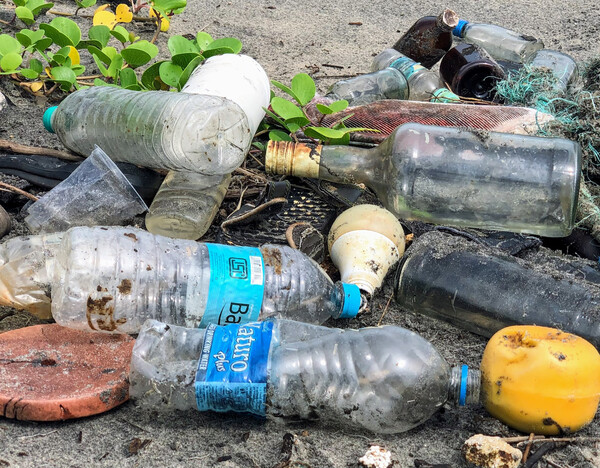
일본 도쿄 이과대학(Tokyo University of Science)의 연구진이 하천, 호수, 강 등 담수에서 미세플라스틱 농도를 정확하게 평가할 수 있는 샘플수 결정 방법을 개발했다. [사진출처(Photo source) = Unsplash © john_cameron]
미세플라스틱(microplastic ; MP) 오염은 세계적인 관심사이다. 그럼에도 불구하고 미세플라스틱의 주요 해양 진입 지점인 하천의 미세플라스틱 농도를 평가하는 표준 방법은 없다. 이로 인해 임의 샘플링과 부정확한 평가가 발생한다.
일본 도쿄 이과대학(Tokyo University of Science)의 연구진이 하천, 호수, 강 등 담수에서 미세플라스틱 농도의 정확한 평가를 위해 적절한 샘플 수를 결정하는 방법을 제안했다. 그 방법은 미세플라스틱 조사에 소비되는 시간과 자원을 크게 줄일 수 있다.
플라스틱 오염의 정도는 직경 5mm 미만의 플라스틱 입자(MP)의 형태로 눈에 보이지 않게 숨겨져 있다. 플라스틱은 분해 속도가 느리기 때문에 작은 입자로 쪼개져 전체 생태계를 오염시킨다.
1970년대 초 발견 이후 몇 년 동안 미세플라스틱은 세계적인 관심사가 되었다. 미세플라스틱은 땅, 공기, 물, 그리고 우리가 먹는 음식, 특히 해산물에서 발견된다. 이것은 강과 같은 담수 공급원이 종종 미세플라스틱를 바다로 운반하고 그곳에서 축적되기 때문이다.
그러나, 널리 퍼져 있음에도 불구하고 현재 강에서 미세플라스틱 농도를 측정하고 정량화하는 표준 절차는 없다. 원래 플랑크톤 샘플을 수집하도록 설계된 플랑크톤 그물은 일반적으로 강에서 미세플라스틱를 포획하는 데 사용된다.
이러한 그물이 막히는 것을 방지하고 큰 표본 크기를 확보하기 위해 강을 따라 고정된 위치에서 여러 개의 표본을 수집하고 미세플라스틱 농도를 모든 표본 결과의 평균으로 계산한다.
그러나 대부분의 연구는 불확실성과 표본 추출 오류를 고려하지 않아 미세플라스틱 농도의 잘못된 평가를 초래하며, 특히 정확한 미세플라스틱 평가에 필요한 샘플의 양에 관한 결과를 초래한다.
이 논문은 오는 10월 1일 발간되는 학술지 『환경오염(Environmental Pollution)』에 ‘도시 하천에서의 미세플라스틱 샘플링의 다양성과 정밀성(Variance and precision of microplastic sampling in urban rivers)’라는 제목으로 발표된다.
최근 연구에서 도쿄 이과대학(Tokyo University of Science)의 다나카 마모루(Mamoru Tanaka) 박사와 니헤이 야스오(Yasuo Nihei) 교수는 일본 에히메대학(Ehime University)의 카타오카 도모야(Tomoya Kataoka) 부교수와 함께 다른 추정치들 사이의 변동성을 설명함으로써 미세플라스틱 농도의 추정치를 개선했다.
다나카 박사는 “분산을 통해 미세플라스틱 오염의 정확한 표현에 필요한 적절한 샘플 수를 추정할 수 있다”라면서 “우리는 미세 플라스틱의 현장 샘플링을 위해 각 오염 상황에서 적절한 반복 횟수를 결정하는 방법을 제안했다”라고 말했다.
또한 분산을 통해 수체에서 미세플라스틱이 어떻게 분포되는지 파악할 수 있다. 예를 들어, 강에 균일하게 분포되어 있으면 표본간의 분산이 낮다. 반면에 분산이 크면 불균일한 군집 분포를 나타낸다.
미세플라스틱 농도의 표본 간 분산을 평가하기 위해 과학자들은 원래 동물성 플랑크톤을 위한 다른 방법을 빌렸다. 미세플라스틱과 동물성 플랑크톤 사이의 샘플링 절차와 농도 추정의 유사성에 대해 다나카 박사는 “강변 미세플라스틱의 수치적 농도 범위가 동물성 플랑크톤의 수치와 겹친다는 것이 밝혀졌다”라고 박사는 설명했다. 이 방법에 따르면 표본 간 분산은 농도 추정의 평균 또는 평균에 비례한다.
연구팀은 미세플라스틱 농도를 위해 일본 지바현 오호리(Ohori) 강과 도네운가(Tone-unga) 운하 2곳에서 플랑크톤 그물에 담긴 시료 10개를 채취했다. 그들은 샘플링 장소에서 총 1천333개의 미세플라스틱 입자를 확인했다.
오호리에서 5.23 입자/㎥, 운가에서 15.22 입자/㎥로 측정된 미세플라스틱의 평균 농도는 일본 하천에서 보고된 미세플라스틱의 평균(4.3 입자/㎥)보다 높았다. 또한 두 위치에서 계산된 평균과 분산이 단순한 선형 회귀 분석과 일치했다.
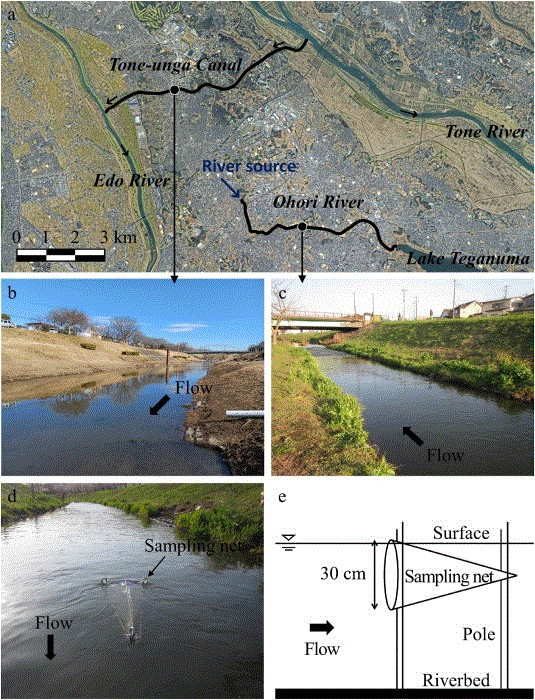
(a) 관측 지점의 지역지도. (b, c) 운가(b)와 오호리(c) 사이트 근처에서 찍은 사진. (d) 오호리 현장에서 금속 기둥을 이용하여 하천 중심선에 위치한 시료채취망 사진. (e) 샘플링 망 전개의 측면도 구성을 나타내는 도식도. 335μm 메쉬망(mesh net)은 강바닥에 부착된 4개의 금속 기둥을 사용하여 하천 중심선에 배치되었다. [사진출처(Photo source) = 도쿄이공대학]
다나카 박사는 “평균 수치 농도의 증가와 함께 분산이 꾸준히 증가했다. 또한 회귀 분석에 따르면 강의 미세플라스틱는 서로 상호작용하지 않아 랜덤 입자 분포를 보인다”라고 말했다.
다나카 박사는 이어 “가장 중요한 것은 연구팀은 높은 미세플라스틱 농도에서는 두 개의 반복 검체가 미세플라스틱 농도를 정확하게 측정하기에 충분하다는 것을 발견했다”라면서 “우리는 두 번의 반복실험의 평균이 3개의 입자/㎥ 이상의 고농도의 조건에서 30% 미만의 충분한 정밀도를 유지한다는 것을 발견했다”라고 덧붙였다.
최근 몇 년 동안 미세플라스틱의 문제가 인식되었고 일본을 포함한 다양한 국가들은 환경에서의 미세플라스틱에 대한 더 나은 감시와 통제를 보장하는 법안을 통과시켰다. 이러한 관점에서 이 연구는 미세플라스틱 평가 조사에 투자하는 시간과 자원을 줄이면서 샘플링 방법론을 개선하는 데 도움이 될 수 있을 것으로 기대된다.
[원문보기]
Improving the Estimation of Microplastic Concentrations in Freshwater Environments
Researchers develop a method to determine the number of samples required for accurate assessment of microplastic contamination in urban rivers
Microplastic (MP) contamination is a worldwide concern. Despite this, there is no standard method for assessing MP concentrations in rivers, which are the main entry points of MPs into oceans. This leads to arbitrary sampling and inaccurate assessments.
Now, researchers from Japan have proposed a method that determines the appropriate number of samples for an accurate assessment of freshwater MP concentration. The method could greatly reduce the time and resources spent on MP surveys.
The extent of plastic pollution remains largely hidden from view in the form of microplastics (MPs): plastic particles with diameters less than 5 mm. Since plastics are slow to degrade, they fragment into tiny particles that end up contaminating entire ecosystems.
In the years since their discovery in the early 1970s, MPs have become a ubiquitous and global concern. MPs are found in land, air, water, and the food that we eat, especially seafood. This is because freshwater sources, such as rivers, often carry off MPs into the oceans, where they accumulate.
Despite its pervasiveness, however, there is currently no standard procedure to measure and quantify MP concentration in rivers. Plankton nets, originally designed to collect plankton samples, are commonly used to capture MPs in rivers.
To prevent these nets from getting clogged and ensure a large sample size, multiple samples are collected at fixed locations along the river and the MP concentration is calculated as the average of all the sampling results.
Most studies, however, do not take uncertainties and sampling errors into account, resulting in an erroneous assessment of MP concentrations, particularly in terms of the amounts of samples required for accurate MP assessments.
Now, in a recent study published in Environmental Pollution, Dr. Mamoru Tanaka and Professor Yasuo Nihei from Tokyo University of Science along with Associate Professor Tomoya Kataoka from Ehime University in Japan have improved upon the estimation of the MP concentration by accounting for the variability between estimations obtained from different samples.
The variance can help estimate the appropriate number of samples required for an accurate representation of MP contamination. "For an on-site sampling of microplastics, we have proposed a method for determining the appropriate number of iterations in each contamination situation," says Dr. Tanaka.
Additionally, the variance can provide insight into how MPs are distributed in the waterbody. For instance, if they are uniformly distributed in the river, the variances between the samples would be low. On the other hand, a high variance would indicate a non-uniform clumped distribution.
To evaluate the inter-sample variances in MP concentration, the scientists borrowed another method originally intended for zooplankton. "It turns out that the numerical concentration ranges of riverine microplastics overlap with those of zooplankton," explains Dr. Tanaka, regarding the similarity of both the sampling procedure and the concentration estimations between MPs and zooplankton. According to this method, the inter-sample variance is proportional to the average or mean of the concentration estimations.
For the MP concentrations, the team collected 10 samples in plankton nets at two sites along the Ohori River and Tone-unga (Unga) canal in Chiba, Japan - two waterbodies that flow through urban areas and contain a high concentration of plastic waste. They identified a total of 1333 MP particles at the sampling sites.
The average concentrations of the MPs, which were measured to be 5.23 particles/m3 in the Ohori and 15.22 particles/m3 in the Unga, were higher than the reported average of MPs in Japanese rivers (4.3 particles/m3). Furthermore, the calculated averages and variance at both locations matched up with a simple linear regression.
"Variance steadily increased with an increase in the mean numerical concentrations," points out Dr. Tanaka. Regression analysis further suggested that the MPs in the rivers do not interact with one another, resulting in random particle distributions.
Most importantly, the team found that at high MP concentrations, two replicate samples are sufficient to measure the MP concentrations accurately. "We found that the mean of two replicates maintained sufficient precision of less than 30% for conditions with high concentrations of more than 3 particles/m3," says Dr. Tanaka.
The problem of MPs has been recognized in recent years and various countries including Japan have passed legislation to ensure better monitoring and control of MPs in the environment. In this light, this study could help improve the sampling methodology, reducing the time and resources invested in MP assessment surveys.
[출처 = 도쿄이공대학(https://www.tus.ac.jp/en/mediarelations/archive/20220803_5628.html) / 2022년 8월 10일]
|  즐겨찾기 추가
 시작페이지로 설정
























