[캐나다] 토론토대학 연구팀, “기계 학습 사용 미세플라스틱 계산 속도 향상”
기계 학습(machine learning) 사용 미세플라스틱 더 쉽고 빠르고 저렴하게 계산 및 분류 프로세스 만드는 새 방법 제안
UNEP, 지난 4월 “미세플라스틱 지구 생태계 위험에 빠뜨리는 ‘대재앙(catastrophe)’ ” 명시
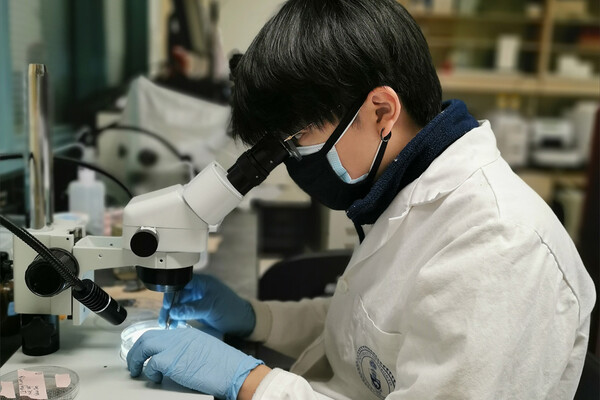
토론토대학의 토목 및 광물 공학대학원 연구 조교인 Weiwu Chen이 엘로디 파스포트(Elodie Passeport) 부교수의 연구실에서 현미경을 사용하여 미세 플라스틱의 수를 세고 있다. [사진출처(Photo source) = 토론토대학 / 사진 제공 = 탄 수야오(Shuyao Tan) 연구원)]
미세플라스틱(Microplastics)은 우리가 마시는 물, 먹는 음식, 숨쉬는 공기 등 우리 주위에 있다. 그러나 연구원들이 건강에 대한 이러한 입자의 실제 영향을 이해하기 전에 존재하는 것을 정량화하는 더 빠르고 효과적인 방법이 필요하다.
캐나다 토론토대학(University of Toronto's)의 응용과학 및 공학학부의 연구원들이 수행한 두 가지 최근 연구에서 기계 학습(machine learning)을 사용하여 미세플라스틱을 더 쉽고 빠르고 저렴하게 계산 및 분류하는 프로세스를 만드는 새로운 방법을 제안했다.
토론토 대학의 토목 및 광물공학 및 화학공학과 엘로디 파스포트(Elodie Passeport) 부교수는 “수질 샘플에서 미세플라스틱을 분석하는 것은 정말 시간이 많이 걸린다”라고 말했다.
엘로디 파스포트(Elodie Passeport) 부교수는 “메이슨 항아리 크기의 샘플을 완전히 분석하는 데 최대 40시간이 걸릴 수 있으며 해당 샘플은 한 시점에서 가져온 것이다. 시간이 지남에 따라 비교하거나 다른 수역에서 샘플을 관찰하려는 경우 특히 어려워진다”고 덧붙였다.
지난달, 유엔환경계획(UNEP ; United Nations Environment Programme)은 플라스틱 오염을 종식시키기 위한 역사적인 결의안을 지지했는데, 이 결의안에는 인간의 건강, 해양 및 연안 종, 지구 생태계를 위험에 빠뜨리는 ‘대재앙(catastrophe)’이라고 명시했다.
미세플라스틱은 생분해되는 데 수백 년에서 수천 년이 걸릴 수 있다. 하지만 눈에 보이는 플라스틱 쓰레기만이 문제가 아니다. 시간이 지남에 따라 플라스틱은 점점 더 작은 입자로 분해됩니다. 크기가 5밀리미터(㎜) 미만이지만 0.1마이크로미터(㎛)보다 큰 조각을 미세플라스틱으로 정의한다.
미세플라스틱의 영향을 연구하는 연구원들은 여전히 이 작은 조각이 벌크 물질(bulk material)과 다른 방식으로 인간과 환경건강에 어떻게 영향을 미칠 수 있는지 이해하려고 노력하고 있다.
과거 연구에서 다양한 환경에서 미세플라스틱의 존재가 입증되었지만, 그 수준을 정량화하는 방법, 그리고 결정적으로 시간과 공간에 따라 다양한 샘플을 비교하는 방법에 대한 표준은 여전히 등장하고 있다. 엘로디 파스포트(Elodie Passeport) 부교수는 화학공학 박사과정 연구원인 탄 수야오(Shuyao Tan)와 전기 및 컴퓨터공학 부교수인 조슈아 테일러(Joshua Taylor)와 함께 분석 문제를 해결했다.
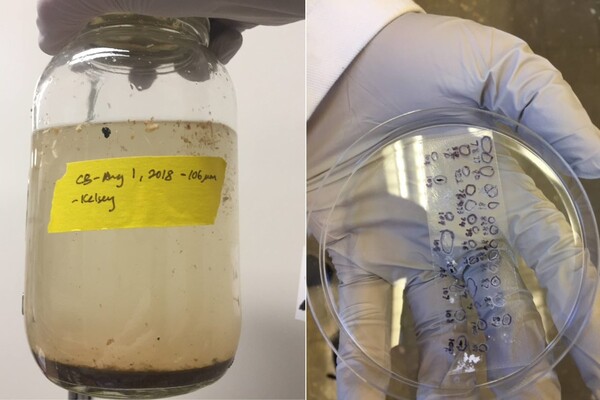
우수 샘플(왼쪽)이 샘플에서 수동으로 뽑아낸 플라스틱 입자와 나란히 놓여 있다(오른쪽). [사진출처(Photo source) = 토론토대학 / 사진 제공 = 켈시 스미스(Kelsey Smyth)]
엘로디 파스포트(Elodie Passeport) 부교수는 “우리는 미세 플라스틱의 농도를 예측할 수 있는 조잡한 측정이 있는지 자문했다”라면서 “기계 학습(machine learning) 및 최적화에 대한 전문지식이 있는 조슈아 테일러(Joshua Taylor) 부교수와 협력하여 우리는 총 질량 측정에서 미세플라스틱 수를 추정할 수 있는 훈련된 알고리즘을 사용하는 예측 모델을 구축했다”고 말했다.
파스포트 부교수는 특히 “우리의 방법은 수동 계산과 유사한 결과로 오류 추적 속성을 보장했지만 비용이 적게 들고 더 빠르므로 여러 지점에서 여러 샘플을 분석하여 미세 플라스틱 오염을 추정할 수 있다”라고 덧붙였다.
지난 1월 ACS ES&T Water에 게재된 이 팀의 조사는 연구자들이 추가 오류나 편차를 도입하지 않고 수집된 샘플의 일부만 수동으로 처리하고 알고리즘을 사용하여 나머지 양을 예측할 수 있다는 장점이 있다.
탄 수야오(Shuyao Tan)는 “미세플라스틱 분석을 연구하는 연구원은 플라스틱 입자의 수, 입자의 종류, 폴리머 및 모양을 알아야 한다”라면서 “이 정보를 통해 그들은 미세플라스틱 오염이 살아있는 유기체에 미치는 영향과 이 오염의 출처를 연구할 수 있으므로 근원에서 처리할 수 있다”라고 강조했다.
가시광선 현미경을 사용하는 기존의 정량화 방법은 핀셋을 사용하여 광학 현미경으로 샘플을 하나씩 계산해야 하며, 이는 인적 오류가 발생하기 쉬운 노동 집약적인 작업이다.
환경 과학을 다루는 주간 국제 동료 심사 과학 저널인 『종합환경과학(Science of the Total Environment)』에 발표된 조사에서 제인 하우(Jane Howe) 부교수가 지도하는 재료공학과의 빈시(Bin Shi) 박사과정 연구원은 미세플라스틱의 자동 정량화 및 분류를 위해 딥 러닝(deep learning) 모델을 사용했다.
빈시(Bin Shi) 연구원은 주사 전자 현미경을 사용하여 미세 플라스틱의 이미지를 분할하고 모양을 분류했다. 시각적 스크리닝 방법과 비교할 때 이 접근 방식은 작고 투명한 플라스틱 입자의 잘못된 식별을 방지할 수 있는 더 깊은 피사계 심도와 미세한 표면 세부사항을 제공한다.
빈시(Bin Shi) 연구원은 “딥 러닝을 사용하면 특히 미네랄(mineral), 기질(substrate), 유기물(organic matter) 및 유기체(organism)와 같이 잘못된 식별을 생성할 수 있는 다른 물질을 제거해야 했기 때문에 미세플라스틱의 정량화 속도를 높일 수 있었다”라면서 “우리는 이렇게 복잡한 환경에서 물체를 효과적으로 수량화하고 분류할 수 있는 정확한 알고리즘(algorithms)을 개발할 수 있었다”라고 말했다.
미세플라스틱의 화학적 조성과 모양의 다양성은 특히 미세플라스틱을 정량화하는 표준화된 방법이 없기 때문에 많은 연구자에게 어려움을 야기할 수 있다.
빈시(Bin Shi) 연구원은 세안, 플라스틱 병, 거품 컵, 세탁기 및 건조기계, 의료용 마스크와 같은 출처에서 구슬, 필름, 섬유, 거품 및 파편과 같은 다양한 모양과 화학 성분의 미세플라스틱 샘플을 수집했다. 그런 다음 그는 주사 전자 현미경을 사용하여 개별 샘플의 이미지를 처리하여 수백 개의 이미지 라이브러리를 만들었다.
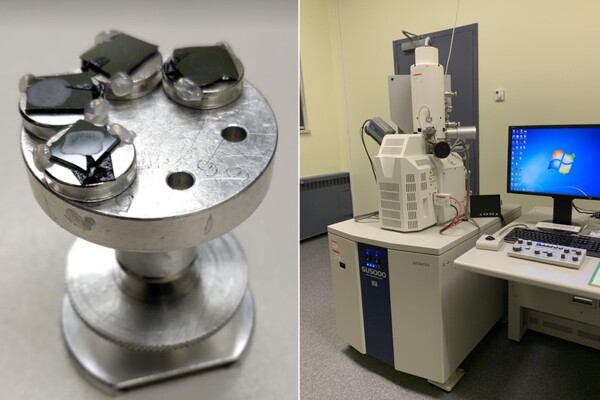
미세플라스틱 샘플을 담고 있는 주사전자현미경(SEM) 판(왼쪽)과 프로젝트에 사용된 SEM(오른쪽). [사진출처(Photo source) = 토론토대학 / 사진 제공 = 빈시(Bin Shi) 연구원)]
이 프로젝트는 미세플라스틱 이미지 분할을 위한 최초의 레이블이 지정된 오픈 소스 데이터 세트로, 전 세계의 연구원들이 이 새로운 방법의 이점을 얻고 연구 관심 분야에 맞는 고유한 알고리즘을 개발할 수 있다.
빈시(Bin Shi) 연구원은 특히 “이 방법은 또한 0.1 마이크로미터보다 작은 입자인 나노플라스틱(nanoplastics)의 규모로 떨어질 가능성이 있다”라고 주장하면서 “다양한 모양과 형태를 가진 다양한 환경의 더 많은 미세플라스틱 샘플을 포함하도록 이미지 라이브러리를 계속 확장할 수 있다면 미세 플라스틱 오염을 훨씬 더 효과적으로 모니터링하고 분석할 수 있다”라고 강조했다.
현재 엘로디 파스포트(Elodie Passeport) 부교수와 탄 수야오(Shuyao Tan) 연구원의 예측 모델의 목표는 연구자가 보다 심층적 인 기술로 분석 노력을 집중해야하는 영역을 식별하는 데 도움이되는 진단 도구가 되는 것이다.
연구팀은 또한 이 방법이 시민 과학자들이 그들 자신의 환경에서 미세 플라스틱 오염을 감시할 수 있도록 도울 수 있기를 바라고 있다.
엘로디 파스포트(Elodie Passeport) 부교수는 “개인은 샘플을 수집하고 여과하고 건조하여 무게를 얻은 다음 훈련된 알고리즘을 사용하여 미세 플라스틱의 양을 예측할 수 있다”고 말했다.
탄 수야오(Shuyao Tan) 연구원은 “작업을 계속하면서 개인이 버튼을 클릭하기만 하면 훈련 샘플을 자동으로 선택할 수 있는 몇 가지 자동 훈련 샘플 선택 방법을 도입하고자 한다”라면서 “머신러닝과 수학에 대한 지식이 없어도 누구나 사용할 수 있도록 우리의 방법을 쉽게 만들고 싶다”라고 덧붙였다.
[원문보기]
U of T researchers use machine learning to speed up counting of microplastics
Microplastics are all around us ? in the water we drink, the food we eat and the air we breathe. But before researchers can understand the real impact of these particles on health, they need faster and more effective ways to quantify what is there.
Two recent studies by researchers at the University of Toronto's Faculty of Applied Science & Engineering have proposed new methods that use machine learning to make the process of counting and classifying microplastics easier, faster and more affordable.
“It’s really time consuming to analyze a water sample for microplastics,” says Elodie Passeport, an associate professor in the departments of civil and mineral engineering and chemical engineering.
“It can take up to 40 hours to fully analyze a sample the size of a mason jar ? and that specimen is from one point in time. It becomes especially difficult when you want to make comparisons over time or observe samples from different bodies of water.”
Last month, the United Nations Environment Programme endorsed a historic resolution to end plastic pollution, which it called “a catastrophe in the making” endangering human health, marine and costal species and global ecosystems.
Microplastics can take hundreds to thousands of years to biodegrade. But it is not just visible plastic refuse that's an issue: over time plastic breaks down into smaller and smaller particles. Those pieces that are less than five millimetres in size but greater than 0.1 micrometres are defined as microplastics.
Researchers who study the effects of microplastics are still trying to understand how these tiny pieces could affect human and environmental health in ways that are different from the bulk material.
Though past studies have demonstrated the presence of microplastics in various environments, the standards for how to quantify their levels - and critically, how to compare different samples over time and space - are still emerging. Passeport worked with Shuyao Tan, a PhD student in chemical engineering, and Joshua Taylor, an associate professor in the department of electrical and computer engineering, to address the challenge of analysis.
“We asked ourselves whether there could be a crude measurement that could predict the concentration of microplastics,” Passeport says.
“In collaboration with Professor Taylor, who has expertise in machine learning and optimization, we established a prediction model that employs a trained algorithm that can estimate microplastic counts from aggregate mass measurements.”
“Our method has guaranteed error-tracking properties with similar results to manual counting, but it’s less costly and faster, allowing for the analysis of multiple samples from multiple points to estimate microplastic pollution,” she adds.?
The team’s investigation, published in January in ACS ES&T Water, has the advantage of allowing researchers to manually process only a fraction of their collected samples and predict the quantity of the rest using?an algorithm, without introducing additional error or variance.
“Researchers working on microplastic analysis need to know how many plastic particles there are, the kinds of particles, the polymers and shapes,” says Tan.
“With this information, they can then study the effects of microplastic pollution on living organisms ? as well as where this pollution is coming from, so they can deal with it at the source.”
Classical quantification methods using visible light microscopy require the use of tweezers to count samples one-by-one under an optical microscope ? a labour-intensive endeavour that is prone to human error.
In an investigation published in Science of The Total Environment, PhD candidate Bin Shi in the department materials science and engineering, who is supervised by Associate Professor Jane Howe, employed deep learning models for the automatic quantification and classification of microplastics.
Shi used scanning electron microscopes to segment images of microplastics and classify their shapes. When compared to visual screening methods, this approach provided a greater depth of field and finer surface detail that can prevent false identification of small and transparent plastic particles.
“Deep learning allows our approach to speed up the quantification of microplastics, especially since we had to remove other materials that could create false identifications, such as minerals, substrate, organic matter and organisms,” says Shi.
“We were able to develop accurate algorithms that can effectively quantify and classify the objects in such complex environments.”
The diversity in the chemical composition and shapes of microplastics can create difficulties for many researchers, especially since there is no standardized method to quantify microplastics.
Shi collected microplastic samples in various shapes and chemical compositions ? such as beads, films, fibres, foams and fragments ? from sources such as face wash, plastic bottles, foam cups, washing and drying machines and medical masks. He then processed images of the individual samples using the scanning electron microscope to create a library of hundreds of images.
The project is the first labelled open-source dataset for microplastics image segmentation, which allows researchers from all over the world to benefit from this new method and develop their own algorithms specific to their research interests.
“This method also has the potential to go down to the scale of nanoplastics, which are particles smaller than 0.1 micrometres,” Shi says. “If we can continue to expand our library of images to include more microplastic samples from different environments with varied shapes and morphologies, we can monitor and analyze microplastic pollution much more effectively.”
For now, the goal of Passeport and Tan’s predictive model is to be a diagnostic tool that can help researchers identify areas where they should concentrate their analytical efforts with more in-depth technologies.
The team also hopes this method can empower citizen scientists to monitor microplastic pollution in their own environments.
“Individuals can collect samples, filter and dry them to get the weight and then use a trained algorithm to predict the amount of microplastics,” Passeport says.
“As we continue our work, we want to introduce some automatic training sample selection methods that will allow individuals to just click a button and automatically select the training sample,” adds Tan. “We want to make our method easy so that they can be used by anyone, without them needing any knowledge of machine learning and mathematics.”
[출처 = 토론토대학(https://www.utoronto.ca/news/u-t-researchers-use-machine-learning-speed-counting-microplastics) / 2022년 4월 25일]
|  즐겨찾기 추가
 시작페이지로 설정
























