[일본] 신슈대, 아가미서 영감 얻은 에어로젤로 태양열 해수담수화 난제 해결
태양열 담수화, 증발기 표면 염분 결정화로 물이동 및 열 변환 능력 저하
바이오매스 유래 에어로젤, 가볍고 다공성 높아 고염도 물에서도 염분 축적 막아
키토산·알긴산나트륨으로 에어로젤 제작…대나무 카본 블랙 더해 햇빛을 열로 바꾸는 광열 성능 구현
일반 햇빛 조건에서 시간당 ㎡당 2.88kg 담수 생산…우수한 증발 성능 확인
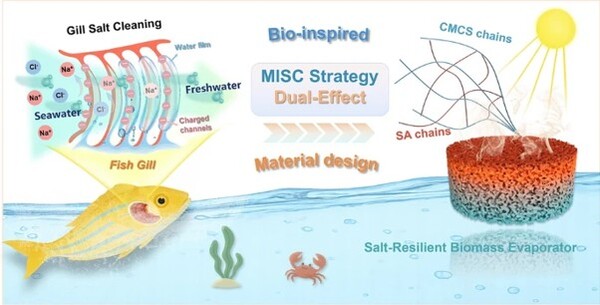
태양열 증발은 햇빛만으로 해수에서 담수를 얻을 수 있는 저비용 기술이다. 그러나 증발기 표면에 염분이 쌓이면서 장기적으로 성능이 떨어진다는 문제가 있다. 일본 신슈대학교(Shinshu University) 연구진은 이를 해결하기 위해 물고기 아가미에서 영감을 얻은 바이오매스 기반 에어로젤(Aerogel)을 개발했다. [사진출처(Photo source) = Shinshu University]
태양열 증발은 햇빛만으로 해수에서 담수를 얻을 수 있는 저비용 기술이다. 그러나 증발기 표면에 염분이 쌓이면서 장기적으로 성능이 떨어진다는 문제가 있다. 일본 신슈대학교(Shinshu University) 연구진은 이를 해결하기 위해 물고기 아가미에서 영감을 얻은 바이오매스 기반 에어로젤(Aerogel)을 개발했다. 이 소재를 적용한 증발기는 고농도 염수에서도 장시간 염분이 쌓이거나 성능이 떨어지지 않고 높은 증발률을 유지한다.
세계적으로 담수 부족이 심해지면서 태양열 증발이 유망한 대안으로 떠오르고 있다. 이 방식은 햇빛으로 염분이 섞이거나 오염된 물의 표면을 가열해 수증기로 바꾸고, 이를 응축해 깨끗한 물을 얻는다. 펌프와 막대한 전력이 필요한 기존 해수담수화 설비와 달리, 태양열 증발기는 햇빛과 이를 흡수해 효율적으로 열로 바꿔 줄 소재만 있으면 된다. 이러한 단순함 덕분에 담수가 부족하고 기반시설이 열악한 지역에 특히 적합한 방식이다.
그러나 증발기는 담수와 염수를 분리하는 과정에서 심각한 문제를 겪는다. 물이 증발하면서 녹아있던 염분이 표면에 남아 점점 농축된다. 장기간 가동하면 염분이 결정화돼 침전물이 생기고, 이 침전물이 물의 이동을 막을 뿐 아니라 표면의 햇빛 흡수 및 열 변환 능력까지 떨어뜨린다. 특히 고농도 염수를 처리할 때 이러한 문제는 더욱 심각해지는데, 염분 축적이 심해지면 결국 증발기는 결국 안정적이고 효율적으로 물을 생산하지 못하게 된다.
이러한 오랜 난제를 풀기 위해 지안 시(Jian Shi) 신슈대 섬유과학기술학부 부교수가 이끄는 연구팀은 자연에서 영감을 얻은 신소재를 개발했다. 이 연구는 지난 7월 13일 온라인으로 공개됐으며, 오는 12월 1일 학술지 『나노 마이크로 레터(Nano-Micro Letters)』 18권 1호에 게재될 예정이다. 연구팀이 소개한 바이오매스 유래 에어로젤은 가볍고 다공성이 매우 높으며, 염도가 극도로 높은 물에서도 염분 축적을 막아 준다. 신슈대의 누오 류(Nuo Liu), 춘홍 주(Chunhong Zhu), 중국 난퉁대학교(Nantong University)의 하이펑 장(Haifeng Zhang)이 공동 저자로 참여했다.
지안 시 교수는 "해양 어류는 바닷물 속에 살면서도, 아가미를 통해 고염 환경에서도 이온과 수분을 지속적으로 조절하고 효율적인 물질 이동을 유지한다"며 "특히 자연이 단순히 염분을 차단하는데 그치지 않고, 정교한 수화 계면을 통해 이온과 물의 이동을 적극적으로 조절한다는 점에 주목했다"고 설명했다.
이러한 아이디어를 바탕으로 연구진은 바이오매스 유래 고분자인 카르복시메틸 키토산과 알긴산나트륨으로 다공성 에어로젤을 만들고, 햇빛을 열로 변환하는 광열 성분으로 대나무에서 추출한 카본 블랙을 첨가했다. 이 고분자들은 도난형 반발력(Donnan-type repulsion)이라는 현상을 통해 특정 염 이온을 밀어내는 전하를 띤 작용기를 포함하고 있다. 또한 친수성 작용기가 소재 표면에 얇은 수분막을 항상 유지해 주어, 계면에 쌓인 염분을 씻어 내는 역할도 한다.
이 소재로 제작된 증발기는 일반적인 햇빛 조건에서 2.88kg m⁻² h⁻¹의 속도로 물을 생산했다. 이는 현재까지 보고된 우수한 증발기들을 뛰어넘는 성능이다. 해수보다 염도가 거의 6배 높은 고농도 염수에서 테스트한 결과에서도 증발기는 24시간 연속 가동됐고, 일주일 동안 주야간 작동을 반복하는 가운데서도 눈에 띄는 염분 축적이나 성능 저하 없이 안정적으로 작동했다.
이 증발기는 저렴하고 생분해성 소재로 만들어져, 연구진은 이를 지속 가능하고 분산형인 담수 공급을 가능하게 할 실용적인 방안으로 보고 있다. 지안 시 교수는 "우리의 증발기 기술은 바이오매스 유래 소재로만 구성돼 있어, 태양열 담수화에 잠재적으로 저렴하고 확장 가능하며 환경 친화적인 접근 방식을 제공할 수 있다"고 설명했다.
앞으로 연구진은 동일한 설계 원리가 담수화뿐 아니라 염분 축적이나 오염 문제를 겪는 다른 수처리 기술에도 확장될 수 있을 것으로 기대한다. 지안 시 교수는 "자연에서 발견되는 정교한 이온 조절과 물 이동 기능을 모방하는 것이 고염도 환경과 같은 까다로운 조건에서도 지속 가능한 수처리 소재를 설계하는 새로운 전략이 될 수 있음을 이번 연구가 보여준다"며 "이는 단순히 새로운 담수화 소재 개발을 넘어, 자연에서 영감을 얻어 실용적인 공학 문제를 해결하고자 하는 우리의 폭넓은 관심을 반영한다"고 밝혔다.
[원문보기]
Fish Gill-Inspired Aerogel Tackles Long-Standing Issue in Solar Desalination
Novel biomass-based, low-cost material combines two natural salt-management strategies to maintain high performance even in highly concentrated brine
Solar evaporation offers a low-cost way to produce freshwater from seawater using only sunlight, but salt buildup on the evaporator surface limits long-term performance. Now, researchers from Japan addressed this issue by developing a biomass-based aerogel inspired by fish gills. Using this material, their evaporator maintained a high evaporation rate over long tests in extremely salty water without any salt deposition or performance loss, paving the way for sustainable and accessible freshwater production.
As freshwater scarcity becomes more prevalent, solar evaporation is drawing attention as a promising solution. This process involves using sunlight to heat the surface of salty or contaminated water, causing it to turn into vapor that can then be collected as clean water as it condenses. Unlike conventional desalination plants, which typically rely on pumps and large amounts of electricity, solar evaporators need little more than sunlight and a material that can absorb it and heat up efficiently. This simplicity makes the approach appealing for regions where freshwater is scarce and infrastructure is limited.
However, the same process that separates freshwater from salt creates a major problem for the evaporator. As water leaves as vapor, dissolved salt remains behind and becomes increasingly concentrated at the evaporation surface. During prolonged operation, the salt can crystallize and form deposits that block water transport and reduce the surface’s ability to absorb sunlight and convert it into heat. These problems become particularly severe when treating highly concentrated brines, as salt accumulation eventually causes the evaporator to lose its ability to produce water stably and efficiently.
To address this long-standing obstacle, a research team led by Associate Professor Jian Shi of the Faculty of Textile Science and Technology at Shinshu University, Japan, has designed a novel nature-inspired material. Their work, made available online on July 13, 2026, and will be published in Volume 18, Issue 1 of the journal Nano-Micro Letters on December 1, 2026, describes a biomass-derived aerogel, a lightweight, highly porous material that resists salt buildup even in extremely salty water. The study included co-authors Nuo Liu and Chunhong Zhu of Shinshu University and Haifeng Zhang of Nantong University.
The team took inspiration from marine fish, as Dr. Shi explains: “Marine fish live in seawater, yet their gills can continuously regulate ions and water while maintaining efficient transport under highly saline conditions. We were particularly fascinated by the fact that nature does not simply block salt; instead, it actively regulates the movement of ions and water through a sophisticated, hydrated interface.”
Building on this idea, the researchers created a porous aerogel from carboxymethyl chitosan and sodium alginate, which are two biomass-derived polymers. They also added carbon black produced from bamboo as the photothermal component that converts sunlight into heat. The polymers contain charged groups that can repel certain salt ions through what’s known as Donnan-type repulsion. Additionally, their hydrophilic groups help maintain a thin layer of water across the material's surface at all times, which helps flush away any accumulated salt along the interface.
An evaporator built using this material produced water at a rate of 2.88 kg m-2 h-1 under normal sunlight, outperforming some of the best evaporators reported to date. When tested in extremely salty water at a concentration nearly six times that of seawater, the evaporator ran continuously for 24 hours and through repeated day–night cycles over a week without any visible salt buildup or loss of performance.
Because the proposed evaporator is made of inexpensive biodegradable materials, the researchers see it as a practical option for ensuring sustainable and decentralized access to freshwater. “Our evaporator technology is made entirely from biomass-derived materials, offering a potentially low-cost, scalable, and environmentally friendly approach to solar-driven desalination,” notes Dr. Shi.
Looking ahead, the team believes the same design principle could extend beyond desalination to other water treatment technologies that struggle with salt buildup or fouling. “Our work shows how mimicking the sophisticated ion-regulation and water-transport functions found in nature can provide a new strategy for designing sustainable materials for water purification under challenging high-salinity conditions,” concludes Dr. Shi. “For us, this research represents more than the development of a new desalination material. It reflects our broader interest in learning from nature to solve practical engineering problems.”
[출처 = 일본 신슈대학교(Shinshu University)(https://www.shinshu-u.ac.jp/english/topics/2026/09/fish-gill-inspired-a.html) / 2026년 9월 30일]
 즐겨찾기 추가
 시작페이지로 설정