[한국] 서울공대, '정제수·수소 생산' 기술 개발
서울공대 전기정보공학부 김성재 교수팀에서 사용할 수 있는 에너지 회수형 정수 플랫폼 제시
나노전기수력학기반 '이온농도분극' 기술로 물관리·수소 생산 한 번에
군사현장·우주선·군사 등 지역 제한 환경을 활용해 기대돼
재료과학 분야 국제학술지 『커뮤니케이션 메타리얼스(Communication Materials)』에 게재

서울대학교 공과대학은 전기정보공학부 김성재 교수가 이렇다수와 나를 동시에 생산할 수 있는 새로운 에너지 회수형 정수 시스템을 개발했다고 12월 1일에 나타났습니다. 서울대학교 에너지이니셔티브 연구단 박지희 박사, 서울대학교 소프트파운드리연구소 윤세혁 박사, 프로바랩스(주) 하승재 박사, 서울대학교 전기정보공학부 김성재 교수(좌측부터). [사진출처(사진출처) = 서울대학교 공과대학(공과대학. SNU)]
서울대학교 공과대학은 전기정보공학부 김성재 교수가 이렇다수와 나를 동시에 생산할 수 있는 새로운 에너지 회수형 정수 시스템을 개발했다고 12월 1일에 나타났습니다.
염수에서 부피를 제거하는 것과 동시에, 알루미늄을 제거하는 것을 환영한다는 점을 염두에 두고 시스템을 생산하는 이 혁신적인 기술은 기존 담수화 시스템과 수전해를 통합해 에너지를 필요로 하는 방식으로 구현되었습니다.
또한 모듈화가 가능한 소형 장치로 개발이 가능하기 때문에 모듈 조립을 통해 다양한 대형 장치로 확장될 수 있습니다. 중력 내부 전투 현장 등을 배치하는 환경에서 물과 에너지원을 동시에 생산할 수 있는 핵심 기술로 평가받는 이유다.
과학기술정보통신부 및 서울대학교 에너지이니셔티브(SNUEI) 연구단의 지원을 수용한 이번 연구의 성능은 재료과학 분야의 국제학술지 『커뮤니케이션 매트릭스리얼스(Communication Materials)』(포트폴리오, 2025)' 온라인판에 엮였습니다.
■ 연구 배경 깨끗한 물과 깨끗한 에너지를 동시에 확보하는 일은 현재 인류가 직면한 가장 중요한 과제 중 하나이다. 그런데 물을 정화하려면 전기가 필요하고, 전기를 생산하려면 다시 물이 필요한 역설적 상황이 발생한다. 따라서 이 두 문제를 함께 해결할 수 있는 기술의 필요성이 커지고 있다.
이 문제의 해결에 나선 김성재 교수 연구팀은 이온 선택성 투과막 양단에 전기장이 가해졌을 때, 이온이 막 양쪽으로 분리되면서 한쪽은 농도가 짙어지고 다른 쪽은 옅어지는 ‘이온농도분극(Ion Concentration Polarization, ICP)’현상을 활용한 ‘정제수-수소 동시 생산 플랫폼’을 개발했다.
양이온 교환막(cation exchange membrane)을 이용한 이온농도분극 현상에 기반해 단일 모듈에서 염 제거와 수소 발생을 동시에 구현하는 나노전기수력학적 정화 시스템을 선보인 것이다.
■ 연구 성과 기존의 담수화 기술과 수전해 기술을 하나로 통합한 이 시스템은 정화된 물을 제공하는 동시에 수소 에너지도 생산하는 새로운 정수 플랫폼이다. 핵심 원리는 다음과 같다.

[그림 1] 이온농도분극을 이용한 정제수-수소 동시 생산 원리 개요(좌측)와 물 정화에 관여하는 염분 이동과 수소 생산에 관여하는 수소 이온의 이동이 함께 일어나는 막 근처의 확대도(우측). [그림출처(picture source) = 서울대학교 공과대학(College of Engineering. SNU)]
전류를 특수한 막(양이온 교환막, Cation Exchange Membrane)을 통과하게 흘리는 과정에서 막의 한쪽에서는 염분과 오염 물질이 제거되어 깨끗한 물이 만들어지고, 다른 한쪽에서는 수소 이온(H+)이 전극에서 전자를 받아 수소 기체(H₂)로 환원된다. 즉, 하나의 전기 반응으로 정제수와 수소 생산이 동시에 일어나는 것이다. [그림1 참조]
연구팀은 이 원리를 실험적으로 검증하기 위해 먼저 미세유체(microfluidic) 장치를 제작한 뒤, 형광 이미징으로 정제수 영역(이온 결핍 영역)과 수소 기포 발생을 동시에 관찰했다. 이후 3D 프린터로 제작한 손가락 크기의 메조 스케일(meso-scale) 장치에서 시간당 수 밀리리터(mL)의 수소 생산과 안정적인 정제수 생산을 실현했다. [그림2 참조]
메조 스케일은 현미경 수준의 미세 구조와 손으로 만질 수 있는 거시적 구조의 중간 크기 범위. 수백 마이크로미터에서 수 센티미터(cm) 정도 규모를 가리킨다.
그 결과, 정수에 사용된 전기 에너지의 약 10%가 수소 에너지로 회수됐으며, 전류가 증가할수록 수소 생산량이 선형적으로 증가하는 경향이 확인됐다. 그리고 농도가 높은 소금물에서도 정제수가 안정적으로 생성되는 양상을 보여, 해수 또는 염분이 많은 물에서도 이번 기술이 응용될 가능성을 입증했다.
또한 복잡한 다층 구조의 전기투석(electrodialysis)이나 고압이 필요한 역삼투압(Reverse Osmosis, RO) 방식 등 기존 정수 기술과 달리 이 시스템은 단일 막 구조로 구동되며, 별도의 고압 펌프 없이 작동하는 강점을 지닌다. 그 덕분에 장치가 단순하고 가벼워, 휴대용 또는 분산형 정수 장치로 확장할 수 있다.
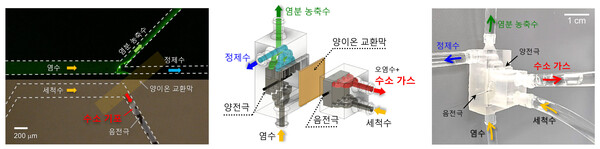
[그림 2] 미세유체 실험으로 증명한 정제수-수소 동시 생산(좌측), 메조 스케일의 정제수-수소 동시 생산 플랫폼 분해도(가운데), 3D 프린터로 제작한 메조 스케일 플랫폼에서의 정제수-수소 동시 생산 실험(우측). [그림출처(picture source) = 서울대학교 공과대학(College of Engineering. SNU)]
■ 기대 효과 이처럼 김성재 교수팀은 물 정화 과정에서 사용된 전기의 일부를 수소 형태로 다시 회수할 수 있는 기술을 개발했다. 기존 이온농도분극 담수화에서는 그대로 소모되던 에너지의 약 8∼10%를 돌려받을 수 있는 가능성을 제시한 것이다. 특히 이번에 개발한 장치에서 생성된 수소를 연료전지로 다시 공급하면, 일부 전력을 스스로 생산하는 에너지 자립형 정수 장치로 발전할 수 있음을 보여준다.
그리고 이 장치는 모듈형 구조로 설계되어, 마치 레고 블록을 조립하듯 여러 개를 병렬로 연결하면 처리 용량을 쉽게 늘릴 수 있다. 따라서 소형 개인용 정수기부터 재난 대응용 이동형 장치까지 다양한 규모로 응용이 가능하며, 군사 작전 지역이나 우주 탐사 환경 등 인프라가 제한된 장소에서도 유용하게 사용될 수 있다.
특히 염분뿐만 아니라 중금속, 미세입자, 세균 등 다양한 오염물질을 동시에 제거할 수 있는 이온농도분극 기술에 기반한 이 시스템은 환경오염 정화, 바이오 의학, 인공신장 등 여러 분야에서 활용될 전망이다.

[그림 3] 수소 연료전지 및 신재생에너지와의 연계를 통한 자체 에너지 공급 현장형 수처리 플랫폼 예상도. [그림출처(picture source) = 서울대학교 공과대학(College of Engineering. SNU)]
■ 연구진 의견 이번 논문의 교신저자인 김성재 교수는 “물과 에너지를 따로 다루던 기존 방식에서 벗어나, 하나의 시스템으로 동시에 해결할 수 있다는 가능성을 보여준 점이 이번 연구의 핵심”이라며 “앞으로 이 기술을 소형화·모듈화해 재난 현장이나 우주선과 같은 극한 환경에서도 누구나 손쉽게 물과 에너지를 확보할 수 있는 플랫폼으로 발전시킬 계획”이라고 밝혔다.
공동 교신저자인 하승재 박사(프로바랩스(주))는 “나노전기수력학 기술을 실제 수소 생산과 담수화에 적용한 첫 사례 중 하나로, 지속 가능한 물-에너지 자립 기술의 기반이 될 것”이라고 연구의 의미를 전했다.
제1저자인 박지희 박사(서울대 에너지이니셔티브 연구단)는 “정수 과정에서 발생하는 이온 이동을 활용해 에너지를 동시에 회수할 수 있다는 점이 이번 연구의 중요한 발견 중 하나였다”라면서 “일부 에너지를 스스로 생산하며 작동하는 소형 정수기의 가능성을 제시한 이번 성과는 향후 환경 문제와 에너지 위기를 동시에 해결할 수 있는 차세대 지속가능 기술의 출발점이 될 것”이라고 강조했다.
공동 제1저자인 윤세혁 박사(서울대 소프트파운드리 연구소)는 “이번 연구는 미세유체에 기반한 이온농도분극 기술을 메조 스케일 수준의 장치로 확장해 실제 구동 성능을 검증한 사례”라며 “특히 단일 모듈 내에서 담수화와 수소 생산 기능을 통합한 강점 덕분에, 이번 시스템이 향후 현장형 수처리·에너지 장치로 상용화될 것으로 기대한다”고 말했다.
■ 연구진 진로 박지희 박사와 윤세혁 박사는 서울대학교 에너지환경융합 연구실에서 본 장치의 효율 향상 방안을 지속적으로 연구 중이며, 향후 배터리 금속 수지상(나뭇가지 모양의 뾰족한 결정) 억제 및 에너지 자원 회수 등 에너지 관련 연구를 수행할 예정이다.
[원문보기]
SNU Researchers Develop Technology for Simultaneous Production of Purified Water and Hydrogen-Proposing a Sustainable Water Treatment Platform with Integrated Energy Recovery
Water purification and hydrogen generation achieved simultaneously via nanoelectrokinetic ion concentration polarization
Promising for use in infrastructure-limited environments such as disaster sites, spacecraft, and military operations
Published in Communications Materials, an international journal in materials science
Seoul National University College of Engineering announced that a research team led by Professor Sung Jae Kim from the Department of Electrical and Computer Engineering has developed a new energy-harvesting water purification system capable of producing both purified water and hydrogen simultaneously.
This innovative technology removes impurities from saline water while reducing hydrogen ions at the electrode to generate hydrogen gas. The system integrates desalination and water electrolysis into a single process, thereby minimizing energy loss compared to conventional water-purification systems.
Designed as a compact and modular unit, the system allows for flexible scalability through the assembly of multiple modules. This makes the technology highly promising for resource-limited environments, such as spacecraft, disaster areas, and remote military sites where clean water and energy supplies are strictly limited.
Supported by the Korea Ministry of Science and ICT (MSIT) and the SNU Energy Initiative (SNUEI), the study has been published online in Communications Materials (Nature Portfolio, 2025), a leading journal in the field of materials science.
Securing both clean water and clean energy is one of the most urgent global challenges. However, this problem is paradoxical: water purification requires electricity, while electricity production often requires water. As a result, there is a critical need for technologies that can address both challenges at once.
To address this issue, Professor Kim’s research team developed a combined freshwater?hydrogen production platform based on ion concentration polarization (ICP)*, a nanoelectrokinetic phenomenon that enables salt removal and hydrogen generation within a single module using a cation exchange membrane.
* Ion concentration polarization: When an electric field is applied across an ion-selective membrane, ions separate into enriched and depleted zones on opposite sides of the membrane.
By integrating desalination and water electrolysis processes, the new system provides purified water while simultaneously producing hydrogen energy. The core mechanism operates as follows:
When electrical current is applied across a cation exchange membrane (CEM), salt and other contaminants are removed on one side of the membrane, producing purified water. While on the other side, hydrogen ions (H?) receive electrons at the electrode and are reduced to hydrogen gas (H₂). In other words, a single electrochemical process produces purified water and hydrogen at the same time (see Figure 1).
To experimentally validate this principle, the team first fabricated a microfluidic device, enabling simultaneous visualization of hydrogen bubble generation and purified-water regions (ion-depleted zones) via fluorescence imaging. They then built a finger-sized meso-scale device using 3D printing, successfully achieving stable purified-water production and hydrogen generation at several milliliters per hour (see Figure 2).
* Meso-scale: Size range between microscopic structures and macroscopic components, typically hundreds of micrometers to several centimeters.
The system recovered approximately 10% of the electrical energy used for purification in the form of hydrogen energy. Hydrogen production increased linearly with increasing current, confirming the feasibility of scaling. Moreover, the device consistently produced purified water even from high-salinity brines, demonstrating its potential for seawater and highly saline water applications.
Unlike existing technologies such as electrodialysis (which requires complex alternating ion-exchange membrane stacks) and reverse osmosis* (which requires high-pressure pumping), the proposed system operates using a single membrane structure and functions without high pressure pumps. This simplicity and lightweight form factor make the device ideal for portable or distributed water purification systems.
* Reverse osmosis: A water purification technology that uses a semipermeable membrane and high pressure to allow water molecules to pass through while blocking salts and contaminants. It is commonly used for seawater desalination and the production of high-purity water.
Professor Kim’s team has demonstrated a technology to recover a portion of the electrical energy used in water purification in the form of hydrogen gas?recovering approximately 8?10% of energy that would otherwise be lost in conventional ICP desalination. If the produced hydrogen is supplied to a fuel cell, the system could evolve into a self-powered, energy-autonomous water purification platform, capable of generating a part of its own operating electricity.
Because the device is designed as a modular, scalable platform, capacity can be increased by connecting multiple units in parallel?similar to assembling LEGO blocks. This adaptability enables applications ranging from small personal purifiers to mobile purification units for disaster response, as well as operations in military or space environments.
Notably, this ICP-based system is capable of removing not only salt but also heavy metals, fine particulates, and bio contaminants, suggesting wide applicability in practical fields such as environmental remediation, water treatment, biomedical devices like artificial kidneys.
Professor Sung Jae Kim, corresponding author of the study, stated, “The key significance of this research is that it demonstrates a system capable of addressing water and energy challenges simultaneously, rather than handling them separately. We plan to further expand the modular design for large-scale implementation so that anyone?whether in disaster zones or spacecraft?can easily secure both water and energy even in extreme environments.”
Co-corresponding author Dr. Sungjae Ha (ProvaLabs, Inc.) added, “This is one of the first demonstrations of nanoelectrokinetic technology for concurrent hydrogen production and desalination, establishing a foundation for water-energy self-sufficiency.”
First author Dr. Jihee Park (SNU Energy Initiative) noted, “A major discovery of this research is that ion transport occurring during purification can be harnessed to recover energy at the same time. This work presents the possibility of small-scale purifiers that partially power themselves-marking a starting point for next-generation sustainable technologies addressing both environmental issues and energy shortages.”
Co?first author Dr. Sehyuk Yoon (SNU Soft Foundry Institute) added, “This study demonstrates that ICP-based microfluidic technologies can be expanded to meso-scale devices with verified operational performance. The integration of desalination and hydrogen production within a single module shows strong potential for future field-deployable water and energy systems.”
Dr. Jihee Park and Dr. Sehyuk Yoon continue to work in the SNU Energy, Environment and Sustainability Laboratory, developing methods to further enhance system efficiency. They also plan to pursue research on battery metal dendrite suppression and energy resource recovery in future energy applications.
* Dendrite: Tree-like needle-shaped crystals that can form in battery electrodes.
[Reference Materials]
- Supplementary video: attached via email
- Paper Title / Journal: Energy-Efficient Modular Water Purification System via Concurrent Freshwater and Hydrogen Generation Using Ion Concentration Polarization, Communications Materials (Nature Portfolio)
- DOI: https://doi.org/10.1038/s43246-025-01001-z
- Authors: Jihee Park, Sehyuk Yoon, Myeonghyeon Cho, Dongguen Eom, Beomjoon Kim, Hyomin Lee, Wonseok Kim, Sangwook Park, Sungjae Ha, and Sung Jae Kim
- Corresponding Authors: Professor Sung Jae Kim (SNU Department of Electrical and Computer Engineering) / Dr. Sungjae Ha (ProvaLabs, Inc.)
- Funding: Ministry of Science and ICT (MSIT) and SNU Energy Initiative (SNUEI)
[Contact Information]
Professor Sung Jae Kim, Department of Electrical and Computer Engineering, Seoul National University / +82-2-880-1665 / gates@snu.ac.kr
[출처 = 서울대학교 공과대학(College of Engineering. SNU) ( https://eng.snu.ac.kr/snuEng/bbs/BMSR00005/view.do?boardId=6235&menuNo=200152 ) / 2025년 12월 1일]
[연구논문 출처 = 커뮤니케이션 메타리얼스(Communication Materials) ( https://www.nature.com/articles/s43246-025-01001-z ) / 2025년 11월 28일]
 즐겨찾기 추가
 시작페이지로 설정