[미국] “세계 물 재활용·재이용 기술 시장, 2030년까지 580억 달러(77조 9천520억 원) 규모”
미국 글로벌 시장조사기관인 ‘리서치 앤 마켓’ 최근 보고서서 전망
2024년 기준 292억달러(39조2천506억원) 규모서 2030년까지 연평균 성장률 12.1% 예측
물 재이용이 가져오는 경제적·환경적 이점을 점차 인식…첨단 수처리 솔루션 수요 증가
한국, 스마트 도시 계획·산업용수 재이용·첨단 처리 시스템 통해 재이용수 활용 추진
미국의 글로벌 시장조사기관인 리서치 앤 마켓(Research and Markets)은 최근 『물 재활용 및 재이용 기술 시장(Water Recycle and Reuse Technologies)』이라는 세계시장 조사 보고서를 발간했다.
이 보고서에 따르면 2024년 기준 292억 달러(39조 2천506억 원) 규모였던 세계 물 재활용 및 재이용 기술 시장은 2024년부터 매년 연평균 성장률(CAGR)이 12.1%를 기록하며 오는 2030년에는 580억 달러(77조 9천520억 원) 규모에 이를 것으로 전망했다. 이 보고서 주요 내용을 요약했다. [번역 및 정리= 배철민 편집국장 겸 글로벌물산업정보센터장]
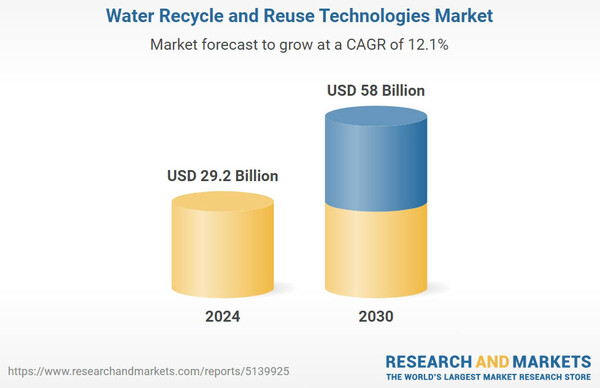
미국의 글로벌 시장조사기관인 리서치 앤 마켓(Research and Markets)은 2024년 기준 292억 달러(39조 2천506억 원) 규모였던 세계 물 재활용 및 재이용 기술 시장은 2024년부터 매년 연평균 성장률(CAGR) 12.1%를 기록하며 오는 2030년에는 580억 달러(77조 9천520억 원) 규모에 이를 것으로 전망했다. [그림출처(picture source) = 리서치 앤 마켓(Research and Markets)]
주요 동향 및 성장 동인
물 재활용 및 재이용 기술은 물 부족 문제와 환경 지속가능성이라는 전 세계적 과제를 해결하는 데 있어 점점 더 중요해지고 있다. 이러한 기술은 산업 공정, 농업 유출수, 도시 하수 등 다양한 출처에서 발생하는 하·폐수를 처리 및 정화하여 재이용이 가능한 상태로 만드는 과정을 포함한다.
처리된 물은 농업용 관개, 산업용 냉각, 지하수 함양, 심지어는 식수 공급 등 다양한 용도로 다시 활용될 수 있다. 막 여과(Membrane Filtration, MF), 자외선(Ultraviolet, UV) 소독, 역삼투압(Reverse Osmosis, RO), 생물학적 처리 공정과 같은 첨단 수처리 기술은 오염물질을 제거하고, 재활용된 물이 엄격한 안전 및 품질 기준을 충족하도록 보장하는 데 핵심적인 역할을 한다.
물 재활용 및 재이용 기술 시장의 성장은 여러 요인에 의해 주도된다. 인구 증가, 도시화, 기후 변화로 인한 물 부족 현상이 심화됨에 따라, 전 세계 여러 지역에서 안정적인 물 공급을 위한 지속가능한 해결책을 모색하고 있는 것이 주요 성장 동인이다.
물 보존과 재이용수 사용을 장려하는 규제 체계 및 정부 정책 또한 중요한 요인이다. 이러한 정책들은 인센티브를 제공하고 관련 기준을 설정함으로써 기술 도입을 촉진시킨다. 막(Membrane) 소재의 개선이나 에너지 효율적인 수처리 공정 도입과 같은 기술적 진보는 물 재이용 시스템의 실현 가능성과 경제성을 높여주고 있다.
산업계에서도 물 재이용이 가져오는 경제적·환경적 이점을 점차 인식하게 되면서 첨단 수처리 솔루션에 대한 수요가 증가하고 있다. 아울러, 비식용 및 식수 목적의 재이용수에 대한 대중의 인식과 수용도가 높아지는 것 또한 시장 확대를 뒷받침하고 있다.
이러한 요인들은 지속적인 연구 개발 노력과 결합하여 물 재활용 및 재이용 기술 시장의 강력한 성장을 견인하고 있으며, 전 세계 수자원의 지속 가능한 관리에 있어 핵심적인 요소로 자리 잡고 있다.
최근 물 재활용 및 재이용 시스템은 처리 기술의 혁신과 물 보존에 대한 인식 확산에 힘입어 상당한 발전을 이루었다. 오늘날의 시스템은 이전보다 더 효율적이고 비용 효과적이며, 최소한의 환경적 영향으로 대량의 물을 처리할 수 있다. 센서와 데이터 분석 기술을 통합한 스마트 물 관리 시스템은 물 재활용 및 재이용 과정을 실시간으로 모니터링하고 최적화함으로써, 해당 시스템의 신뢰성과 효율성을 높여준다.
또한, 분산형 처리 시설이 주목받고 있다. 이는 지역 단위의 물 재이용 솔루션을 가능하게 하여, 대규모 인프라 구축의 필요성을 줄이고 운송비용을 절감해 준다. 이러한 발전은 지속 가능한 물 관리에 기여할 뿐만 아니라, 가뭄의 영향을 완화하고 과도하게 개발된 담수 자원에 대한 의존도를 낮추는 데에도 도움을 준다.
미국에서는 캘리포니아, 애리조나, 텍사스, 플로리다가 가장 활발한 시장으로 꼽히고 있다. 캐나다는 산업 및 지방 용수관리 분야에서 재이용을 적용하고 있다. 사진은 미국 플로리다주 사라소타 카운티(Sarasota County) ‘비리지 물 재이용 시설(Bee Ridge Water Reclamation Facility, BRWRF)’. [사진출처(Photo source) = 미국 토목학회(ASCE)]
물 재이용을 재편하는 혁신적 변화
물 재활용 및 재이용 분야는 기후 리스크, 도시 인구 증가, 영양물질 및 오염물질에 대한 규제 강화, 그리고 농업·산업·상업 지구 및 고밀도 도시에서의 수요 증가로 인해 재편되고 있다. 수도 사업자들은 기존의 ‘처리 후 방류’라는 선형적 모델에서 벗어나, 도시 하수와 산업 폐수를 신뢰할 수 있는 지역 자원으로 활용하는 순환형 모델로 점차 전환하고 있다.
기술 도입 또한 가속화되고 있다. 막 생물 반응기(Membrane Bioreactor, MBR), 한외여과( Utrafiltration, UF), 역삼투(RO), 자외선(UV) 소독, 고도 산화 공정(Advanced Oxidation), 오존 처리(Ozonation), 활성탄 처리(Activated Carbon), 실시간 수질 모니터링 등의 기술은 수처리 공정의 신뢰성을 높이고 대중의 신뢰를 강화하고 있다.
유럽연합(EU)의 '농업용수 재이용 최소 요건에 관한 규정(Regulation (EU) 2020/741)'이나 캘리포니아주의 식수 재이용 체계와 같은 규제들은 도시, 농업, 산업 전반에 걸쳐 안전하고 확장 가능한 물 재이용을 구현할 수 있는 명확한 경로를 제시하고 있다.
물 재이용 시스템에 미치는 인공지능(AI)의 누적 영향
인공지능(AI)은 물 재활용 및 재이용 시스템 전반에서 성과를 높이는 핵심 요소로 자리 잡고 있다. AI 기반 분석 기술은 예측 정비, 이상 징후 탐지, 생물학적 공정 최적화, 화학물질 투입 제어, 에너지 관리, 수요 예측, 그리고 막 오염(Membrane Fouling)의 조기 발견 등을 지원한다.
이러한 기능들은 특히 중요하다. 펌핑(Pumping), 폭기(Aeration), 소독(Disinfection), 고도 처리 공정(Advanced Treatment Processes )은 수도 사업자나 산업 운영자에게 있어 운영비용과 시스템 신뢰성을 결정짓는 핵심 요소이기 때문이다.
공공기관이나 수도서비스 제공업체에 있어 AI의 가장 실용적인 활용 사례는 운영자를 대체하는 것이 아니라, 의사결정의 질을 높이는 것이다. AI는 SCADA(원격 감시 제어 시스템), 실험실 데이터, 온라인 센서, 디지털 트윈(Digital Twin), 자산 관리 플랫폼과 결합하여 규제 준수 신뢰도를 높이고, 예기치 않은 가동 중단 시간을 줄이며, 처리 성능을 최적화한다. 또한 규제 당국, 수요처, 지역 사회를 대상으로 투명한 보고가 이루어질 수 있도록 돕는다.
싱가포르의 ‘뉴워터(NEWater)’ 프로그램은 대중의 수용성과 고품질 재생수 생산 측면에서 전 세계적인 모범 사례로 꼽힌다. [사진출처(Photo source) = 워터저널 DB 자료]
주요 지역별 물 재이용 현황 및 시사점
아시아·태평양(Asia-Pacific) 지역은 중국, 인도, 싱가포르, 일본, 한국, 호주 등의 국가들에서 나타나는 고밀도 도시화, 산업 확장, 심각한 물 부족 문제로 인해 물 재활용 및 재이용을 선도하고 있다.
싱가포르의 ‘뉴워터(NEWater)’ 프로그램은 대중의 수용성과 고품질 재생수 생산 측면에서 전 세계적인 모범 사례로 꼽히며, 호주는 오랜 가뭄을 겪으면서 도시 회복력 계획의 일환으로 재생수 활용을 완전히 정착시켰다. 중국과 인도는 도시 용수 정책, 산업 회랑(Industrial Corridor), 오염 통제 우선순위 등을 통해 하·폐수 재이용을 강화하고 있으며, 이는 향후 재이용 도입의 중심지로 자리매김할 전망이다.
북미는 주 정부 주도의 재이용 규정, 연방 정부 지원, 가뭄 대응 프로젝트, 그리고 성숙한 공공시설 역량을 바탕으로 재이용을 추진하고 있으며, 미국에서는 캘리포니아, 애리조나, 텍사스, 플로리다가 가장 활발한 시장으로 꼽히고 있다. 캐나다는 산업 및 지방 용수관리 분야에서 재이용을 적용하고 있다.
남미는 각국이 하·폐수 처리 인프라를 현대화하고 위생 시설 보급률을 확대함에 따라 장기적인 잠재력이 높다. 브라질은 위생 체계를 통해 2033년까지 물 및 하수 서비스 투자 목표를 설정하고 있으며, 멕시코는 주요 도시 및 농업 지역의 물 부족 문제에 직면해 있다.
유럽은 성숙한 하·폐수 처리 시스템, EU 차원의 재이용 기준, 그리고 특히 농업용수 재이용을 위한 EU 규정 2020/741에 따른 강력한 지속가능성 정책의 혜택을 누리고 있다. 중동은 구조적 물 부족, 해수담수화-재이용 통합, 처리된 하수 방류 프로그램, 그리고 걸프 지역 경제 전반의 스마트 시티 개발에 힘입어 재이용이 활발히 추진되고 있다.
아프리카의 물 재이용 기회는 하·폐수 처리 격차 해소, 도시 위생 개선, 부족한 담수 자원 보호, 그리고 빠르게 성장하는 도시에 적합한 분산형 솔루션에 대한 자금 지원과 밀접하게 관련되어 있다.
물 재이용을 위한 주요 전략 그룹별 분석
ASEAN 시장은 급속한 도시 성장, 산업 단지, 관광 수요, 그리고 여러 해안 및 섬 경제권의 제한된 담수 자원이라는 특징에 의해 형성되고 있다. 물 부족에 시달리고 고도로 도시화된 ASEAN 지역에서는 산업용수 공급, 조경 관개, 지역 냉방, 그리고 도시 물 수요 회복력 강화를 위한 재이용을 점점 더 고려하고 있으며, 이는 하수 처리 및 스마트 물 인프라에 대한 투자 확대에 힘입은 것이다.
GCC(걸프협력회의) 회원국들은 전략적으로 가장 중요한 재이용 그룹 중 하나다. 사우디아라비아, UAE(아랍에미리트), 카타르, 쿠웨이트, 바레인, 오만과 같은 국가들은 해수담수화와 처리된 하수 방류수 재이용을 결합하여 물 안보를 강화하고, 지하수 부담을 줄이며, 도시, 조경, 농업 및 산업 분야의 비음용수 수요를 충족시키고 있다.
사우디아라비아, UAE(아랍에미리트), 카타르, 쿠웨이트, 바레인, 오만과 같은 국가들은 해수담수화와 처리된 하수 방류수 재이용을 결합하여 물 안보를 강화하고, 지하수 부담을 줄이며, 도시, 조경, 농업 및 산업 분야의 비음용수 수요를 충족시키고 있다. 사진은 사우디 ‘라빅 3단계 민자 담수화 플랜트 프로젝트(Rabigh 3 IWP)’. [사진출처(Photo source) = 사우디 수자원청(SWA)]
유럽연합(EU)은 규정(EU) 2020/741을 통해 농업용수 재이용에 대한 세계에서 가장 명확한 규제 환경을 조성하고 있으며, 보다 광범위한 순환 경제 및 물 수요 회복력 정책은 고부가가치 재이용 활용을 장려하고 있다.
BRICS(브릭스, 브라질·러시아·인도·중국·남아프리카공화국) 경제권은 농업, 도시 서비스, 광업, 발전, 제조업, 도시 기반 시설 전반에 걸쳐 규모의 경제에 기반한 수요를 나타내며, 중국, 인도, 브라질, 러시아, 남아프리카공화국은 각각 수질 문제, 물 부족, 기반 시설 현대화에 대한 뚜렷한 압력에 직면해 있다.
G7 국가들은 기반 시설 재건, 수질 개선, 가뭄 회복력 강화, 기후 변화 적응 재정 확보를 우선시하고 있으며, NATO(북대서양 조약기구) 회원국들은 특히 가뭄, 홍수, 사이버 위험, 지정학적 혼란으로 인해 서비스 연속성이 영향을 받는 지역에서 물 안보를 핵심 기반 시설 회복력의 일부로 점점 더 인식하고 있다.
주요 국가별 물 재이용 현황
미국은 주 정부 규제, 미국 국토개간국의 WaterSMART(워터스마트) 및 Title XVI(타이틀 16) 프로그램, 서부 지역의 가뭄 압력에 힘입어 물 재활용 및 재사이용 시장이 가장 활발한 국가 중 하나이다.
캐나다는 주 정부 지침, 산업용수 재활용, 자원 부문 활용을 통해 재이용을 확대하고 있으며, 멕시코는 물 부족에 시달리는 도시, 농업 지역, 산업 단지에서 도시 및 산업용수 재이용 수요를 창출하고 있다.
브라질은 국가 서비스 목표에 따라 위생 시설 투자가 확대됨에 따라 재사용 도입이 더욱 활발해질 전망이며, 영국은 지역별 수자원 공급 불균형 해소를 위한 장기 수자원 계획의 일환으로 재사용 방안을 검토하고 있다.
독일과 프랑스는 EU의 지속가능성, 수질 및 농업 정책에 발맞추어 물 재이용을 추진하고 있으며, 이탈리아와 스페인은 지중해 지역의 가뭄 문제로부터 큰 영향을 받고 있다. 특히 스페인은 유럽에서 관개 및 도시 용도로 재생수를 가장 활발하게 사용하는 국가 중 하나이다.
러시아는 산업용수 재활용, 도시 인프라 현대화, 하·폐수 처리 시설 개선 분야에서 기회를 모색하고 있다. 중국은 도시 물 정책, ‘스펀지 도시(sponge city)’ 개념, 산업계의 수요, 그리고 오염 통제 정책을 통해 물 재이용 규모를 확대하고 있으며, 인도는 물 부족을 겪는 도시와 산업 단지, 도시 하·폐수 처리 프로그램을 중심으로 재이용을 늘려가고 있다.
일본은 인구 밀도가 높은 도시 환경에서 고도 처리 기술, 신뢰성, 스마트 물관리 시스템(Smart Water Systems)을 강조하고 있으며, 호주는 가뭄 대응형 재이용, 대수층 함양, 그리고 대중의 수용성을 높이기 위한 전략 측면에서 중요한 선례가 되는 시장이다.
한국은 탄탄한 디지털 인프라와 회복력 있는 도시 물 관리에 대한 정책적 관심을 바탕으로, 스마트 도시 계획, 산업용수 재이용, 첨단 처리 시스템을 통해 재이용수 활용을 추진하고 있다.
한국은 탄탄한 디지털 인프라와 회복력 있는 도시 물 관리에 대한 정책적 관심을 바탕으로, 스마트 도시 계획, 산업용수 재이용, 첨단 처리 시스템을 통해 재생수 활용을 추진하고 있다. 사진은 (주)포웰이 운영하고 있는 포항하수처리수 재이용 시설. [사진출처(Photo source) = (주)포웰(Powell)]
업계 리더를 위한 제언
업계 리더들은 물 부족 해결, 규제 준수, 방류수 감축, 그리고 용수 공급 비용 절감을 통해 실질적인 가치를 창출할 수 있는 물 재이용 프로젝트를 우선적으로 추진해야 한다.
지방 공공 수도 사업자는 관개, 산업용수 공급, 냉각, 화장실 세척, 건설 용도, 대수층 함양 등 비음용 목적의 활용부터 시작할 수 있다. 이후 규제 체계가 정립되고, 처리 기술의 타당성이 검증되며, 대중의 수용성이 충분히 확보된 단계에서 간접적 또는 직접적 음용수 재이용으로 범위를 확대해 나갈 수 있다.
또한 리더들은 오염원 관리, 센서 네트워크 구축, 운영 인력 교육, 사이버 보안, 에너지 최적화, 그리고 지역사회와의 소통에 조기에 투자해야 한다. 성공적인 물 재활용 및 재이용 프로그램은 대중의 신뢰, 투명한 수질 정보 공개, 생애주기 비용 분석, 위험 기반의 처리 시설 설계, 그리고 수도 사업자, 기술 공급업체, 규제 기관, 산업계 사용자, 농업 분야 수요처, 대량 수요처 간의 장기적인 파트너십을 기반으로 구축된다.
연구 방법론
이 요약 보고서는 UN-Water, 유네스코(UNESCO), 세계은행(World Bank), 미국 환경보호청(EPA), 미국 개간국(Bureau of Reclamation), 유럽연합 집행위원회(European Commission), 각국 물 관련 기관, 그리고 기존에 발표된 규제 체계 등 공신력 있는 공공 및 기관 자료를 바탕으로 작성되었다.
이 보고서의 분석은 하·폐수 처리율, 물 부족 지표, 인프라 정책, 재이용 관련 규정, 기후 회복력 계획, 기술 도입 패턴, 그리고 공공 부문에서 시행 중인 물 재이용 프로그램 등을 종합적으로 고려했다.
또한 수요 동인, 정책적 준비 태세, 기술 성숙도, 지역별 물 관련 위험, 실행 장벽, 그리고 최종 용도별 적합성을 평가하는 시장 지향적 틀을 활용하여 통찰을 도출했다. 국가별, 지역별, 그룹별 분석 결과는 정부 프로그램, 규제 문서, 기관 보고서, 기존 물 안보 연구 등 공개된 자료와 대조·검증되었다. 이를 통해 시장 규모 산정이나 시장 점유율, 미래 예측에 의존하지 않으면서도 사실적 정확성과 실질적 유용성을 확보하고, 검색 엔진 최적화(SEO)를 고려한 내용을 구성했다.
결론
물 재활용 및 재이용은 지속 가능한 물 관리의 전략적 핵심 요소로 자리 잡고 있다. 기후 변동성, 가뭄, 인구 증가, 산업 수요, 수질 문제 등으로 인해 담수 시스템에 가해지는 압박이 커지는 가운데, 재생수는 회복력 강화와 환경 보호, 경제적 연속성을 뒷받침할 수 있는 신뢰할 만한 지역적 수자원 공급원이 된다.
정책적 명확성, 고도화된 처리 기술, 디지털 모니터링, 에너지 효율성, 그리고 대중의 수용성이 조화를 이루는 곳에서 가장 큰 기회가 창출될 것이다. 지금 선제적으로 대응하는 수도 사업자, 산업계, 공공 기관은 장기적인 물 관련 위험을 줄이고, 더욱 엄격해지는 수질 기준을 충족하며, 순환형 물 인프라를 강화할 수 있다. 또한, 재이용수를 회복력 있는 도시 및 산업 개발의 핵심 요소로 자리매김하게 할 수 있을 것이다.
[원문보기]
Water Recycle and Reuse Technologies - Global Strategic Business Report
The global market for Water Recycle and Reuse Technologies was valued at US$29.2 Billion in 2024 and is projected to reach US$58 Billion by 2030, growing at a CAGR of 12.1% from 2024 to 2030.
This comprehensive report provides an in-depth analysis of market trends, drivers, and forecasts, helping you make informed business decisions. The report includes the most recent global tariff developments and how they impact the Water Recycle and Reuse Technologies market.
Global Water Recycle and Reuse Technologies Market - Key Trends & Drivers Summarized
Water recycle and reuse technologies have become increasingly crucial in addressing the global challenges of water scarcity and environmental sustainability. These technologies involve the treatment and purification of wastewater from various sources, including industrial processes, agricultural runoff, and municipal sewage, to make it suitable for reuse.
The treated water can be repurposed for a range of applications such as agricultural irrigation, industrial cooling, groundwater replenishment, and even potable water supply. Advanced treatment methods, including membrane filtration, ultraviolet (UV) disinfection, reverse osmosis, and biological processes, play a pivotal role in removing contaminants and ensuring that recycled water meets stringent safety and quality standards.
The growth in the water recycle and reuse technologies market is driven by several factors. Increasing water scarcity due to population growth, urbanization, and climate change is a primary driver, as regions worldwide seek sustainable solutions to secure their water supplies.
Regulatory frameworks and government initiatives promoting water conservation and the use of recycled water are also significant factors, providing incentives and setting standards that encourage the adoption of these technologies. Technological advancements, such as improvements in membrane materials and energy-efficient treatment processes, are enhancing the feasibility and affordability of water recycling systems.
Industrial sectors are increasingly recognizing the economic and environmental benefits of water reuse, leading to higher demand for advanced treatment solutions. Additionally, growing public awareness and acceptance of recycled water for non-potable and potable uses are supporting market expansion.
These factors, combined with ongoing research and development efforts, are driving the robust growth of the water recycle and reuse technologies market, making it a critical component in the sustainable management of global water resources.
The implementation of water recycling and reuse systems has seen significant advancements in recent years, driven by innovations in treatment technologies and growing awareness of water conservation.
Modern systems are more efficient and cost-effective, capable of treating large volumes of water with minimal environmental impact. Smart water management systems, integrating sensors and data analytics, enable real-time monitoring and optimization of water recycling processes, enhancing their reliability and efficiency.
Additionally, decentralized treatment facilities are gaining popularity, allowing for localized water recycling solutions that reduce the need for extensive infrastructure and transportation costs.
These advancements not only contribute to sustainable water management but also help mitigate the effects of droughts and reduce dependency on over-exploited freshwater sources.
Transformative Shifts Reshaping Water Reuse
The water recycle and reuse landscape is being reshaped by climate risk, urban population growth, tighter nutrient and contaminant regulations, and rising demand from agriculture, industry, commercial districts, and high-density cities.
Utilities are increasingly moving from a linear model of treat-and-discharge to a circular model that treats municipal wastewater and industrial effluent as dependable local resources.
Technology adoption is also accelerating. Membrane bioreactors, ultrafiltration, reverse osmosis, ultraviolet disinfection, advanced oxidation, ozonation, activated carbon, and real-time water quality monitoring are improving treatment reliability and public confidence.
Regulations such as the European Union’s Regulation (EU) 2020/741 on minimum requirements for agricultural water reuse and California’s potable reuse framework are creating clearer pathways for safe, scalable deployment across municipal, agricultural, and industrial applications.
Cumulative Impact of AI on Water Reuse Systems
Artificial intelligence is becoming a cumulative performance lever across water recycle and reuse systems. AI-enabled analytics can support predictive maintenance, anomaly detection, biological process optimization, chemical dosing control, energy management, demand forecasting, and early detection of membrane fouling.
These capabilities are especially valuable because pumping, aeration, disinfection, and advanced treatment processes are major operating-cost and reliability drivers for utilities and industrial operators.
For public agencies and water service providers, the most practical AI use cases are not replacing operators but strengthening decision quality. When paired with SCADA systems, laboratory data, online sensors, digital twins, and asset management platforms, AI can improve compliance confidence, reduce unplanned downtime, optimize treatment performance, and support transparent reporting to regulators, off-takers, and communities.
Key Regional Water Reuse Insights
Asia-Pacific is a leading region for water recycle and reuse because of dense urbanization, industrial expansion, and severe water stress in countries such as China, India, Singapore, Japan, South Korea, and Australia. Singapore’s NEWater program remains a global benchmark for public acceptance and high-grade reclaimed water, while Australia’s long-term drought experience has embedded recycled water into urban resilience planning.
China and India are strengthening wastewater reuse through urban water policies, industrial corridors, and pollution-control priorities, making the region central to future reuse deployment.
North America is advancing through state-led reuse rules, federal funding, drought-driven projects, and mature utility capabilities, with California, Arizona, Texas, and Florida among the most active U.S. markets and Canada applying reuse in industrial and provincial water management contexts.
Latin America presents strong long-term potential as countries modernize wastewater infrastructure and expand sanitation coverage, with Brazil’s sanitation framework supporting investment through 2033 targets for water and sewage services and Mexico facing water stress in major urban and agricultural regions.
Europe benefits from mature wastewater treatment systems, EU-level reuse standards, and strong sustainability policy alignment, particularly under Regulation (EU) 2020/741 for agricultural reuse. The Middle East is driven by structural water scarcity, desalination-reuse integration, treated sewage effluent programs, and smart-city development across Gulf economies.
Africa’s reuse opportunity is tied to closing wastewater treatment gaps, improving urban sanitation, protecting scarce freshwater resources, and financing decentralized and fit-for-purpose solutions for fast-growing cities.
Key Strategic Group Insights for Water Reuse
ASEAN markets are shaped by rapid urban growth, industrial parks, tourism demand, and limited freshwater availability in several coastal and island economies. Water-stressed and highly urbanized ASEAN locations are increasingly considering reuse for industrial supply, landscape irrigation, district cooling, and municipal resilience, supported by broader investment in wastewater treatment and smart water infrastructure.
The GCC is one of the most strategically important reuse groups because countries such as Saudi Arabia, the United Arab Emirates, Qatar, Kuwait, Bahrain, and Oman are pairing desalination with treated sewage effluent reuse to improve water security, reduce pressure on groundwater, and support non-potable demand in cities, landscaping, agriculture, and industry.
The European Union is creating one of the world’s clearest regulatory environments for agricultural reuse through Regulation (EU) 2020/741, while broader circular economy and water resilience policies are encouraging higher-value reuse applications.
BRICS economies represent scale-driven demand across agriculture, municipal services, mining, power generation, manufacturing, and urban infrastructure, with China, India, Brazil, Russia, and South Africa each facing distinct water quality, scarcity, and infrastructure modernization pressures.
G7 countries are prioritizing infrastructure renewal, water quality, drought resilience, and climate adaptation finance, while NATO members increasingly recognize water security as part of critical infrastructure resilience, especially where drought, floods, cyber risks, and geopolitical disruptions affect service continuity.
Key Country-Level Water Reuse Insights
The United States is one of the most active water recycle and reuse markets, supported by state regulations, the U.S. Bureau of Reclamation’s WaterSMART and Title XVI programs, and drought pressures in the West.
Canada is advancing reuse through provincial guidance, industrial water recycling, and resource-sector applications, while Mexico’s water-stressed cities, agricultural regions, and industrial clusters create demand for municipal and industrial reclaimed water.
Brazil is positioned for stronger reuse adoption as sanitation investment expands under national service targets, and the United Kingdom is evaluating reuse within long-term water resources planning to address regional supply-demand pressures.
Germany and France are advancing reuse through EU-aligned sustainability, water quality, and agricultural policy, while Italy and Spain are strongly influenced by Mediterranean drought exposure; Spain is among Europe’s most established users of reclaimed water for irrigation and municipal applications.
Russia’s opportunities are concentrated in industrial water recycling, municipal modernization, and wastewater infrastructure upgrades. China is scaling reuse through urban water policies, sponge city concepts, industrial demand, and pollution-control priorities, while India is expanding reuse in water-stressed cities, industrial corridors, and municipal wastewater programs.
Japan emphasizes advanced treatment, reliability, and smart water systems in dense urban settings, and Australia remains a reference market for drought-adaptive recycling, aquifer recharge, and public acceptance strategies.
South Korea is advancing reclaimed water through smart city initiatives, industrial water reuse, and high-technology treatment systems, supported by strong digital infrastructure and policy interest in resilient urban water management.
Actionable Recommendations for Industry Leaders
Industry leaders should prioritize reuse projects where water scarcity, regulatory compliance, discharge reduction, and avoided supply costs create measurable value.
Municipal utilities can begin with fit-for-purpose non-potable applications such as irrigation, industrial supply, cooling, toilet flushing, construction use, and aquifer recharge before expanding into indirect or direct potable reuse where regulations, treatment validation, and public engagement are mature.
Leaders should also invest early in source control, sensor networks, operator training, cybersecurity, energy optimization, and community communication. Successful water recycle and reuse programs are built on public trust, transparent water quality reporting, lifecycle cost analysis, risk-based treatment design, and long-term partnerships among utilities, technology providers, regulators, industrial users, agricultural off-takers, and large-volume customers.
Research Methodology
This executive summary is grounded in secondary research from recognized public and institutional sources, including UN-Water, UNESCO, the World Bank, the U.S. Environmental Protection Agency, the U.S. Bureau of Reclamation, the European Commission, national water agencies, and published regulatory frameworks.
The analysis considers wastewater treatment rates, water stress indicators, infrastructure policy, reuse regulations, climate resilience planning, technology adoption patterns, and documented public-sector water reuse programs.
Insights were synthesized using a market-oriented framework that evaluates demand drivers, policy readiness, technology maturity, regional water risk, implementation barriers, and end-use suitability. Country, regional, and group findings were cross-checked against publicly available government programs, regulatory documents, institutional reports, and established water security research to maintain factual accuracy, practical relevance, and SEO-aligned coverage without relying on market sizing, market share, or forecasting.
Conclusion
Water recycle and reuse is becoming a strategic pillar of sustainable water management. As climate variability, drought, population growth, industrial demand, and water quality pressures intensify stress on freshwater systems, reclaimed water provides a dependable local supply that can support resilience, environmental protection, and economic continuity.
The strongest opportunities will emerge where policy clarity, advanced treatment, digital monitoring, energy efficiency, and public acceptance align. Utilities, industries, and public agencies that act now can reduce long-term water risk, meet stricter quality standards, strengthen circular water infrastructure, and position recycled water as a mainstream component of resilient urban and industrial development.
[출처 = 리서치 앤 마켓(Research and Markets)(https://www.researchandmarkets.com/reports/5139925/) / 2026년 11월 25일
[출처 = 리서치 앤 마켓(Research and Markets)(https://www.researchandmarkets.com/reports/4990006/) /2026년 9월 30일]
 즐겨찾기 추가
 시작페이지로 설정



























