[해외연구보고서] 일본 오키나와대, 물 속 PFAS 신속하게 검출하는 휴대용 장치 개발
PFAS만 선택적으로 포획하는 ‘합성 항체’ 기반 전기화학 센서 개발
전문 실험실 없이 현장에서 PFAS 분석 가능한 저비용 플랫폼 개발
PFOA·PFOS 검출 성능 입증… 다양한 PFAS로 확장 가능성 제시
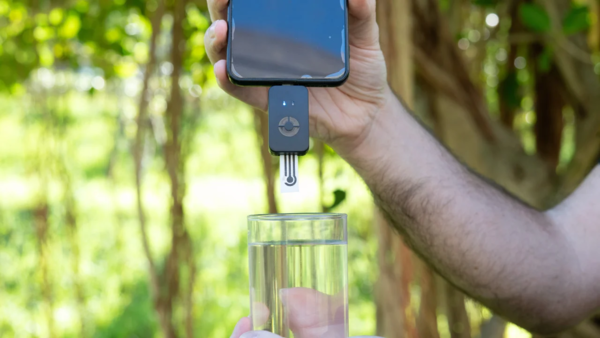
일본 오키나와과학기술대학교(OIST)의 마이크로·바이오·나노유체 공학(Micro/Bio/Nanofluidics Unit) 연구팀은 이러한 문제를 해결하기 위해 별도의 전문 실험실 없이도 현장에서 PFAS를 검출할 수 있는 신뢰성 높은 저비용 분석 플랫폼을 개발했다. [사진제공(Photo Source) = Andrew Scott & Jeff Prine/OIST, CC BY 4.0]
과불화화합물(PFAS)은 분해에 대한 저항성이 매우 강해 '영원한 화학물질'로 불리는 합성 화학물질이다. 이러한 잔류성 물질은 물과 토양, 생물체 내에 축적될 수 있어 인체 건강과 환경에 미치는 잠재적 영향에 대한 우려가 높아지고 있다.
PFAS 오염을 신속하고 정확하게 검출하는 것은 이러한 위험에 대응하기 위한 첫걸음이다. 그러나 현재 PFAS 분석은 일반적으로 환경 시료를 채취한 뒤 첨단 질량분석기(Mass Spectrometry)를 갖춘 전문 실험실로 운반해 분석해야 한다. 이 방법은 높은 민감도와 정확도를 제공하지만 비용 부담이 크고 분석 결과를 얻기까지 상당한 시간이 소요된다는 한계가 있다.
일본 오키나와과학기술대학교(OIST)의 마이크로·바이오·나노유체 공학(Micro/Bio/Nanofluidics Unit) 연구팀은 이러한 문제를 해결하기 위해 별도의 전문 실험실 없이도 현장에서 PFAS를 검출할 수 있는 신뢰성 높은 저비용 분석 플랫폼을 개발했다.
연구를 이끈 마크 설리번(Mark Sullivan) 박사는 “우리의 목표는 장기적으로 전문 실험실 밖에서도 사용할 수 있는 민감도 높고 비용효율적인 검출 기술을 개발하는 것”이라며 “이번 연구를 통해 과불화옥탄산(PFOA)와 과불화옥탄설폰산(PFOS)을 효과적으로 검출할 수 있음을 입증했으며, 동일한 플랫폼을 기반으로 다른 PFAS 화합물 검출로 확장할 가능성도 확인했다”고 설명했다.
연구 결과는 국학술지 『바이오센서 및 바이오일렉트로닉스(Biosensors and Bioelectronics)』에 게재됐다.
합성 항체와 전기화학 센서로 PFAS 검출
연구팀은 PFAS에 선택적으로 인식할 수 있도록 설계된 새로운 분자 각인 고분자(Molecularly Imprinted Polymers, MIPs)를 개발했다. 이 물질은 표적 분자인 PFAS를 중심으로 형성되며, 특정 분자와 결합할 수 있는 인식 부위를 만들어낸다. 이후 PFAS를 제거하면 해당 분자가 들어맞을 수 있는 빈 공간만 남게 되는데, 이는 마치 자물쇠와 열쇠의 관계 처럼 분자를 다시 선택적으로 포획할 수 있도록 한다. 이러한 특성 때문에 MIP는 흔히 ‘합성 항체(Synthetic Antibodies)'로 불린다.
연구진이 개발한 센서는 PFAS 특이적 MIP로 코팅돼 있으며, PFAS가 결합할 때 발생하는 전기화학적 신호 변화를 측정해 오염 여부와 농도를 분석한다. 전류 변화가 클수록 시료 내 PFAS 농도다 높다는 의미다.
그림 1. 음용수·담수 시료에서 나노MIP 기반 PFAS 센서 검증
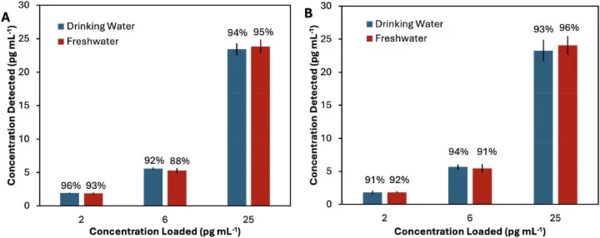
담수 및 식수에 PFOA(A)와 PFOS(B)를 첨가해 PFAS 센서의 성능을 평가한 결과. 검출 농도는 실제 농도와 높은 일치도를 보였으며, 일본의 PFOA·PFOS 음용수 기준치는 50 pg/mL다. [그림제공(Picture Source) = Biosensors and Bioelectronics]
이 방식은 추가적인 화학 시약이 필요하지 않아 기존 분석법보다 간단하고 경제적이다. 특히 휴대형 수질 모니터링 장비로 활용할 경우 현장 분석의 효율성을 크게 높일 수 있을 것으로 기대된다.
플랫폼은 소형화와 저비용 생산, 대량 제조를 고려해 설계됐다. 연구진은 시제품 제작 과정에서 재활용 직물 위에 100개의 일회용 전극(disposable electrodes)을 스크린 인쇄 방식으로 단 몇 시간 만에 제작했다. 이후 전극 표면을 PFAS 특이적 MIP로 코팅하고 전기 신호를 측정하는 상용 포텐쇼스타트(potentiostat)와 연결했다. 이 장치는 스마트폰이나 노트북에 직접 연동해 사용할 수 있다.
또한 MIP 제조 공정은 모듈형 구조를 갖고 있어 표적 분자만 바꾸면 다양한 PFAS 화합물 검출에도 적용할 수 있다. 이번 연구에서는 대표적인 PFAS 물질이자 인체 유해성이 잘 알려진 PFOS와 PFOA를 대상으로 성능을 검증했다.
‘영원한 화학물질’에 맞서는 새로운 환경 모니터링 기술
PFAS는 환경과 인체 건강에 심각한 위협이 되는 물질로 평가된다. 가장 큰 이유는 열과 물, 기름은 물론 자연환경에서도 쉽게 분해되지 않는 높은 안정성 때문이다. 이러한 특성은 산업적으로는 장점이지만, 환경으로 유입되면 장기간 잔류하며 제거가 매우 어렵다.
또 다른 문제는 PFAS의 종류가 매우 다양하다는 점이다. 현재 PFAS 계열에는 1만 종이 넘는 화학물질이 포함된 것으로 알려져 있지만, 실제로 규제 대상에 포함된 물질은 약 50~150종에 불과하다.
연구팀이 개발한 MIP 플랫폼은 모듈식 구조를 기반으로 하기 때문에 다양한 PFAS 분자에 비교적 쉽게 적용할 수 있으며, 향후 PFAS 오염 문제 해결을 위한 기술적·경제적 진입 장벽을 낮출 것으로 기대된다.
페린 라세르(Perrine Lasserre) 박사는 “이번 연구는 지자제는 물론 일반 가정에서 PFAS 오염 가능성을 파악하고 필요한 대응 방안을 결정할 수 있는 검출 시스템 구축이 가능하다는 점을 보여준다”며 “특정 지역의 오염 사실을 지자체에 알리거나 정수 필터 설치 여부를 결정하는 등 다양한 의사결정에 활용될 수 있다. 이 기술이 제공할 수 있는 모든 가능성은 궁극적으로 사회에 긍정적인 기여를 할 것”이라고 말했다.
에이미 쉔(Amy Shen) 교수는 “정확하면서도 접근성이 높은 검출 기술은 PFAS 오염 문제 해결을 위한 중요한 출발점”이라며 “이번 연구는 합성 분자 인식 기술과 저비용 전기화학 장치를 결합해 극미량의 PFAS도 검출할 수 있음을 보여준다. 아직 추가 개발과 현장 검증이 필요하지만, 환경 모니터링을 보다 쉽고 널리 보급할 수 있는 잠재력이 매우 크다”고 밝혔다.
[원문보기]
A portable device for accurately and rapidly detecting PFAS in water
Inexpensive electrodes combined with new ‘synthetic antibodies’ detect trace levels of “forever chemicals” in water, opening a promising route to portable environmental monitoring.
Per- and polyfluoroalkyl substances (PFAS) are synthetic chemicals known for their exceptional resistance to degradation, earning them the nickname “forever chemicals.” These persistent substances can accumulate in water, soil, and living organisms, raising growing concerns about their potential impacts on human health and the environment.
Detecting PFAS contamination is a critical first step toward addressing these risks. However, conventional PFAS analysis typically requires collecting environmental samples and transporting them to specialized laboratories equipped with advanced mass spectrometry instruments. Although highly sensitive and accurate, these methods can be costly and time-consuming.
Researchers from the Micro/Bio/Nanofluidics Unit at the Okinawa Institute of Science and Technology (OIST) have now created a reliable, easy-to-mass-produce platform that enables regulators and other environmental actors to detect PFAS on the spot without the need for an external lab.
“Our goal is to develop a sensitive, low-cost technology that can eventually be used outside specialized laboratories,” says Dr. Mark Sullivan. “We have demonstrated that it works for PFOA and PFOS, and the same platform could potentially be adapted to detect other PFAS compounds.”
The new device is described in Biosensors and Bioelectronics.
Catching PFAS with synthetic antibodies and electrical currents
The researchers have designed a new class of molecularly imprinted polymers, or MIPs, that are perfectly tailored to fit PFAS. The materials are formed around the target molecule — in this case, PFAS — creating a binding site. The target molecule is then washed away, leaving behind a material that recognizes and captures the target again, like a lock that is perfectly shaped for a key. This is also why MIPs are often called ‘synthetic antibodies.’
Their device detects PFAS by measuring changes in electrical current as target molecules bind to a sensor coated with PFAS-specific MIPs. The greater the change in electrical current, the higher the PFAS concentration is in the water sample. Because the measurement requires no additional chemical reagents, this approach could provide a simpler, lower-cost solution for portable, on-site water monitoring.
The platform is compact, low-cost, and designed for easy manufacturing. For the prototype, the researchers screen-printed 100 disposable electrodes onto repurposed fabric in just a few hours. These were then coated with PFAS-specific MIPs and connected to commercially available potentiostats, which measure electrical signals and can plug directly into a smartphone or laptop.
Furthermore, the MIP manufacturing method is modular, meaning the target molecule can be replaced with any member of the PFAS family; for this prototype, the researchers chose the two most common PFAS chemicals with documented health risks: PFOS and PFOA.
Strengthening the global environmental immune defense against forever chemicals
PFAS have proven to be an insidious problem for the environment and health due to two key factors: their exceptional resistance to heat, water, oil, and environmental degradation makes them both useful and extremely difficult to break down; and their diversity, with the PFAS family encompassing more than 10,000 similar chemicals, of which 50-150 members are regulated across the globe.
The team’s MIP platform’s modularity makes it relatively simple to adapt it to different PFAS molecules and, more importantly, lowers the barrier to addressing PFAS contamination going forward. Dr. Perrine Lasserre continues:
“It shows that it’s possible to make a detection system that empowers local agencies or even families to make an informed decision about whether and how to address potential PFAS contamination — such as alerting municipal authorities to contamination at specific sites, or whether to invest in a water filter. Whatever we can achieve with this system is going to be beneficial.”
“Accurate and accessible detection is an important step toward addressing PFAS contamination,” says Professor Amy Shen. “Our study demonstrates how synthetic molecular recognition can be combined with low-cost electrochemical devices to detect extremely small concentrations of these persistent chemicals. While further development and field validation are needed, we see considerable potential for making environmental monitoring more accessible and widely available.”
[출처 = 오키나와 과학기술대학교(Okinawa Institute of Science and Technology)(https://www.oist.jp/news-center/news/2026/10/28/portable-device-accurately-and-rapidly-detecting-pfas-water) / 2026년 10월 28일]
[연구논문 출처 = 바이오센서 및 바이오일렉트로닉스(Biosensors and Bioelectronics)(https://www.sciencedirect.com/science/article/pii/S0956566326009486?via%3Dihub)]
 즐겨찾기 추가
 시작페이지로 설정



























